Bihar CM Nitish Urges Officials to Celebrate Festivals With Tribals, SC and EBC Communities
Synopsis
Bihar CM Nitish Kumar's office has appealed to elected representatives and administrative officers to personally celebrate festivals with Adivasi, Scheduled Caste, and Extremely Backward Class communities, stressing that true festive joy requires equal participation across all social sections.
Key Takeaways
The Chief Minister's Office of Bihar issued the appeal on Sunday, November 8, 2026 .
CM Nitish Kumar specifically asked elected representatives and administrative officials to reach out to Adivasi, Scheduled Caste, and Extremely Backward Class (EBC) communities during festivals.
The message stressed that festivals are truly meaningful only when all sections of society participate equally.
The appeal targets both political representatives and state bureaucrats, signalling a governance-level push, not merely a symbolic gesture.
The directive fits Bihar's long-standing pattern of using festival occasions as social-inclusion outreach moments for marginalised communities.
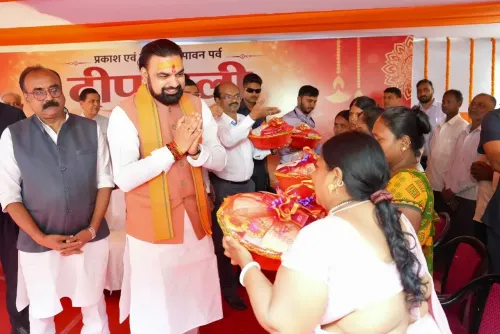
Festivals mean little if the margins are left out — that is the message Bihar Chief Minister Nitish Kumar delivered on Sunday, November 8, 2026, as the Chief Minister's Office of Bihar urged elected representatives and administrative officers to step into the neighbourhoods of Adivasi, Scheduled Caste, and Extremely Backward Class communities and celebrate alongside them.
The appeal, shared by the Chief Minister's Office on X, carried a pointed message in Hindi: 'त्योहारों की वास्तविक खुशी तभी सार्थक होती है, जब समाज के सभी वर्गों के लोग इसमें समान रूप से सहभागी बनें' — 'The true joy of festivals becomes meaningful only when people from all sections of society participate equally in them.'
Who Was Being Asked — and Why It Matters
The appeal was directed squarely at two groups: elected people's representatives (janpratinidhis) and administrative officials. By naming both, the CM's message stretches beyond symbolic gesture — it asks the machinery of government to visibly bridge the social distance that persists between upper-caste or mainstream communities and Adivasi, SC, and EBC populations during festive periods.
Bihar's tribal and Scheduled Caste communities have historically faced exclusion from mainstream celebration spaces. The Extremely Backward Classes — a category that encompasses dozens of occupational and artisan communities — represent a significant share of the state's population and have been a consistent focus of Nitish Kumar's political and welfare architecture across his long tenure.
A Pattern Written Into Bihar's Governance Playbook
This is not a one-off directive. Bihar administrations have repeatedly used festival occasions as social-inclusion pressure points, nudging officials toward communities that might otherwise see the state only in its bureaucratic form. The underlying logic: if a district collector or a sitting MLA appears at a Dalit or tribal locality during a festival, it signals access, belonging, and parity — however symbolic — in ways that a government scheme alone cannot.
Nitish Kumar, who has built a political identity around social justice for backward communities since the early 2000s, has consistently framed EBC and SC outreach as both a governance imperative and an electoral priority. The festival-inclusion message sits naturally within that arc.
Whether elected representatives and collectors actually follow through — and whether the directive reaches down to block and panchayat level — will determine how much real warmth this message generates beyond the feed.
Point of View
SC, and EBC localities, the CM is making social proximity a performance metric for the administration. The move also reflects a broader Bihar pattern: channelling social-justice messaging through symbolic, low-cost public acts to maintain EBC and Dalit coalition loyalty. The real test, as always, is whether the directive translates into documented ground-level action or remains a well-intentioned post.
NationPress
8 Nov 2026
Frequently Asked Questions
What did Bihar CM Nitish Kumar say about festivals and marginalised communities?
CM Nitish Kumar appealed to elected representatives and administrative officials to visit Adivasi, Scheduled Caste, and Extremely Backward Class communities and celebrate festivals with them, saying true festive joy is meaningful only when all sections of society participate equally.
Who did the Bihar CM's office ask to celebrate festivals with tribal and SC communities?
The appeal was directed at both elected people's representatives (janpratinidhis) and administrative officers across the state of Bihar.
Which communities were specifically mentioned in the Bihar CM's festival appeal?
The appeal specifically named Adivasi (tribal) communities, Scheduled Caste (SC) groups, and Extremely Backward Class (EBC) populations.
Why does Bihar emphasise social inclusion during festivals?
Bihar has a long-standing governance pattern of using festival occasions to reduce social distance between mainstream society and marginalised groups including tribals, Dalits, and EBC communities — a priority that has defined CM Nitish Kumar's social-justice agenda.
When was the Bihar CM's social inclusion festival appeal posted?
The Chief Minister's Office of Bihar posted the appeal on Sunday, November 8, 2026 .