BJP, JD(U) slam Sonia Gandhi over Vande Mataram row at Congress HQ
Synopsis
A video from Congress's Independence Day event at Indira Bhavan has ignited a political firestorm, with BJP and JD(U) leaders accusing Sonia Gandhi of attempting to cut short the singing of Vande Mataram. Congress says she was merely looking out for ailing party chief Kharge in the heat — but the ruling alliance is not buying it, and the row has quickly become a proxy battle over patriotism and national symbols.
Key Takeaways
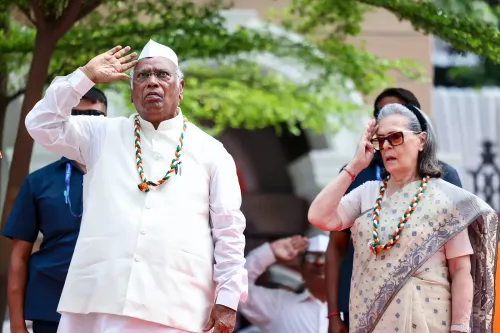
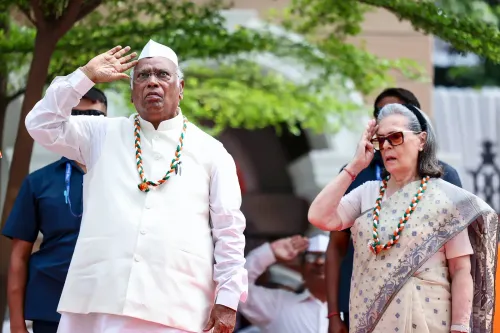
A video from Congress HQ Indira Bhavan on Independence Day shows Sonia Gandhi making hand gestures during the singing of Vande Mataram , triggering a political row.
BJP and JD(U) leaders called the incident 'shameful' and 'unforgivable,' with some demanding accountability.
BJP MP Praveen Khandelwal and MP Minister Vishwas Sarang were among the most vocal critics, invoking Home Minister Amit Shah's earlier description of the act as a 'sin.' Congress MP Tariq Anwar said Sonia Gandhi was concerned about party president Mallikarjun Kharge's health in the harsh sun — not objecting to the song.
Jharkhand Minister Shilpi Neha Tirkey questioned the BJP's demand for full recitation, citing the historical and secular reasons only two stanzas are traditionally sung at official events.
The Bharatiya Janata Party (BJP) and Janata Dal (United) on 17 August launched a sharp attack on Congress and party veteran Sonia Gandhi after a video surfaced appearing to show her making hand gestures during the singing of Vande Mataram at Indira Bhavan, the Congress party headquarters, during Independence Day celebrations. Ruling alliance leaders called the incident deeply shameful, while Congress defended Sonia Gandhi's conduct, saying she was concerned about party president Mallikarjun Kharge's health in the harsh sun.
What the Video Shows
The video, which circulated widely on social media, reportedly shows Sonia Gandhi gesturing with her hands while Vande Mataram was being sung at the Congress headquarters. BJP leaders interpreted this as an attempt to cut short the full rendition of the national song. Congress, however, maintained that her gesture was directed at party workers to make seating arrangements for an elderly Kharge in the intense heat — not at the song itself.
BJP and JD(U) React
BJP MP Praveen Khandelwal said the video showed how 'Vande Mataram' was 'disregarded and insulted' at the Congress headquarters. 'Whether it is Vande Mataram or our national anthem Jana Gana Mana, it is mandatory to stand up immediately whenever they are played or heard. However, the action Sonia Gandhi took while Vande Mataram was being sung amounts to a direct insult...' he said.
Madhya Pradesh Minister Vishwas Sarang called the act 'unforgivable,' adding that it showed Sonia Gandhi had 'still not accepted India in her heart.' He invoked Home Minister Amit Shah's earlier characterisation of the incident as a 'sin.' Uttar Pradesh Minister Manoj Pandey framed it as part of what he described as 'a continuous attack on India's identity, honour, self-respect and national pride.'
BJP National Spokesperson C. R. Kesavan called the alleged attempt to stop the full singing of Vande Mataram 'an indefensible misdeed,' drawing a historical parallel: 'In 1905, the Imperial British banned the public singing of Vande Mataram and made it a criminal offence,' he said, arguing Sonia Gandhi 'must be held fully accountable.'
JD(U) National Spokesperson Rajeev Ranjan took a more measured line, saying political differences aside, once a measure is passed by both Houses of Parliament and receives presidential assent making a rendition mandatory, 'everyone should respect this law.' Bihar Minister Ram Kripal Yadav said the public had witnessed the incident and could judge for themselves.
Congress Pushes Back
Congress MP Tariq Anwar rejected the BJP's framing outright, saying the party was 'bereft of issues and hence resorting to diversionary tactics.' He said Sonia Gandhi was simply concerned about Kharge's wellbeing in the harsh sun and had suggested arrangements be made for the elderly leader. Congress leader Husain Dalwai said she 'did absolutely the right thing,' calling her a 'courageous woman.'
Jharkhand Minister Shilpi Neha Tirkey questioned why only two stanzas of Vande Mataram are traditionally sung, arguing the choice was rooted in the country's commitment to secularism. She accused the BJP of manufacturing controversy to avoid accountability on other issues, including what she called the 'black law' of the MMDR Bill.
Background and Context
Vande Mataram holds the status of India's national song, distinct from the national anthem Jana Gana Mana. Conventionally, only the first two stanzas are sung at official functions — a practice dating to the Constituent Assembly era — on account of later stanzas that some communities have historically found objectionable on religious grounds. The BJP's demand for full recitation has periodically resurfaced as a political flashpoint. This is not the first time Sonia Gandhi's conduct at a public event has drawn criticism from ruling party leaders, reflecting a pattern of political contestation over symbols of national identity.
With the controversy now firmly in the public domain, both sides are expected to keep it alive in the lead-up to upcoming state assembly sessions.
Point of View
Since the two-stanza convention has been the settled practice since the Constituent Assembly era and is not straightforwardly overridden by legislation. Congress's counter — that this is diversionary — is convenient but not entirely wrong: the timing, days after Independence Day, suggests the row is being kept alive for electoral rather than constitutional reasons.
NationPress
1 Oct 2026
Frequently Asked Questions
What happened at the Congress headquarters on Independence Day?
During Independence Day celebrations at Indira Bhavan in New Delhi, a video surfaced showing Sonia Gandhi appearing to gesture with her hands while Vande Mataram was being sung. BJP and JD(U) leaders alleged she was attempting to stop the full rendition of the national song, while Congress said she was concerned about party president Mallikarjun Kharge's health in the heat.
Why are BJP leaders calling Sonia Gandhi's conduct 'shameful'?
BJP leaders argue that Vande Mataram, as India's national song, commands the same reverence as the national anthem, and that any attempt to interrupt or curtail its singing amounts to a public insult to national identity. Several ministers and spokespersons called the act 'unforgivable' and demanded accountability.
What is Congress's explanation for Sonia Gandhi's gesture?
Congress MP Tariq Anwar said Sonia Gandhi was not objecting to Vande Mataram but was asking party workers to make seating arrangements for an elderly Mallikarjun Kharge, who was struggling in the harsh sun. Congress characterised the BJP's attack as a diversionary tactic driven by a lack of real issues.
Why are only two stanzas of Vande Mataram traditionally sung?
The convention of singing only the first two stanzas of Vande Mataram dates to the Constituent Assembly era. Later stanzas contain references that some communities found objectionable on religious grounds, and the practice was adopted to uphold the country's secular character. Jharkhand Minister Shilpi Neha Tirkey cited this history in her rebuttal of the BJP's position.
Who else has commented on the Vande Mataram row?
Among those who spoke out were BJP National Spokesperson C. R. Kesavan, UP Minister Manoj Pandey, MP Minister Vishwas Sarang, Bihar Minister Ram Kripal Yadav, and JD(U) Spokesperson Rajeev Ranjan — all critical of Sonia Gandhi. On the Congress side, Tariq Anwar, Husain Dalwai, and Jharkhand Minister Shilpi Neha Tirkey defended her conduct.