BJP Advocates for Raw Jute MSP Increase: A Game Changer for West Bengal Farmers
Synopsis
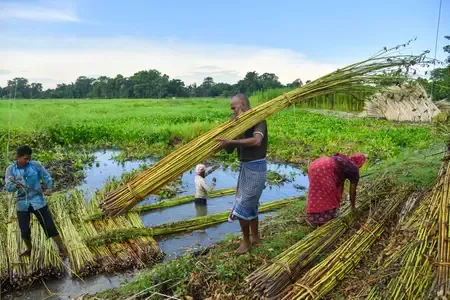
The BJP claims the Union Cabinet's recent MSP hike for raw jute will greatly benefit West Bengal's farmers. With significant increases since 2014, this decision is expected to enhance rural incomes and strengthen the agricultural sector.
Key Takeaways
The MSP for raw jute has been raised to Rs 5,925 per quintal.
This increase represents a 61.8% return over production costs.
Since 2014, the MSP has increased nearly 2.5 times.
Over 80% of India's jute is produced in West Bengal.
A total of Rs 1,342 crore has been transferred to jute farmers since 2014.
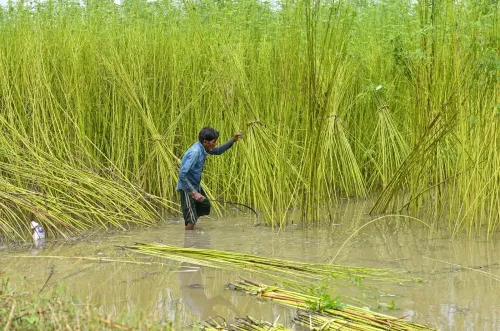
Kolkata, Feb 25 (NationPress) The Bharatiya Janata Party (BJP) asserted on Wednesday that the recent decision by the Union Cabinet to significantly raise the minimum support price (MSP) for raw jute will substantially aid numerous farmers in West Bengal.
Amit Malviya, Chief of BJP's Information Technology (IT) cell and the party's main observer for West Bengal, highlighted in a social media post that the Union Government has set the MSP for raw jute (TD-3 grade) at Rs 5,925 per quintal for the 2025-27 season, which guarantees a return of 61.8 percent over the all-India weighted average production cost.
"This increment of Rs 275 per quintal showcases the government's steadfast commitment to farmers' welfare," Malviya remarked.
In his online statement, Malviya elaborated on the multiple increases in the MSP for raw jute since 2014, when the National Democratic Alliance took office.
"Since 2014, the MSP for jute has surged nearly 2.5 times, reflecting a dedicated focus on reinforcing the agricultural sector. From 2014 to 2026, a total of Rs 1,342 crore has been directly transferred to jute farmers, a remarkable increase compared to the Rs 441 crore allocated in the previous decade," Malviya commented.
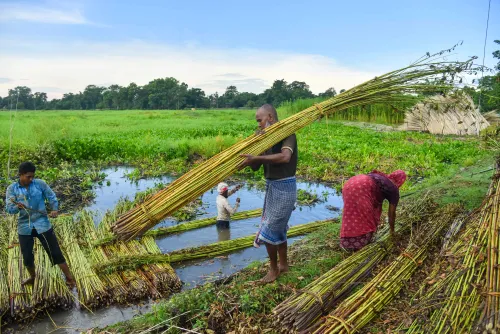
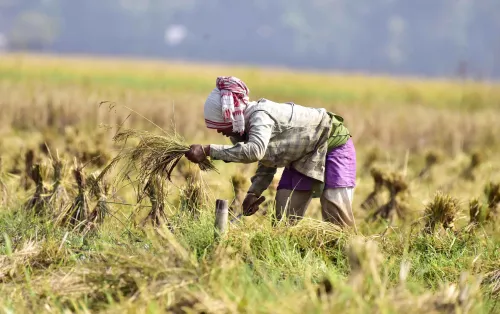
He emphasized that with West Bengal producing over 80 percent of India's total jute output, this policy directly benefits countless farmers and workers, thereby enhancing rural incomes and securing livelihoods throughout the state.
"I extend my heartfelt thanks to Prime Minister Shri Narendra Modi for this pivotal decision, which reiterates the government's commitment to our farmers and the prosperity of West Bengal," Malviya expressed.
Political analysts believe that the Union Government's decision to increase the MSP for raw jute provides the BJP a counter-narrative against the Trinamool Congress's ongoing claims that the Centre aims to undermine the jute industry.
Recently, Trinamool Congress Rajya Sabha member, Ritabrata Banerjee, wrote to the Union Textiles Minister, Giriraj Singh, accusing the Centre of neglecting the critical need for a raw jute stabilization or buffer policy that would establish reserve norms, transparent release triggers, and timely stock rotation linked to the minimum support price procurement.
Point of View
The BJP's announcement regarding the MSP hike for raw jute reflects a strategic attempt to bolster its support among farmers in West Bengal. The increase not only signifies economic assistance but also serves as a political tool against opposition narratives, showcasing the government's commitment to agricultural development.
NationPress
13 Oct 2026
Frequently Asked Questions
What is the new minimum support price for raw jute?
The new minimum support price for raw jute (TD-3 grade) is set at Rs 5,925 per quintal for the 2025-27 season.
How much has the MSP for jute increased since 2014?
Since 2014, the MSP for jute has increased nearly 2.5 times.
What percentage of India's jute production comes from West Bengal?
West Bengal contributes over 80 percent of India's total jute production.
What financial assistance has been provided to jute farmers since 2014?
From 2014 to 2026, Rs 1,342 crore has been directly transferred to jute farmers.
Who is the Prime Minister thanked for this MSP decision?
Prime Minister Shri Narendra Modi was thanked for this significant decision.