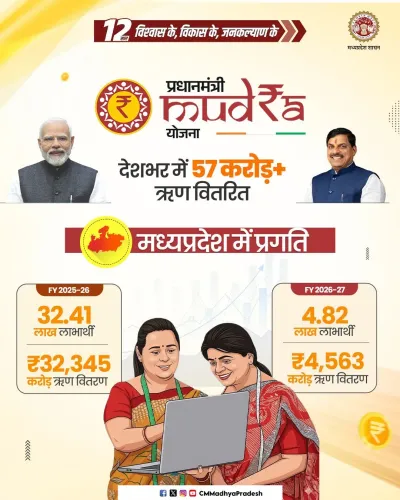
PM Modi backs Rs 5,000 cr Credit Fund to power MUDRA loans

Synopsis
The Indian Cabinet has approved continuation of the Credit Guarantee Fund for Micro Units with a Rs 5,000 crore corpus, aiming to facilitate over Rs 12.5 lakh crore in collateral-free MUDRA loans up to Rs 20 lakh over five years, with lower guarantee fees to widen lender participation.
Key Takeaways
The Cabinet approved continuation of the Credit Guarantee Fund for Micro Units (CGFMU) on 11 November 2026 .
A refreshed corpus of Rs 5,000 crore is designed to facilitate over Rs 12.5 lakh crore in MUDRA loans over the next five years .
Credit guarantee cover now supports collateral-free loans up to Rs 20 lakh under PM MUDRA Yojana .
Lower guarantee fees will be charged to lending institutions to encourage broader participation.
PM MUDRA Yojana , launched in April 2015 , lends across three tiers — Shishu , Kishore , and Tarun — targeting non-corporate, non-farm micro enterprises.
The move continues a decade-long policy of expanding formal credit access to India's informal micro sector through guarantee mechanisms.
A Rs 5,000 crore guarantee corpus, the promise of Rs 12.5 lakh crore in loans over five years, and collateral-free credit up to Rs 20 lakh — the Cabinet's decision to continue the Credit Guarantee Fund for Micro Units is one of the most consequential boosts to India's micro-enterprise ecosystem in recent memory. Prime Minister Narendra Modi announced the approval on Wednesday, 11 November 2026, framing it as a direct lifeline for young Indians ready to build businesses from scratch.
What the Cabinet just unlocked for micro-entrepreneurs
The Credit Guarantee Fund for Micro Units (CGFMU) was originally operationalised alongside the Pradhan Mantri Mudra Yojana (PM MUDRA Yojana), which was launched on 8 April 2015 to channel formal credit to non-corporate, non-farm micro and small enterprises. The fund's core job is straightforward but powerful: it absorbs lender risk on unsecured loans, making banks and microfinance institutions willing to lend to borrowers who have ideas but no collateral to offer.
The Cabinet's continuation decision doubles down on that logic. With a refreshed Rs 5,000 crore corpus, the guarantee mechanism is designed to unlock over Rs 12.5 lakh crore in MUDRA loans across the next five years — a multiplier effect that reflects how credit guarantees work: each rupee of public guarantee backing enables a far larger volume of private lending.
Collateral-free loans up to Rs 20 lakh and lower guarantee fees
Two specific design changes stand out in Modi's post. First, credit guarantee support now covers collateral-free loans up to Rs 20 lakh under PM MUDRA Yojana — an expansion of the ceiling that matters enormously to first-generation entrepreneurs who cannot pledge property or assets. Second, lower guarantee fees will be charged to lenders, an incentive structure intended to push more financial institutions to actively offer MUDRA products rather than treat them as a compliance exercise.
PM MUDRA Yojana operates across three lending tiers — Shishu (up to Rs 50,000), Kishore (Rs 50,001 to Rs 5 lakh), and Tarun (Rs 5 lakh to Rs 20 lakh) — covering the full spectrum from a street vendor's first loan to a workshop owner's expansion capital.
A decade-long bet on the informal micro sector
This announcement fits a consistent policy arc stretching back to 2015: successive enhancements to MUDRA limits, repeated reductions in guarantee fee structures, and a persistent effort to bring the informal micro sector into the formal credit fold. The government's underlying argument is that expanding guaranteed credit access is the fastest route to self-employment generation — turning borrowers into employers and 'job seekers into job creators', as Modi put it.
The real test, as always, will be in the disbursement data. Tracking whether actual MUDRA loan volumes hit the Rs 12.5 lakh crore target over the next five years — and whether the reduced guarantee fees translate into genuinely broader lender participation — will reveal how much of this corpus converts into working capital for real enterprises.
India's micro-enterprise ambitions now rest on a Rs 5,000 crore guarantee backstop. Whether that backstop becomes a launchpad depends on how aggressively lenders move.
Point of View
Micro-entrepreneurs will proliferate and generate employment organically. The Rs 12.5 lakh crore target is an ambitious multiplier claim that will face scrutiny against actual disbursement trajectories. Reducing guarantee fees signals an acknowledgement that earlier fee structures dampened lender enthusiasm — a tacit course-correction. Whether this iteration breaks the pattern of headline loan targets outpacing on-the-ground enterprise creation will define its legacy.
NationPress
11 Nov 2026
Frequently Asked Questions
What is the Credit Guarantee Fund for Micro Units?
The Credit Guarantee Fund for Micro Units (CGFMU) is a government-backed fund that guarantees collateral-free loans extended to micro-enterprises under PM MUDRA Yojana, reducing the risk for lenders and enabling broader credit access.
What is the new corpus approved for CGFMU?
The Cabinet approved a Rs 5,000 crore corpus for the Credit Guarantee Fund for Micro Units, intended to facilitate over Rs 12.5 lakh crore in MUDRA loans over the next five years.
What is the maximum loan amount covered under PM MUDRA Yojana?
Under the latest Cabinet approval, credit guarantee support covers collateral-free loans up to Rs 20 lakh under PM MUDRA Yojana, across its three tiers — Shishu, Kishore, and Tarun.
When was PM MUDRA Yojana launched?
PM MUDRA Yojana was launched on 8 April 2015 to provide formal credit to non-corporate, non-farm micro and small enterprises across India.
How do lower guarantee fees help micro-entrepreneurs?
Lower guarantee fees reduce the cost burden on lending institutions, incentivising them to offer more MUDRA loans actively, which in turn increases the availability of affordable, collateral-free credit for micro-entrepreneurs and first-generation business owners.