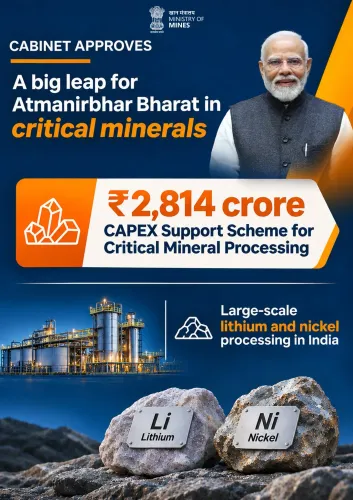
Cabinet Clears ₹2,814 Cr Scheme to Boost Critical Mineral Processing
Synopsis
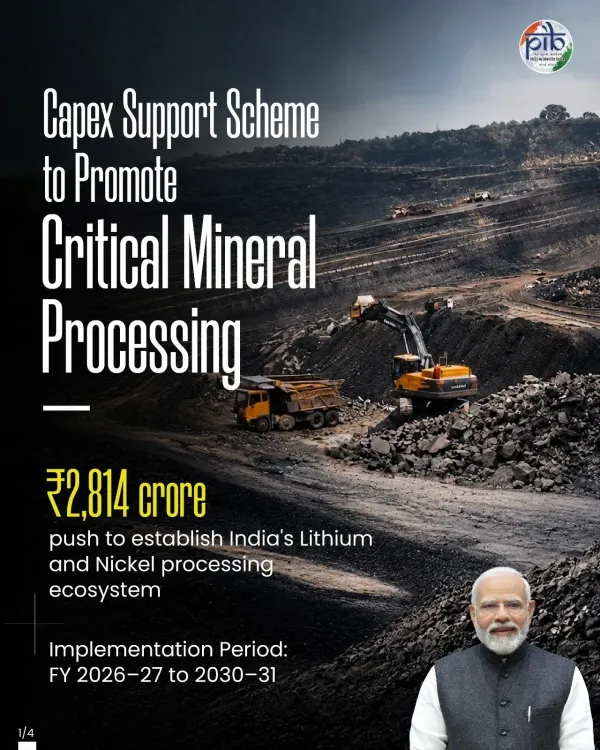
The Union Cabinet cleared a ₹2,814 crore capital-support scheme to expand India's domestic critical-mineral processing capacity over five years (FY 2026-27 to 2030-31), deepening the country's push to cut dependence on China-dominated supply chains for batteries, semiconductors, and renewable energy equipment.
Key Takeaways
The Union Cabinet approved a ₹2,814 crore capital-support scheme for critical mineral processing on November 4, 2026 .
The scheme runs for five years from FY 2026-27 to FY 2030-31 .
Objectives include expanding domestic processing capacity, attracting private investment, and reducing import dependence.
The move builds on the MMDR Amendment Act, 2023 , which opened 30 critical minerals to private exploration and mining.
KABIL , established in 2019 , continues to pursue overseas mineral asset acquisition to complement domestic processing scale-up.
Key beneficiaries include domestic processors, the EV sector, electronics manufacturers, and the defence supply chain.
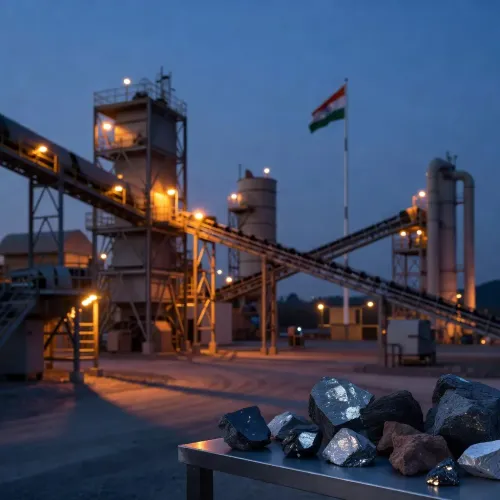
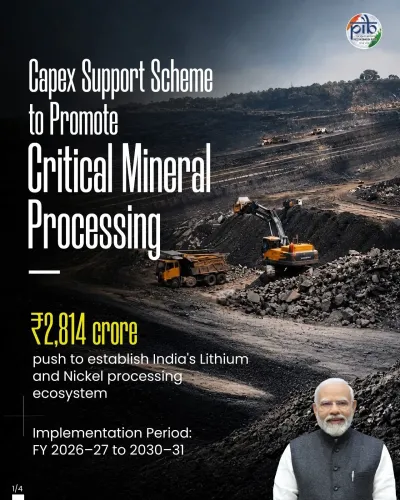
India just placed a serious bet on mineral independence. Under Prime Minister Narendra Modi's chairmanship, the Union Cabinet on Wednesday, November 4, 2026 approved a capital-support scheme worth ₹2,814 crore to accelerate domestic processing of critical minerals — the raw sinews of everything from EV batteries to defence electronics to solar panels.
Union Agriculture Minister Shivraj Singh Chouhan announced the approval on X, noting that the scheme spans five fiscal years, from 2026-27 through 2030-31, and is designed to expand domestic processing capacity, attract investment, reduce import dependence, and anchor India more firmly in the global critical-mineral value chain.
Why ₹2,814 Crore, Why Now
Critical minerals — lithium, cobalt, nickel, rare earths — are the building blocks of the clean-energy and advanced-technology economy. Right now, the processing of these minerals is overwhelmingly concentrated in China, leaving India, like most of the world, dangerously exposed. A disruption upstream can freeze an EV assembly line in Pune or delay a defence procurement in Delhi. The Cabinet's move addresses exactly that choke point.
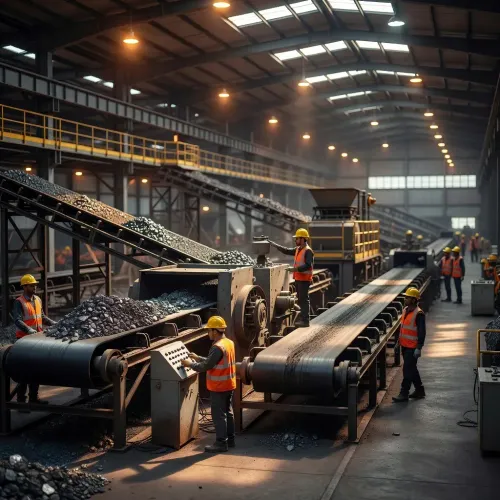
The scheme's capital-support structure is significant. By offering upfront financial assistance to processors, the government lowers the barrier for private players who have the technology but balk at the capital intensity of building greenfield processing facilities. Domestic processors, EV and electronics manufacturers, and the defence supply chain all stand to benefit directly.
Building on the 2023 MMDR Amendment and KABIL
This is not India's first move on the critical-minerals board — it is a decisive escalation. The Mines and Minerals (Development and Regulation) Amendment Act, 2023 had already opened up exploration and mining of 30 identified critical minerals to private players, cracking open a sector long dominated by state entities. Before that, the government established Khanij Bidesh India Ltd (KABIL) in 2019 to scout and secure overseas mineral assets, particularly lithium and cobalt. India also joined the US-led Mineral Security Partnership, signalling its intent to build supply-chain alliances beyond any single dominant supplier.
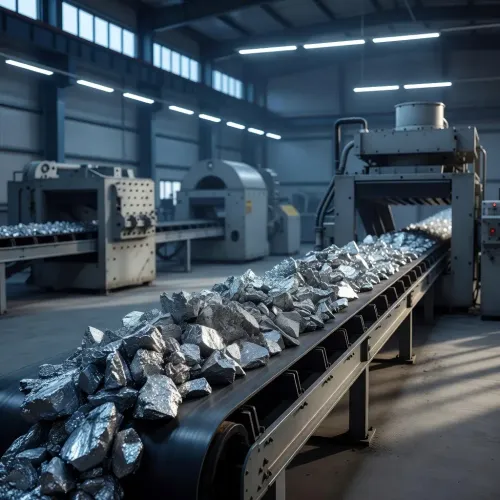
The new scheme is the downstream piece of that puzzle. Mining and exploration mean little if the ore cannot be refined at home. This capital-support programme plugs the processing gap — the most value-accretive and strategically sensitive link in the chain.
What the Five-Year Window Means for India's EV and Clean-Tech Ambitions
The timing is deliberate. India's EV market is scaling fast, domestic solar-panel manufacturing is ramping up, and the defence sector is deepening localisation under Atmanirbhar Bharat. All three converge on a common dependency: processed critical minerals. Without domestic processing, every gigafactory and every solar module still runs on an invisible Chinese import somewhere in its supply chain.
The scheme's five-year horizon — through FY 2030-31 — roughly aligns with the production ramp of EV platforms currently in development and the timelines of several large battery-cell manufacturing projects. If capacity additions track the scheme's intent, India could enter the 2030s with a materially different mineral-processing footprint.
Detailed scheme guidelines and project-sanctioning processes are expected to follow through the regular budgetary cycle, with the first tranche of approvals likely in FY 2026-27. The real test will be whether private capital flows match the government's capital support — and whether processing capacity actually comes online at scale.
India has drawn the map. Now it has to build the road.
Point of View
814 crore critical-minerals scheme is less an isolated announcement and more the downstream capstone of a multi-year supply-chain sovereignty strategy — one that connects KABIL's overseas acquisitions, the 2023 MMDR amendment, and India's Mineral Security Partnership membership into a coherent arc. The capital-support model signals that the government recognises processing, not just mining, as the high-value strategic chokepoint. The five-year window is well-timed against India's EV and clean-energy production ramp, but the scheme's real impact will hinge on private-sector uptake and whether processing capacity additions are tracked and enforced with the same rigour as the financial outlay. If execution matches ambition, this could meaningfully shift India's position in global battery and semiconductor supply chains by the early 2030s.
NationPress
4 Nov 2026
Frequently Asked Questions
What is the critical mineral processing scheme approved by the Cabinet?
It is a five-year capital-support scheme worth ₹2,814 crore, approved by the Union Cabinet on November 4, 2026, to expand India's domestic processing capacity for critical minerals such as lithium, cobalt, and rare earths from FY 2026-27 to FY 2030-31.
Which critical minerals does the scheme target?
The scheme broadly targets critical minerals essential for clean energy and advanced technology, including those identified under the MMDR Amendment Act 2023, such as lithium, cobalt, nickel, and rare earth elements used in EV batteries, semiconductors, and renewable energy equipment.
How does this scheme reduce India's import dependence on China?
By offering capital support to domestic processors, the scheme incentivises building local refining and processing capacity, reducing India's reliance on China-dominated global supply chains that currently process the bulk of the world's critical minerals.
What earlier steps did India take on critical minerals before this scheme?
India established Khanij Bidesh India Ltd (KABIL) in 2019 to secure overseas mineral assets, passed the MMDR Amendment Act in 2023 to open 30 critical minerals to private exploration, and joined the US-led Mineral Security Partnership to diversify supply-chain alliances.
Who will benefit from the critical mineral processing scheme?
Primary beneficiaries include domestic mineral processors, electric vehicle and electronics manufacturers who depend on processed mineral inputs, and India's defence industry, which requires critical minerals for advanced equipment and systems.