Cabinet clears NH-347B upgrade, widening in Madhya Pradesh
Synopsis
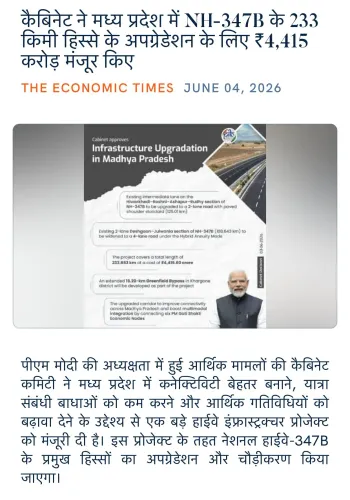
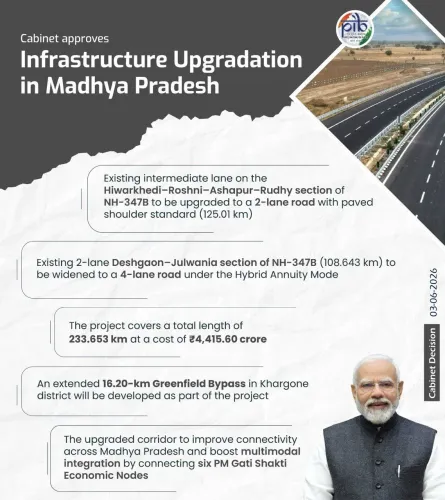
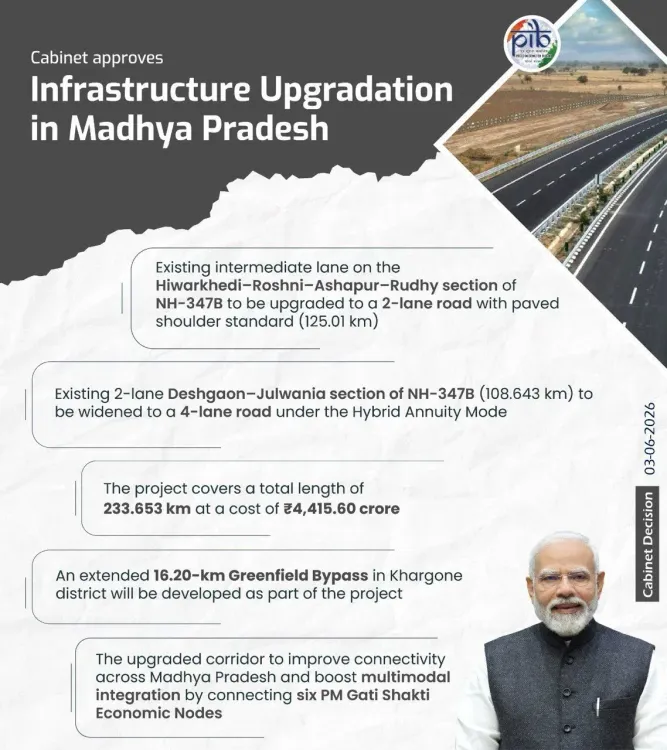
The Union Cabinet, chaired by Prime Minister Narendra Modi, has approved upgrading the Hiwarkhedi-Roshni-Ashapur-Rudhy stretch of NH-347B to 2-lane with paved shoulder standard and widening the Deshgaon-Julwaniya section to 4 lanes in Madhya Pradesh, Union Minister Dr. Jitendra Singh announced on X under hashtag CabinetDecisions.
Key Takeaways
Union Cabinet approved upgrade and widening on two stretches of NH-347B in Madhya Pradesh.
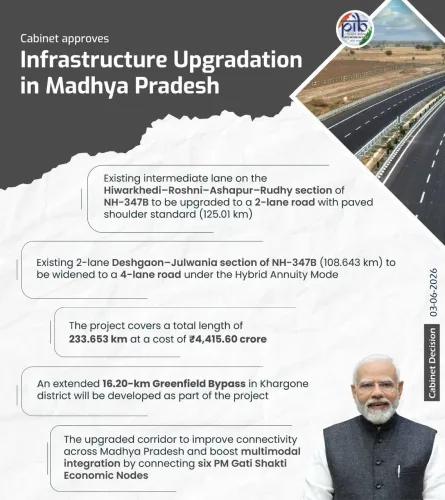
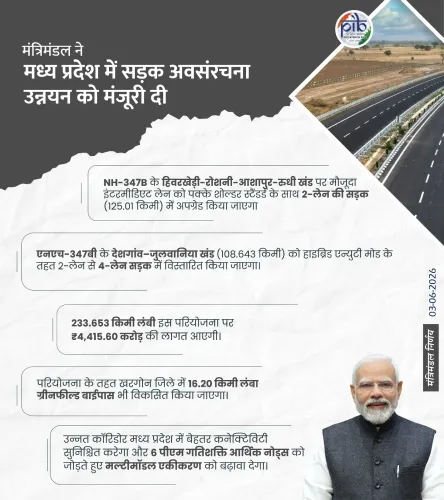
Hiwarkhedi-Roshni-Ashapur-Rudhy section moves from intermediate lane to 2-lane with paved shoulder standard.
Deshgaon-Julwaniya section to be widened from existing 2-lane to 4-lane.
Decision announced by Union Minister Dr.
Jitendra Singh on X under hashtag CabinetDecisions.
Project continues the central government's pattern of incremental upgrades on existing NH alignments.
Union Science and Technology Minister Dr. Jitendra Singh on Wednesday announced that the Union Cabinet, chaired by Prime Minister Narendra Modi, has approved the upgradation and widening of two sections of National Highway 347B in Madhya Pradesh. The decision covers the conversion of an existing intermediate lane to a 2-lane with paved shoulder standard on the Hiwarkhedi-Roshni-Ashapur-Rudhy stretch, and the widening of an existing 2-lane to 4-lane on the Deshgaon-Julwaniya section.
In his post on X, the Minister wrote that the '#Cabinet under PM Sh @NarendraModi approves upgradation of existing intermediate lane to 2 Lane with Paved Shoulder Standard of Hiwarkhedi -Roshni-Ashapur-Rudhy Section of NH-347B and widening of existing 2 lane to 4 lane from Deshgaon-Julwaniya Section of NH-347B in Madhya Pradesh'. The announcement was tagged under '#CabinetDecisions', the umbrella label used to communicate apex-level approvals.
Context
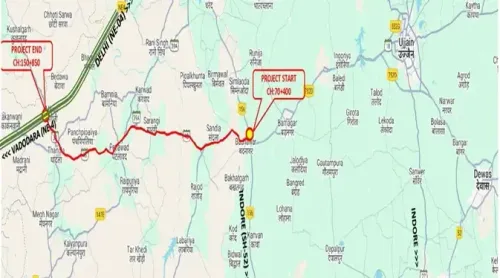
NH-347B is part of central India's east-west connectivity grid, threading through districts in western Madhya Pradesh and linking interior agricultural and industrial clusters to the wider national highway network. The two stretches cleared by the Cabinet target different stages of capacity addition: one moves a sub-standard intermediate lane up to the formal 2-lane paved shoulder configuration, while the other adds a full extra carriageway to bring traffic capacity to 4-lane standard.
Paved shoulder design is typically used on corridors where freight volumes have outgrown a basic two-lane but have not yet justified four-laning, providing additional usable width and improved safety margins. The 4-laning of the Deshgaon-Julwaniya stretch indicates that traffic on that segment has crossed thresholds that warrant a higher service level.
Policy backdrop
The two clearances sit within the central government's long-running highway expansion arc that gained scale after the launch of the Bharatmala Pariyojana programme in 2015 and its formal approval in 2017. That programme placed emphasis on systematic upgradation of existing national highway alignments rather than purely greenfield construction, and successive Cabinets have cleared similar incremental stretches across central India.
By choosing to upgrade alignments already in use, the Ministry of Road Transport and Highways generally avoids the longer timelines associated with fresh land acquisition and environmental clearances, while still delivering measurable capacity gains. The pattern visible in this approval, with one stretch moving to paved shoulder and another to 4-lane, reflects that staged approach.
Stakeholders and impact
Direct beneficiaries include residents along the corridor in Madhya Pradesh and freight operators moving goods between the state and neighbouring Maharashtra and Rajasthan. Faster and safer movement on upgraded sections typically reduces vehicle operating costs for transporters and travel time for passenger traffic.
State-level stakeholders, including the public works machinery in Madhya Pradesh, will be involved in coordination on land matters, utility shifting and any related approvals. Local economies along the alignment, particularly mandis and small manufacturing units, generally see improved logistics access once such upgrades are operational.
What's next
The next markers will be the tendering timelines set by the Ministry of Road Transport and Highways for both packages, followed by award of construction contracts and any state-level land acquisition notifications. Project execution timelines, alignment-specific design details and the total sanctioned outlay are expected to be detailed in subsequent official communications.
For the corridor's users, the practical implication is a phased improvement in travel conditions on NH-347B over the construction window, with the 4-lane Deshgaon-Julwaniya section offering the more visible capacity jump once commissioned.
Point of View
Alignment-based highway capacity additions rather than headline-grabbing greenfield projects. By pairing a paved-shoulder upgrade with a 4-lane widening on the same corridor, the Cabinet is signalling differentiated treatment based on traffic loads, a hallmark of post-Bharatmala planning. Politically, routing the announcement through a senior Union Minister underlines the messaging discipline the government brings to even routine infrastructure clearances. The real test will lie in tendering speed and on-ground land acquisition in Madhya Pradesh.
NationPress
21 Oct 2026
Frequently Asked Questions
What did the Union Cabinet approve on NH-347B in Madhya Pradesh?
The Cabinet approved upgrading the Hiwarkhedi-Roshni-Ashapur-Rudhy section of NH-347B to 2-lane with paved shoulder standard and widening the Deshgaon-Julwaniya section from 2-lane to 4-lane in Madhya Pradesh.
Who announced the NH-347B Cabinet decision?
Union Science and Technology Minister Dr. Jitendra Singh announced the decision on X, tagging it under the hashtag CabinetDecisions.
What is a 2-lane with paved shoulder standard?
It is a highway configuration where a standard two-lane carriageway is supplemented by a paved shoulder on either side, providing extra usable width for safer overtaking and improved capacity without full 4-laning.
Which states benefit from NH-347B improvements?
The direct beneficiary is Madhya Pradesh, but freight movement between Madhya Pradesh, Maharashtra and Rajasthan is also expected to gain from improved capacity on the corridor.
When will construction on the upgraded NH-347B stretches begin?
Construction timelines will be determined by tendering and award schedules set by the Ministry of Road Transport and Highways following the Cabinet approval; specific start dates have not been announced.