Rijiju: Cabinet clears NH-347B widening in Madhya Pradesh
Synopsis
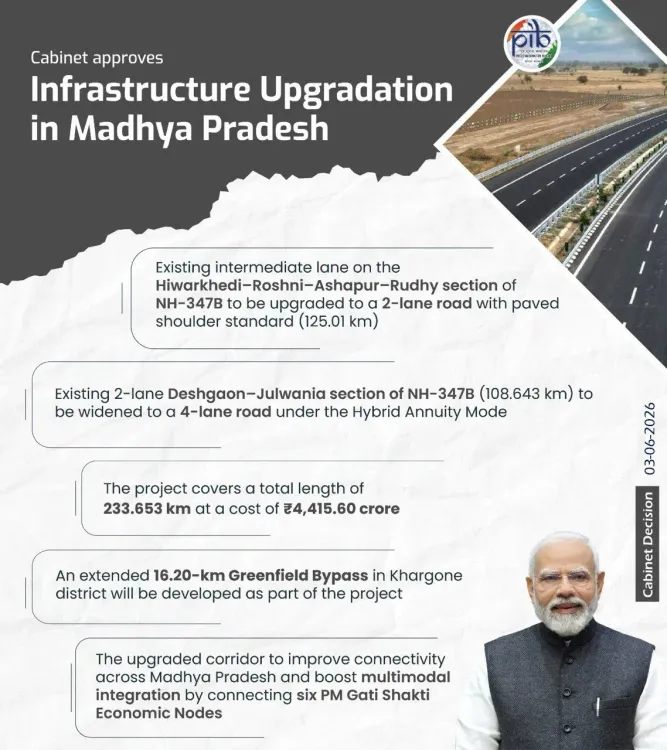
Union Parliamentary Affairs Minister Kiren Rijiju announced that the Modi-led Union Cabinet has approved upgrading the Hiwarkhedi-Roshni-Ashapur-Rudhy stretch of NH-347B to a two-lane paved-shoulder standard and widening the Deshgaon-Julwaniya stretch from two to four lanes in Madhya Pradesh, as part of the centre's continued push on secondary national highway connectivity.
Key Takeaways
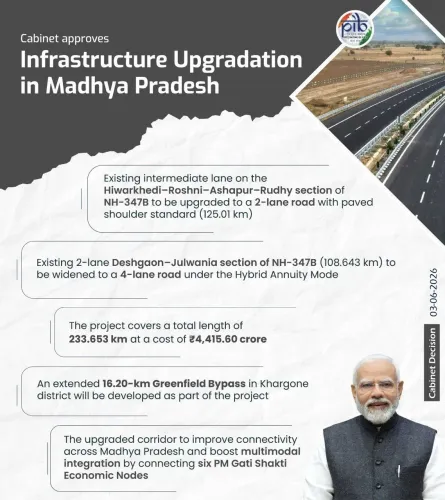
Union Cabinet approves upgradation of the Hiwarkhedi-Roshni-Ashapur-Rudhy section of NH-347B to two-lane paved-shoulder standard.
Deshgaon-Julwaniya section of NH-347B cleared for widening from two lanes to four lanes.
Both stretches lie in Madhya Pradesh and serve rural and agricultural districts.
Decision aligns with Bharatmala Pariyojana, approved in 2015 to upgrade about 34,800 km of national highways.
Announcement made by Union Parliamentary Affairs Minister Kiren Rijiju on X with hashtag #CabinetDecisions.
Next steps include detailed project reports, tender notices and land-acquisition notifications.
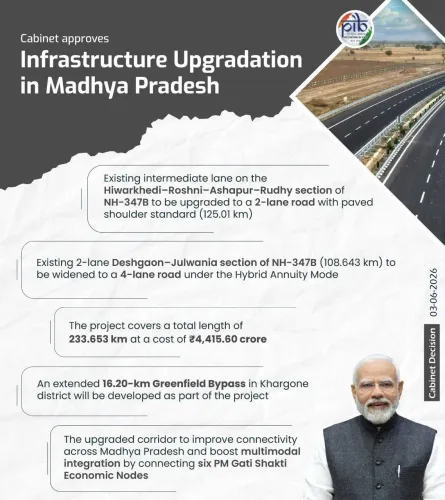
Union Parliamentary Affairs Minister Kiren Rijiju on 3 June 2026 announced that the Union Cabinet, chaired by Prime Minister Narendra Modi, has approved the upgradation and widening of two sections of National Highway 347B in Madhya Pradesh. The decision covers conversion of the existing intermediate lane to a two-lane paved-shoulder standard on the Hiwarkhedi-Roshni-Ashapur-Rudhy stretch and widening from two to four lanes on the Deshgaon-Julwaniya stretch.
In his post on X, Rijiju said the cabinet, 'under the leadership of Hon'ble PM Shri Narendra Modi ji', had cleared the two interventions on NH-347B, tagging the announcement with #CabinetDecisions. The post was accompanied by a single image and made no mention of project cost, alignment length or completion timeline.
Context
NH-347B is a secondary national highway corridor running through parts of Madhya Pradesh, linking smaller towns and agricultural belts to larger interstate arteries. The two stretches identified in the cabinet decision sit within districts that have historically depended on intermediate-lane and two-lane roads for the movement of farm produce and passenger traffic.
The announcement follows a pattern in which the Union Cabinet periodically clears individual highway widening packages rather than bundling them into a single phase. Such standalone approvals typically precede the publication of detailed project reports and tender notices by the National Highways Authority of India and the Ministry of Road Transport and Highways.
Policy backdrop
The clearance fits within the broader framework of Bharatmala Pariyojana, the umbrella road development programme approved by the Union Cabinet in 2015 to develop and upgrade roughly 34,800 km of national highways across India. Phase-I of Bharatmala explicitly targeted the conversion of intermediate-lane highways to two-lane paved-shoulder configurations, particularly in central India.
Successive cabinets have used incremental approvals to close connectivity gaps between rural districts and major economic corridors. The focus on NH-347B aligns with the central government's stated objective of expanding the core national highway network towards 50,000 km by the end of the decade, with Madhya Pradesh receiving multiple widening and upgradation packages under this arc.
Stakeholders and impact
The most direct beneficiaries are residents along the Hiwarkhedi-Roshni-Ashapur-Rudhy and Deshgaon-Julwaniya corridors, who currently rely on narrower carriageways for daily commuting and goods movement. A paved-shoulder upgrade typically improves safety for two-wheelers and slow-moving vehicles by separating them from through traffic.
Logistics operators moving agricultural produce, cement and consumer goods within Madhya Pradesh are expected to gain from the four-laning of the Deshgaon-Julwaniya section, which should reduce travel time and vehicle operating costs. State-level transport authorities and contractors empanelled with the central highways ministry are the other principal stakeholders in the execution phase.
What's next
The immediate steps to watch are the publication of detailed project reports, tender notices and land-acquisition notifications for the two approved sections of NH-347B. The timeline for award of works, appointment of concessionaires or engineering-procurement-construction contractors, and the start of physical work will determine how quickly the cabinet decision translates into commuter-visible change on the ground.
For the Modi government, the back-to-back clearance of mid-sized highway packages reinforces its messaging on rural-to-corridor connectivity. For Madhya Pradesh, the NH-347B decision adds to a growing list of central allocations that will shape the state's freight and passenger road economy in the coming years.
Point of View
Rather than relying solely on flagship corridor announcements. By pairing a paved-shoulder upgrade with a two-to-four lane widening in the same state, the centre is signalling that secondary network strengthening remains a live priority alongside expressway construction. For Madhya Pradesh, which has been a consistent recipient under the Bharatmala arc, this incrementalism is politically useful: each package generates a localised connectivity story without waiting for a phase-level announcement. The real test will be execution speed once land-acquisition notifications follow.
NationPress
18 Oct 2026
Frequently Asked Questions
What did the Union Cabinet approve on NH-347B?
The Union Cabinet approved upgrading the Hiwarkhedi-Roshni-Ashapur-Rudhy section of NH-347B in Madhya Pradesh to a two-lane paved-shoulder standard, and widening the Deshgaon-Julwaniya section of the same highway from two lanes to four lanes.
Where is NH-347B located?
NH-347B is a national highway corridor in Madhya Pradesh that connects smaller towns and agricultural belts to larger interstate arteries, and has featured in successive phases of central road development programmes.
Who announced the NH-347B decision?
Union Parliamentary Affairs Minister Kiren Rijiju announced the cabinet decision on X, attributing the approval to the Union Cabinet chaired by Prime Minister Narendra Modi.
How does this fit into Bharatmala Pariyojana?
Bharatmala Pariyojana, approved in 2015, targets development and upgradation of about 34,800 km of national highways, including converting intermediate-lane stretches to two-lane paved-shoulder standards, which is exactly what is being done on the Hiwarkhedi-Roshni-Ashapur-Rudhy section.
When will work on NH-347B start?
The official post did not specify a start date. The standard sequence after cabinet approval involves detailed project reports, tender notices and land-acquisition notifications before physical construction begins.