PM Modi clears NH-347B upgrades in Madhya Pradesh
Synopsis
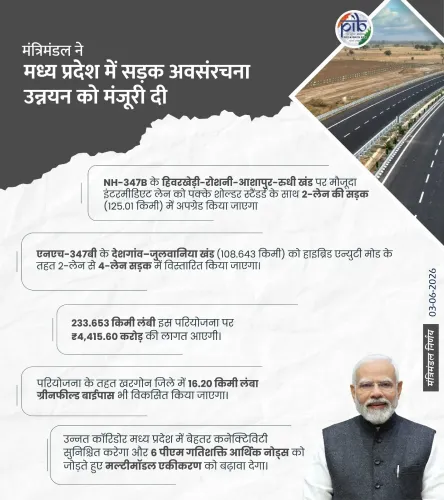
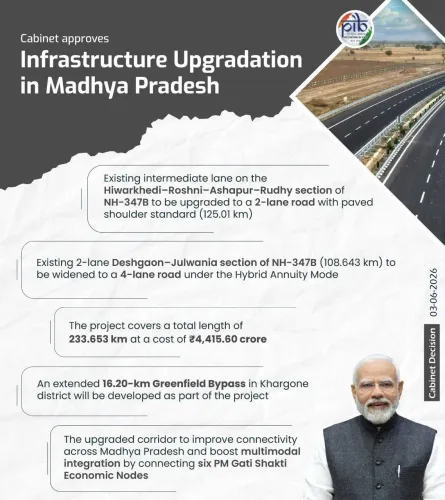
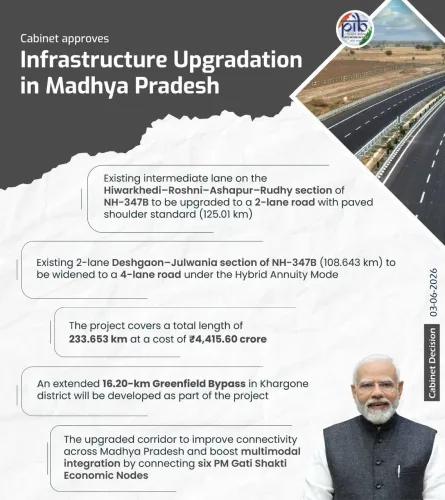
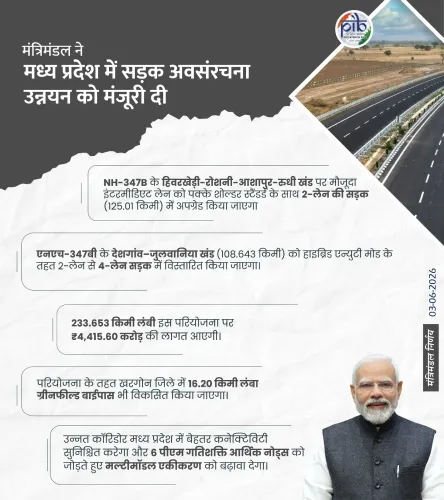
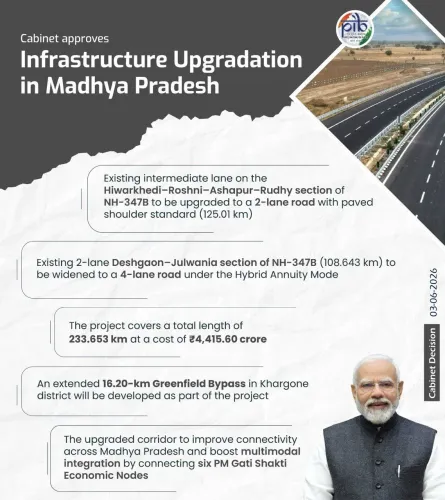
Prime Minister Narendra Modi has announced central approval for upgrading two stretches of NH-347B in Madhya Pradesh, widening the Hivarkhedi-Roshni-Ashapur-Rudhi section to two lanes and converting the Deshgaon-Julwania section from two to four lanes to improve state connectivity.
Key Takeaways
PM Modi announced Union government approval for NH-347B upgrades in Madhya Pradesh.
The Hivarkhedi-Roshni-Ashapur-Rudhi section will be widened to two lanes.
The Deshgaon-Julwania section will be converted from two lanes to four lanes.
The decision aligns with the Bharatmala Pariyojana framework launched in 2015.
Beneficiaries include long-haul truckers, intercity passengers and MP traders.
Implementation will hinge on NHAI tendering and land acquisition progress.
Prime Minister Narendra Modi announced that the Union government has approved upgrades to two key stretches of National Highway 347B in Madhya Pradesh, in a move aimed at improving connectivity across the central Indian state. In a post on X, the Prime Minister said the decision will widen the Hivarkhedi-Roshni-Ashapur-Rudhi section to two lanes and convert the Deshgaon-Julwania stretch from two lanes to four lanes.
Writing in Hindi, PM Modi said, 'Our government has today taken an important decision towards further improving connectivity in Madhya Pradesh.' He added that the approval covers the upgrade of the Hivarkhedi-Roshni-Ashapur-Rudhi section of NH-347B to a two-lane configuration along with conversion of the Deshgaon-Julwania section from a two-lane road to a four-lane corridor. The original Hindi phrasing — 'कनेक्टिविटी को और बेहतर करने की दिशा में' (towards further improving connectivity) — frames the decision as part of a continuing push rather than a one-off announcement.
Context
National Highway 347B runs through Madhya Pradesh, connecting interior districts in the Nimar and Malwa belts with broader inter-state corridors. The two sections cleared for upgrade lie along alignments that handle a mix of agricultural freight, passenger traffic and connector flows feeding into larger east-west arteries.
Widening a stretch from a single carriageway to a two-lane standard, and another from two to four lanes, is intended to ease bottlenecks at chokepoints and reduce travel time for goods vehicles moving between production clusters and consumption hubs. The post stopped short of disclosing the project cost or completion timeline.
Policy backdrop
The approval fits within the broader arc of national highway expansion that has accelerated since 2014. The Bharatmala Pariyojana, launched in 2015, set a target of developing more than 34,000 km of national highways across the country, with Madhya Pradesh figuring prominently because of its position as a logistics bridge between the western ports and the northern hinterland.
Successive central decisions have leaned towards incremental widening of existing alignments rather than greenfield construction — a pattern that minimises land acquisition disputes while still unlocking capacity. The NH-347B clearances follow this template, upgrading what is already in use rather than carving a fresh corridor.
Stakeholders and impact
The most immediate beneficiaries are highway users on the Hivarkhedi-Roshni-Ashapur-Rudhi and Deshgaon-Julwania stretches, including long-distance truckers, intercity bus operators and private vehicle owners. Traders in Madhya Pradesh who move soybean, cotton and processed goods stand to gain from lower turnaround times if the projects are delivered on schedule.
Local contractors, equipment suppliers and labour markets along the alignment are likely to see activity once tenders are floated. Roadside settlements may also experience changes in land-use pressure as four-laning typically widens the right-of-way and reshapes access points.
What's next
Attention will now shift to the National Highways Authority of India tendering process and the status of land acquisition on the approved alignments. The pace at which detailed project reports translate into ground-breaking will determine whether the announcement converts into measurable travel-time gains for users in Madhya Pradesh.
If executed without delays, the upgrades could strengthen the state's claim as a transit spine for central India and feed into the wider national highway grid that the government has been steadily expanding.
Point of View
Which keeps land acquisition friction low while still adding usable capacity. Madhya Pradesh's recurring presence in such approvals reflects its geographic role as a connector between western ports and the northern hinterland. For the state's BJP government, each such clearance feeds a politically useful narrative of visible federal partnership. The real test, as always, lies in how quickly tenders move and whether construction matches the speed of announcements.
NationPress
18 Oct 2026
Frequently Asked Questions
What did PM Modi announce about NH-347B?
PM Narendra Modi announced that the Union government has approved upgrades to two sections of NH-347B in Madhya Pradesh — widening the Hivarkhedi-Roshni-Ashapur-Rudhi stretch to two lanes and converting the Deshgaon-Julwania stretch from two lanes to four lanes.
Where does NH-347B run?
NH-347B is a national highway corridor in Madhya Pradesh that links interior districts in the state with wider inter-state routes, carrying a mix of freight and passenger traffic.
What is the Bharatmala Pariyojana?
Bharatmala Pariyojana is a central highway development programme launched in 2015 with a target of developing more than 34,000 km of national highways, including stretches across Madhya Pradesh.
Who benefits from the NH-347B upgrade?
Highway users on the affected stretches benefit most directly, including truckers, intercity bus operators and private motorists. Traders in Madhya Pradesh moving agricultural and processed goods also stand to gain from faster logistics.
When will the NH-347B widening work begin?
The post did not disclose a start date. Work will depend on the National Highways Authority of India's tendering timeline and the progress of land acquisition along the approved alignments.