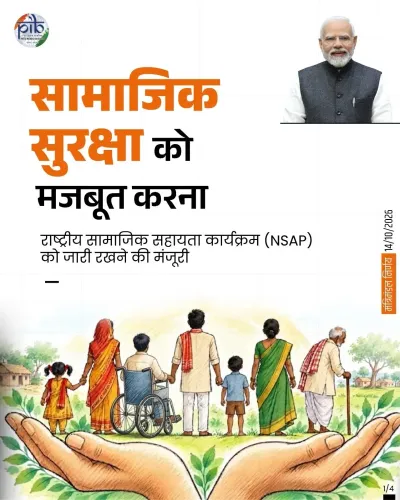
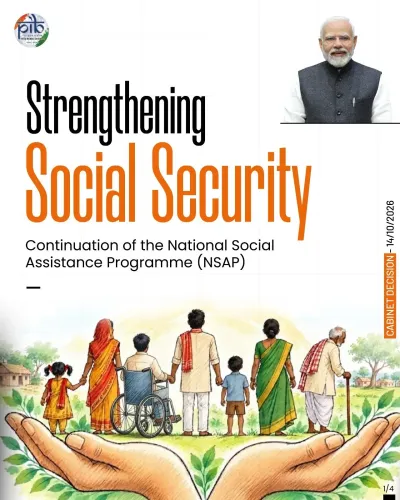
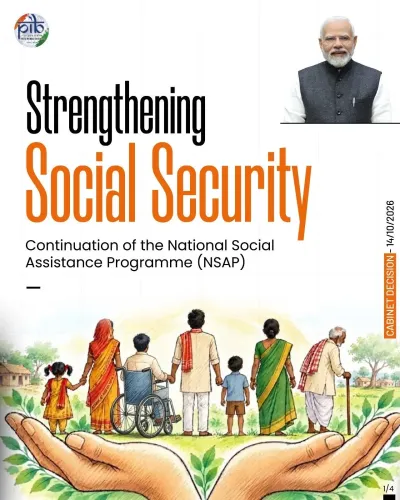
Cabinet Clears NSAP Continuation: ₹53,428 Cr for 3.20 Cr Beneficiaries
Synopsis
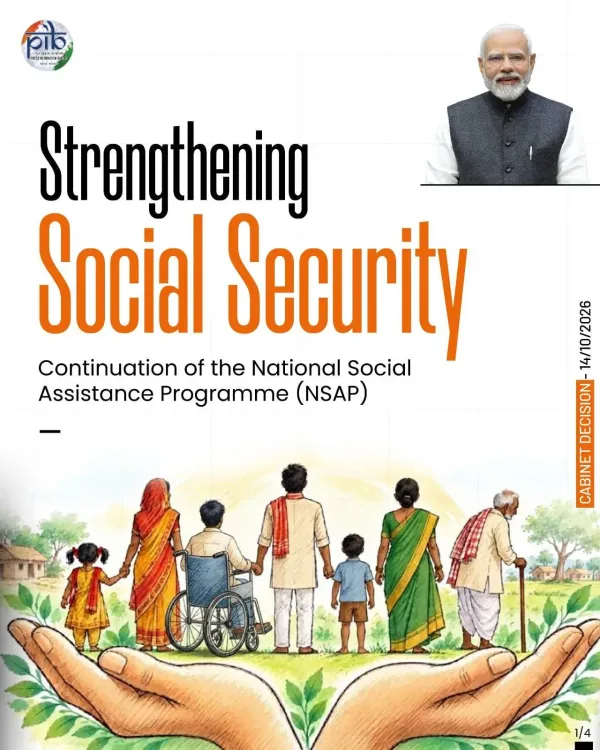
The Union Cabinet chaired by PM Modi has approved the continuation of the National Social Assistance Programme (NSAP) with a ₹53,428 crore outlay for 2026-31, benefiting 3.20 crore elderly, widowed and disabled citizens across all 36 States and UTs.
Key Takeaways
The Union Cabinet has approved the continuation of the National Social Assistance Programme (NSAP) for five years from 2026-27 to 2030-31 .
Total approved outlay stands at ₹53,428 crore for the five-year period.
3.20 crore beneficiaries across all 36 States and Union Territories will be covered.
NSAP provides direct cash transfers to the elderly, widows, and persons with disabilities.
The Ministry of Rural Development administers the scheme, with states managing last-mile delivery.
NSAP has been a continuous feature of India's social security architecture since its launch in 1995 .
India's social safety net just got a five-year guarantee. Union Ports and Shipping Minister Sarbananda Sonowal announced on Wednesday, October 14, 2026, that the Union Cabinet — chaired by Prime Minister Narendra Modi — has approved the continuation of the National Social Assistance Programme (NSAP) with a total outlay of ₹53,428 crore covering 2026-27 to 2030-31.
What NSAP covers — and who it reaches
The NSAP is India's front-line direct cash transfer scheme for the country's most vulnerable: the elderly, widows, and persons with disabilities. Launched in 1995 as a fully funded central scheme, it operates across all 36 States and Union Territories, with states and UTs handling last-mile delivery to doorsteps. The fresh Cabinet approval guarantees resources for 3.20 crore beneficiaries across this network — a population roughly the size of a mid-tier Indian state.
The Ministry of Rural Development is the nodal central ministry that administers NSAP and coordinates with state governments on beneficiary identification, verification, and fund flow. For millions of pensioners who depend on these transfers as their primary income, continuity of the scheme is not an administrative detail — it is an economic lifeline.
₹53,428 crore over five years: the scale of the commitment
A ₹53,428 crore multi-year outlay signals a firm fiscal commitment well ahead of annual Budget cycles, insulating the scheme from year-to-year allocation uncertainty. This pattern — locking in resources for five-year tranches — has become a defining feature of how successive administrations have managed direct-benefit social schemes: promise the envelope, then manage delivery within it.
The approval lands as the government enters the first year of a new medium-term planning window. State governments will now begin the process of fund allocation planning and beneficiary list verification ahead of the 2026-27 rollout. Any fine-tuning to individual Budget line items within the tranche will come in subsequent Union Budgets — but the floor is set.
Three decades of NSAP — and why it keeps getting renewed
NSAP has outlasted multiple governments, economic cycles, and reform waves since its 1995 launch — a rare constant in India's shifting policy landscape. Its longevity reflects a political consensus that targeted cash transfers to elderly, widowed, and disabled citizens represent an irreducible minimum of state obligation. No administration has wound it down. Each has extended it, often with modest enhancements.
The Cabinet's latest renewal keeps that record intact — and sets the terms for social assistance delivery through the end of the decade.
For 3.20 crore Indians living at the margins, the five-year clock just started ticking in their favour.
Point of View
428 crore envelope is less a policy innovation than a deliberate act of fiscal steadiness — insulating a three-decade-old scheme from the turbulence of annual Budget negotiations. That continuity itself carries political weight: it signals to 3.20 crore vulnerable households that the state's minimum social obligation will not be renegotiated mid-cycle. The multi-year approval pattern also reflects the government's broader preference for committing to direct-benefit frameworks in advance, reducing the scope for last-minute cuts. The real test, as with all NSAP cycles, will be whether state-level delivery machinery can keep pace — beneficiary verification backlogs and last-mile transfer delays have historically been the scheme's Achilles' heel.
NationPress
14 Oct 2026
Frequently Asked Questions
What is the National Social Assistance Programme (NSAP)?
NSAP is a centrally sponsored direct cash transfer scheme launched in 1995 that provides social pensions to elderly citizens, widows, and persons with disabilities across India. It is administered by the Ministry of Rural Development and implemented through all 36 States and Union Territories.
How much money has the Cabinet approved for NSAP 2026-31?
The Union Cabinet has approved a total outlay of ₹53,428 crore for the continuation of NSAP over five years from 2026-27 to 2030-31.
How many people will benefit from the NSAP renewal?
The approved continuation covers 3.20 crore beneficiaries spread across all 36 States and Union Territories of India.
Who chairs the Cabinet meetings that approve NSAP and similar welfare schemes?
The Union Cabinet is chaired by Prime Minister Narendra Modi. Major policy approvals, including the continuation of centrally sponsored schemes like NSAP, require Cabinet clearance.
Which ministry is responsible for implementing NSAP?
The Ministry of Rural Development is the nodal central ministry for NSAP. It coordinates with state and UT governments on fund allocation, beneficiary verification, and last-mile delivery of pension transfers.