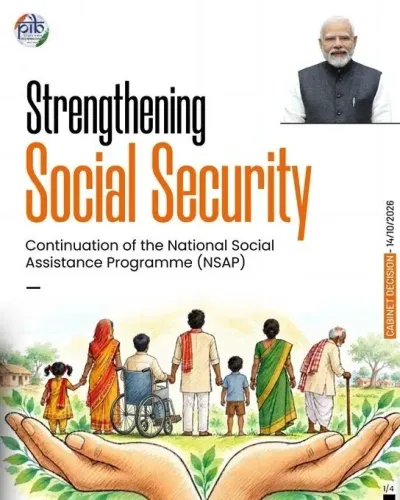
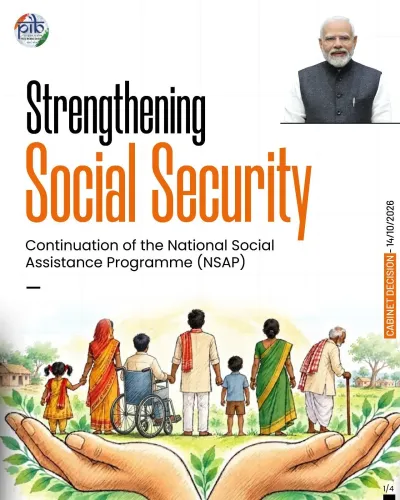
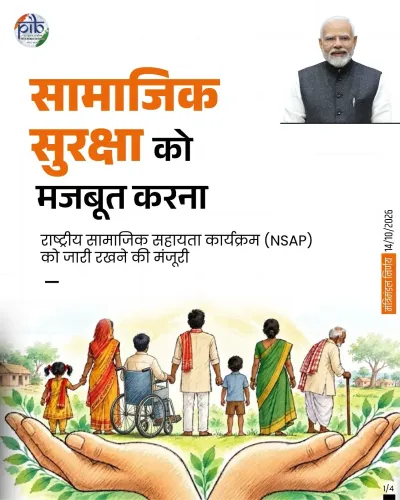
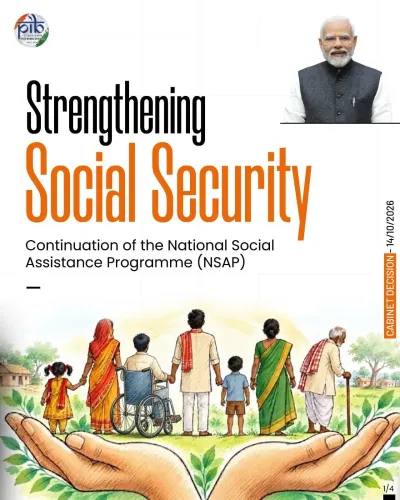
Cabinet Approves ₹53,428 Cr NSAP Extension for 2026–31
Synopsis
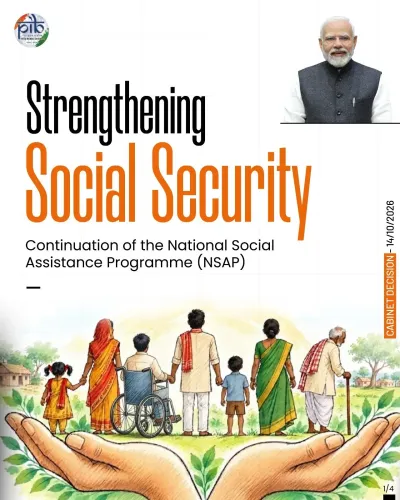
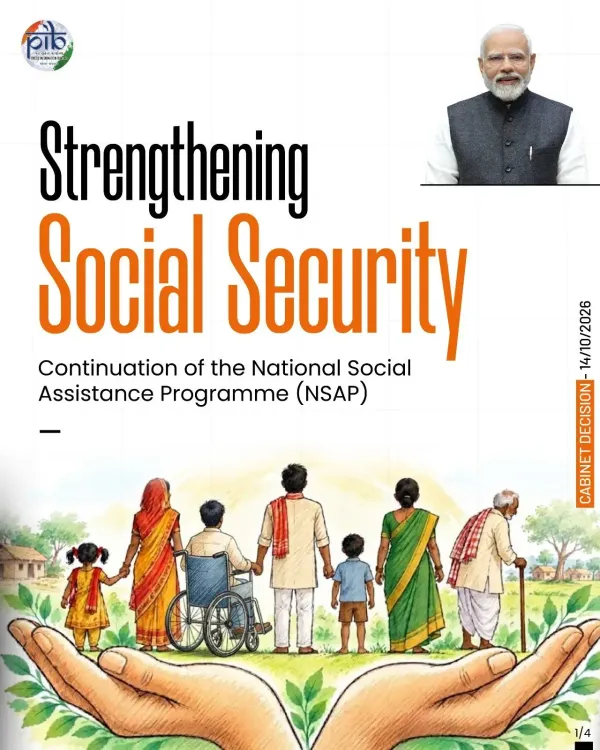
The Union Cabinet has approved a ₹53,428 crore extension of the National Social Assistance Programme for 2026–31, with revised eligibility and enhanced pension assistance for Divyangjan — continuing India's 30-year-old non-contributory social security net for the elderly poor, widows, and persons with disabilities.
Key Takeaways
₹53,428 crore approved for NSAP continuation across 2026–27 to 2030–31 .
Scheme covers three core groups: elderly poor, widows, and Divyangjan (persons with disabilities).
Revised eligibility norms and enhanced pension assistance specifically introduced for Divyangjan in this cycle.
NSAP was originally launched on 15 August 1995 as India's primary non-contributory social security scheme.
Disbursement typically flows via direct benefit transfers through the Ministry of Rural Development and state governments.
State implementation guidelines and revised eligibility thresholds are yet to be formally issued.
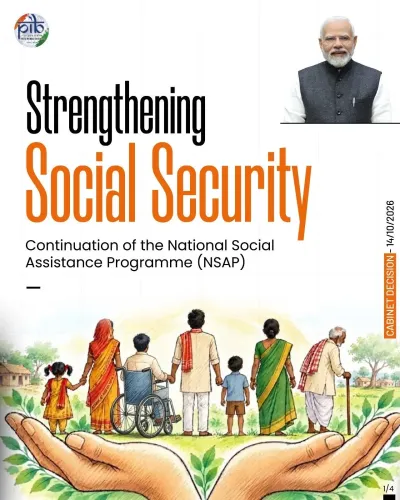
India's oldest non-contributory pension programme just got a five-year lifeline — and a significant upgrade for persons with disabilities. Union Education Minister Dharmendra Pradhan announced on Wednesday, 14 October 2026 that the Union Cabinet, chaired by Prime Minister Narendra Modi, has approved the continuation of the National Social Assistance Programme (NSAP) with a total outlay of ₹53,428 crore covering the period 2026–27 to 2030–31.
Thirty years on: what NSAP actually does
Launched on 15 August 1995, the NSAP is India's cornerstone non-contributory social security scheme — meaning beneficiaries pay nothing in; the state covers it entirely. It channels direct pension assistance to three of the country's most economically vulnerable groups: the elderly poor, widows, and Divyangjan (persons with disabilities). Over three decades and successive five-year renewals, the programme has become part of the baseline safety net for millions of households that have no formal employment record and no other pension access.
The current renewal follows the established pattern of five-year funding cycles, but this round carries a specific policy signal: revised eligibility norms and enhanced pension assistance for Divyangjan. That targeted revision reflects a broader push under the current government to mainstream disability inclusion into welfare architecture rather than treat it as a residual category.
₹53,428 crore: what the number means in practice
Spread across five fiscal years, the approved outlay averages roughly ₹10,686 crore per year — a centrally sponsored commitment that flows to states, which then implement disbursement, often through direct benefit transfers (DBT) into beneficiaries' bank accounts. The centre-state funding ratio and the precise revised eligibility thresholds are expected to be detailed in implementation guidelines that state governments will now work through.
For context, the NSAP's longevity across governments of different political colours underscores a durable cross-party consensus: that a floor of social protection for the elderly, widowed, and differently-abled is non-negotiable public policy. Each renewal has nudged coverage and benefit levels incrementally upward, and this cycle appears to continue that trajectory — with Divyangjan welfare receiving a more explicit push than in previous extensions.
Who gains, and what to watch next
The immediate beneficiaries are the elderly poor, widows, and persons with disabilities across India — particularly in rural areas where NSAP pensions often constitute the only formal income in a household. The revised eligibility criteria could bring previously excluded individuals into coverage, though the specifics will emerge only once the Ministry of Rural Development — the nodal ministry for NSAP — releases the updated operational guidelines.
The questions worth watching: how the centre-state cost-sharing ratio shifts in this cycle, whether the revised Divyangjan norms align with the Rights of Persons with Disabilities Act, 2016, and how quickly state governments move to update their beneficiary rolls. Parliament's budget sessions will likely see scrutiny of both the revised eligibility benchmarks and the adequacy of the per-beneficiary pension amount — a figure that critics have historically argued lags behind inflation.
A thirty-year-old programme just renewed with a half-lakh-crore commitment is a statement of institutional durability. Whether the revised benefit levels match the cost of dignified living in 2026 is the question that will outlast Wednesday's cabinet announcement.
Point of View
Extending a scheme that touches the poorest households ahead of state election cycles is rarely accidental. The real test of this cabinet decision will come in the implementation details: whether revised eligibility thresholds are expansive enough to absorb previously excluded beneficiaries, and whether per-capita benefit levels are finally indexed to reflect real-world inflation. For now, the ₹53,428 crore figure establishes a fiscal floor; the ceiling on actual impact depends entirely on state-level execution.
NationPress
14 Oct 2026
Frequently Asked Questions
What is the National Social Assistance Programme (NSAP)?
The NSAP is a centrally sponsored, non-contributory social security scheme launched on 15 August 1995. It provides direct pension assistance to the elderly poor, widows, and persons with disabilities (Divyangjan) who have no other formal income support.
How much has the government approved for NSAP in the new cycle?
The Union Cabinet has approved a total outlay of ₹53,428 crore for the NSAP covering the five-year period from 2026–27 to 2030–31.
What has changed for Divyangjan under the new NSAP approval?
The cabinet decision includes revised eligibility norms and enhanced pension assistance specifically for Divyangjan (persons with disabilities), making this cycle more explicitly disability-inclusive than previous extensions.
Which ministry implements the NSAP?
The Ministry of Rural Development is the nodal ministry for the NSAP. It sets operational guidelines and works with state governments to disburse benefits, increasingly through direct benefit transfers into beneficiaries' bank accounts.
Who are the beneficiaries of the NSAP scheme in India?
NSAP targets three vulnerable groups: the elderly poor, widows, and Divyangjan (persons with disabilities). The scheme is designed for individuals who lack any formal employment history or other pension access.