Pralhad Joshi pitches India as clean energy leader at Bloomberg Forum
Synopsis
Union Minister Pralhad Joshi told the Bloomberg New Economy Forum that India has crossed 308 GW of non-fossil capacity and achieved its 50% clean electricity NDC target five years ahead of schedule, and invited Bloomberg to partner in the Bharat Renewable Energy Summit in New Delhi this November.
Key Takeaways
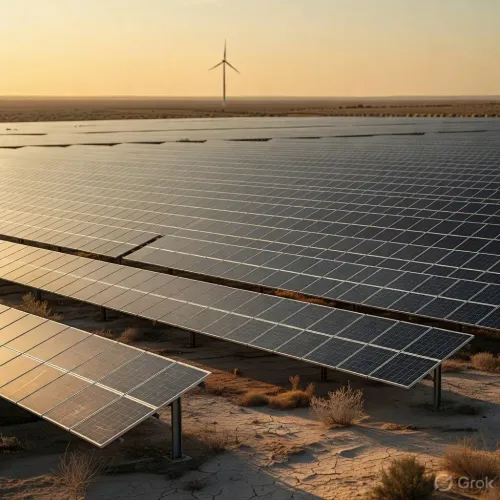
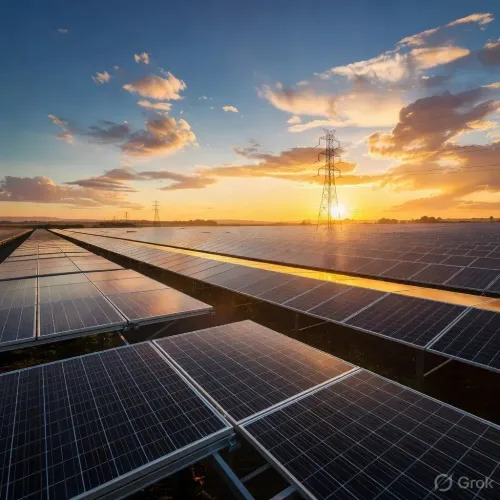
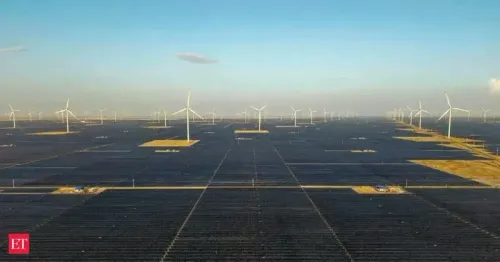
India has achieved 50% non-fossil installed electricity capacity , hitting its 2030 NDC target five years early .
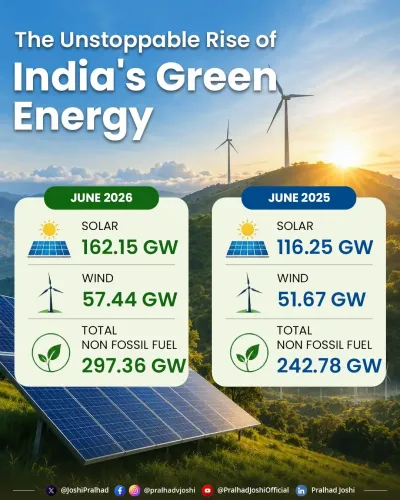
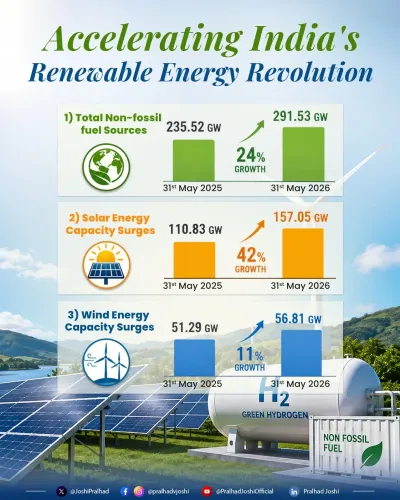
Total non-fossil capacity now stands at 308 GW , as cited by Union Minister Pralhad Joshi at the Bloomberg New Economy Forum.
Flagship schemes PM Surya Ghar (rooftop solar) and PM KUSUM (agricultural solar pump-sets, launched 2019) are the primary domestic drivers of this expansion.
Joshi formally invited Bloomberg to partner in the Bharat Renewable Energy Summit and Expo at Bharat Mandapam, New Delhi, 2–5 November 2026 .
India's pitch positions the country as a scalable clean energy model for the Global South , seeking deeper international investment and collaboration.
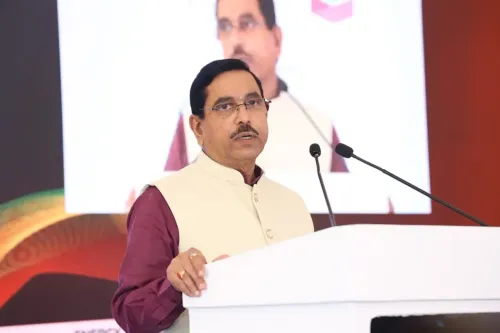
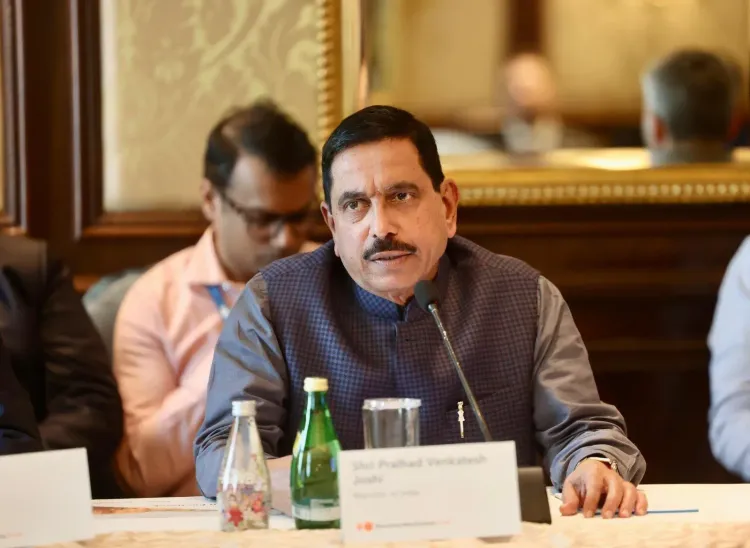
India arrived at one of the world's premier energy-transition forums not with a pledge, but with a scorecard. Union Minister Pralhad Joshi, addressing the Bloomberg New Economy Forum on Wednesday, 14 October 2026, told a global audience that India has already crossed the 50 percent non-fossil installed electricity capacity milestone — a target the country had committed to reaching by 2030 under its Nationally Determined Contributions (NDCs), achieved five years early.
Speaking on the panel titled 'Accelerating the Renewable Energy Age' alongside BloombergNEF executive Ethan Zindler, Joshi anchored India's climate credibility in a single headline number: 308 GW of non-fossil capacity now on the grid. For a country that was once seen primarily as a coal-dependent developing economy, that figure is a geopolitical statement as much as a technical one.PM Surya Ghar and PMKUSUM: the schemes powering the surge
Joshi credited the scale and speed of India's transition to two flagship Central schemes operating at opposite ends of the energy chain. PM Surya Ghar has taken rooftop solar into millions of households, reducing the electricity burden on ordinary families while adding distributed generation to the national grid. PM KUSUM, launched in 2019, has been steadily solarising agricultural pump-sets across rural India — simultaneously cutting diesel consumption and giving farmers a secondary income stream by feeding surplus power back to utilities.
Both schemes operate under the broader policy architecture that Prime Minister Narendra Modi's government has built around the energy transition, pairing household-level adoption with utility-scale capacity addition to create a layered, resilient renewable base. India's co-founding of the International Solar Alliance in 2015 remains the diplomatic frame within which these domestic achievements are presented to international partners.
The Bloomberg partnership pitch and the November summit
Joshi used the forum appearance as a live sales call. He extended a formal invitation to Bloomberg to partner in the Bharat Renewable Energy Summit and Expo, scheduled at Bharat Mandapam, New Delhi, from 2–5 November 2026. The ask was deliberate: Bloomberg's data infrastructure and investor reach, combined with India's policy momentum, could accelerate capital flows toward clean energy projects not just in India but across the Global South.
The framing of the Global South is not incidental. India has consistently positioned itself at multilateral forums as the nation that can demonstrate a replicable low-carbon development model for emerging economies — proof that rapid growth and decarbonisation are not mutually exclusive. The November summit is where that argument will be stress-tested against actual investment commitments.
What the early NDC achievement actually signals
Beating a major climate target by five years is the kind of headline that travels. It shifts India's negotiating position in global climate talks from 'responsible developing nation asking for space' to 'demonstrable leader setting the pace'. For BloombergNEF, whose analysts track energy-transition finance globally, an early NDC crossing in the world's third-largest energy market is a signal that deployment risk in India is lower than comparable emerging economies — a point that feeds directly into investor pricing.
Whether the November summit translates that signal into announced partnerships and hard capital will determine how much of this week's forum energy converts into durable policy outcomes.
Point of View
Not just a domestic policy win — it reframes India in global climate negotiations as a pace-setter rather than a laggard seeking concessions. Joshi's appearance at the Bloomberg forum, paired with a live invitation to the November summit, signals a strategic shift toward monetising that credibility through foreign investment partnerships. The Global South framing is equally deliberate: by positioning India as the proof-of-concept for clean growth in developing economies, New Delhi is building soft-power capital ahead of upcoming UN climate negotiations. The real test arrives at Bharat Mandapam in November, when rhetoric must convert into bankable commitments.
NationPress
14 Oct 2026
Frequently Asked Questions
Has India achieved its 50% renewable energy target?
According to Union Minister Pralhad Joshi, India has achieved 50% non-fossil installed electricity capacity, meeting its 2030 NDC target five years ahead of schedule, with 308 GW of non-fossil capacity on the grid.
What is the Bharat Renewable Energy Summit 2026?
The Bharat Renewable Energy Summit and Expo is scheduled at Bharat Mandapam, New Delhi, from 2–5 November 2026. Minister Joshi has invited Bloomberg to partner in the event, which aims to advance clean energy solutions for India and the Global South.
What is PM Surya Ghar scheme?
PM Surya Ghar is a Central government scheme that promotes rooftop solar installations, providing subsidised or free electricity to households while adding distributed generation capacity to the national grid.
What is the PM KUSUM scheme?
PM KUSUM, launched in 2019, is a Central scheme to solarise agricultural pump-sets across India, cutting farmers' diesel costs and allowing them to feed surplus solar power back to utilities for additional income.
What did Pralhad Joshi say at the Bloomberg New Economy Forum?
Joshi highlighted India's 308 GW non-fossil capacity, the early achievement of its 2030 NDC milestone, the role of PM Surya Ghar and PM KUSUM in driving the clean energy transition, and invited Bloomberg to partner in the November renewable energy summit in New Delhi.