Giriraj Singh Eyes $1 Trillion Trade Target by 2030
Synopsis
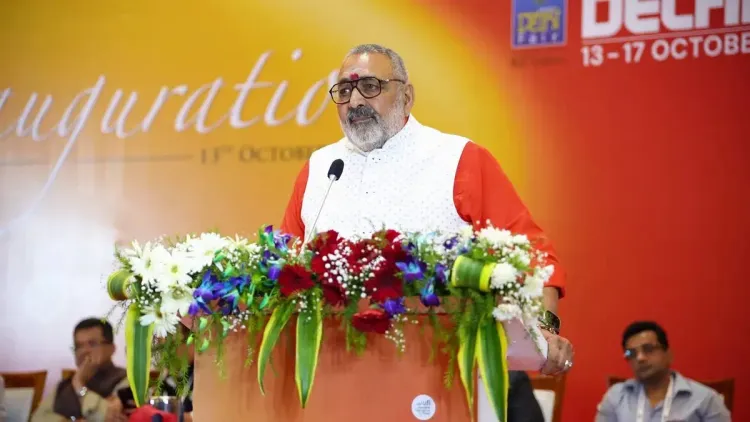
Textiles Minister Giriraj Singh praised Indian exporters for reaching new global markets despite headwinds and called on industry to unite behind the government's goal of crossing $1 trillion in trade by 2030 under PM Modi's leadership.
Key Takeaways
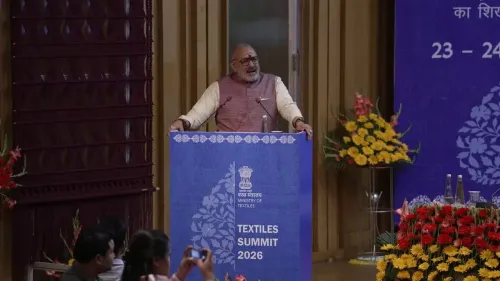
Union Textiles Minister Giriraj Singh posted on October 14, 2026 praising Indian exporters for expanding into new global markets despite adverse conditions.
Singh credited Prime Minister Narendra Modi's leadership for instilling national confidence and driving export resilience.
He called on all stakeholders — exporters and industry — to collectively push toward a $1 trillion trade target by 2030 .
The statement aligns with the Atmanirbhar Bharat initiative launched in May 2020 , which promoted domestic manufacturing and export diversification.
India's government has been pushing export diversification toward Asia, Africa, and Latin America as part of its broader trade growth strategy since 2014.
The textiles sector, directly under Singh's ministry, is among India's top foreign-exchange earners and a key driver of the export push.
India's exporters and industry are punching through headwinds — and Union Textiles Minister Giriraj Singh wants every stakeholder to know it is just the beginning. On Wednesday, October 14, 2026, Singh took to X to credit the country's business community for carving out new global markets despite adverse conditions, framing their resilience as a proof of concept for an even larger national ambition: crossing the $1 trillion trade mark by 2030.
In his post, Singh wrote — 'विपरीत परिस्थितियों के बावजूद हमारे निर्यातकों और उद्योग जगत ने नए बाजारों तक पहुँच बनाकर वैश्विक व्यापार में भारत की स्थिति को और मजबूत किया है' — 'Despite adverse circumstances, our exporters and industry have strengthened India's position in global trade by reaching new markets.' He attributed this momentum to the leadership of Prime Minister Narendra Modi and called it a fresh demonstration of national confidence and capability.
From Atmanirbhar Bharat to a Trillion-Dollar Horizon
The ambition Singh is rallying around did not emerge in isolation. The ideological scaffolding was erected in May 2020, when the Modi government launched the Atmanirbhar Bharat initiative — a sweeping push to reduce import dependence, scale up domestic manufacturing, and diversify the country's export basket. What began as a pandemic-era survival strategy has since evolved into a trade-expansion doctrine, with government incentives targeting new destinations across Asia, Africa, and Latin America rather than concentrating on traditional Western buyers.
Singh's post fits squarely into that arc. The emphasis on 'new markets' signals that the export diversification drive is being treated not as an emergency measure but as a permanent competitive upgrade — one where the textile sector, which Singh directly oversees, has a significant role to play.
Why the $1 Trillion Call-to-Arms Matters Now
The target Singh invoked — taking India's trade beyond $1 trillion by 2030 — is a figure that has anchored government export rhetoric for several years. Singh's framing on Wednesday shifts the register from aspiration to urgency: 'अब... हम सभी को मिलकर पूरी ताकत से आगे बढ़ना है' — 'Now... all of us must move forward together with full strength.' That collective address — aimed squarely at exporters and industry — reads less like a ministerial statement and more like a pre-Budget mobilisation signal.
Analysts tracking India's Foreign Trade Policy will watch whether this kind of political momentum translates into concrete export-promotion scheme announcements or revised incentive structures in the coming months. The textile sector alone — employing millions and ranking among India's top foreign-exchange earners — would be a bellwether for how seriously the government is pressing the accelerator.
Point of View
He reinforces the government's ownership of India's export narrative at a moment when global trade headwinds could otherwise invite criticism. For the textiles sector specifically, such high-profile ministerial buy-in often precedes concrete scheme announcements — making this worth watching beyond its rhetorical surface. The broader pattern suggests the BJP is positioning trade growth, not just welfare or infrastructure, as a 2029 electoral asset.
NationPress
14 Oct 2026
Frequently Asked Questions
What is India's trade target for 2030?
The Indian government has set an ambition of crossing $1 trillion in total trade by 2030 , a goal Union Textiles Minister Giriraj Singh publicly reinforced on October 14, 2026, calling on exporters and industry to unite behind it.
What is Atmanirbhar Bharat and how does it relate to exports?
Atmanirbhar Bharat , launched in May 2020 , is the Modi government's initiative to promote domestic manufacturing and reduce import dependence. It also pushed export diversification, targeting new markets in Asia, Africa, and Latin America rather than relying solely on traditional Western buyers.
What did Giriraj Singh say about Indian exporters?
Singh praised Indian exporters and industry for strengthening India's position in global trade by reaching new markets despite adverse circumstances, attributing the achievement to PM Modi's leadership.
Why is the textiles sector important to India's export target?
The textiles sector is one of India's largest foreign-exchange earners and a major employer. As Union Textiles Minister, Giriraj Singh oversees the sector, making his statements on export ambition directly relevant to its policy direction.
What should we watch for after Giriraj Singh's trade statement?
Observers will track whether this statement precedes concrete announcements — such as new export-promotion schemes, revised incentive structures, or updated Foreign Trade Policy provisions — in the next Union Budget or policy cycle.