India Aims for $100 Billion Textile Exports by 2030-31, Says Giriraj Singh
Synopsis
India is setting ambitious goals for its textile industry, aiming for $100 billion in exports by 2030-31. Union Minister Giriraj Singh highlights the importance of diversifying production and enhancing sustainability to strengthen global market presence.
Key Takeaways
India aims for $100 billion in textile exports by 2030-31 .
Focus on high-value manufacturing and year-round garment production .
Target to increase global market share from 4.7% to 14.7% .
Future driven by sustainability and innovation .
Bharat Tex 2026 to connect manufacturers with global buyers .
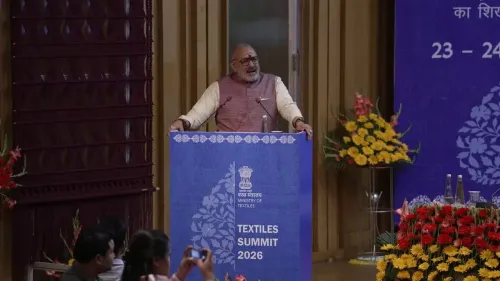
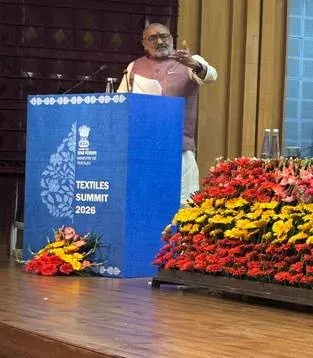
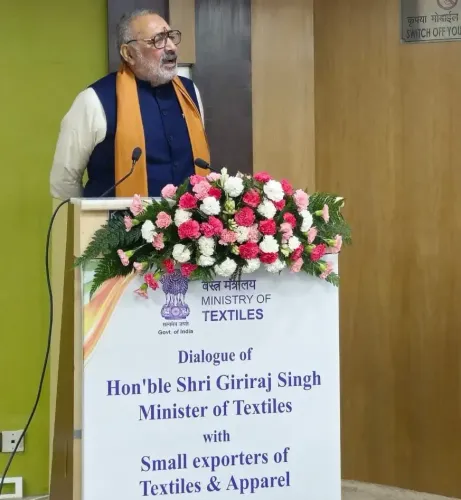
New Delhi, March 11 (NationPress) - In a recent address, Union Minister of Textiles Giriraj Singh emphasized that India must transition towards high-value and large-scale manufacturing while enhancing year-round garment production to fortify its global standing in the textile industry.
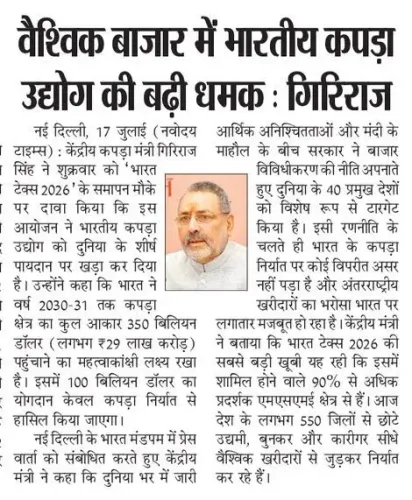
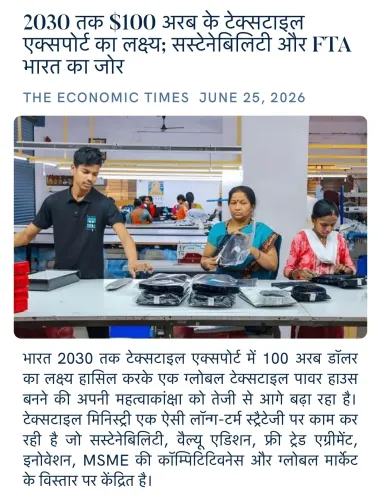
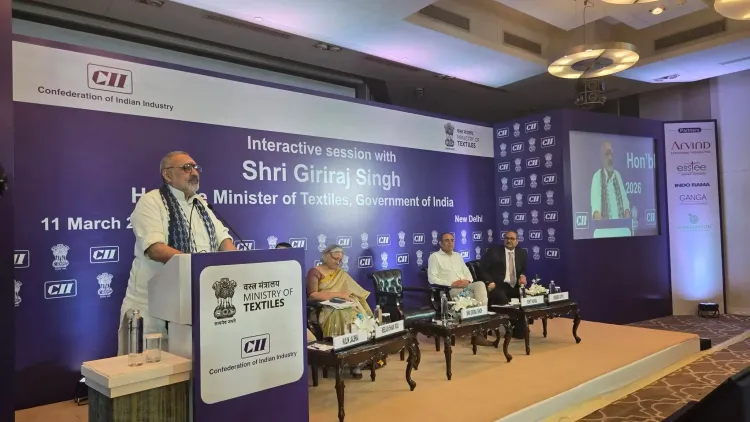
During an industry meeting organized by the Confederation of Indian Industry in New Delhi, the minister outlined India's ambitions to grow its textile economy to $350 billion and achieve exports worth $100 billion by 2030-31.
Singh pointed out that India's contribution to the global textile trade should increase from the present 4.7 percent to 14.7 percent, highlighting the necessity for the industry to enhance productivity and competitiveness.
The minister also addressed the structural challenges in garment production, noting that a significant portion of India's output is currently concentrated on summer apparel, meeting about eight months of global demand.
“The industry should broaden its production capabilities to accommodate garments for all seasons, thereby accessing a wider array of international markets,” he stated.
Moreover, Singh mentioned that the future of the textile sector will increasingly hinge on sustainability and innovation. He urged the industry to diversify into technical textiles, value-added garments, and innovative textile solutions where India possesses substantial potential.
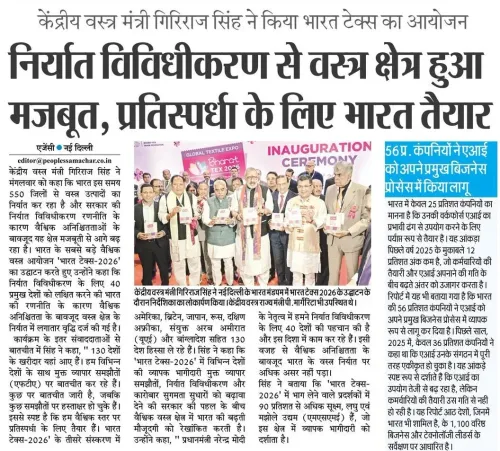
He also referenced the upcoming Bharat Tex 2026 event, planned from July 14 to 17, which aims to link Indian manufacturers with global buyers and investors.
During the event, Neelam Shami Rao, Secretary in the Ministry of Textiles, remarked that India must enhance raw material availability, manufacturing capabilities, infrastructure, and market diversification to facilitate future growth.
She noted that India’s fiber production, currently at approximately 15 million metric tonnes, needs to rise to nearly 23 million metric tonnes, supported by initiatives such as the National Fibre Mission.
Industry leaders also underscored the importance of scaling garment production to meet potential demand stemming from new trade agreements.
Point of View
The government's focus on innovation may well position India as a major player in the global textile sector.
NationPress
3 Oct 2026
Frequently Asked Questions
What is India's target for textile exports by 2030-31?
India aims for $100 billion in textile exports by 2030-31.
Who is the Union Minister of Textiles?
The Union Minister of Textiles is Giriraj Singh.
What is the current share of India in global textile trade?
India's current share in global textile trade is 4.7 percent.
What are the upcoming initiatives in India's textile sector?
Upcoming initiatives include the Bharat Tex 2026 event and the National Fibre Mission to enhance fiber production.
What challenges does the Indian textile industry face?
The challenges include a focus on seasonal garments and the need for increased production capabilities for all seasons.