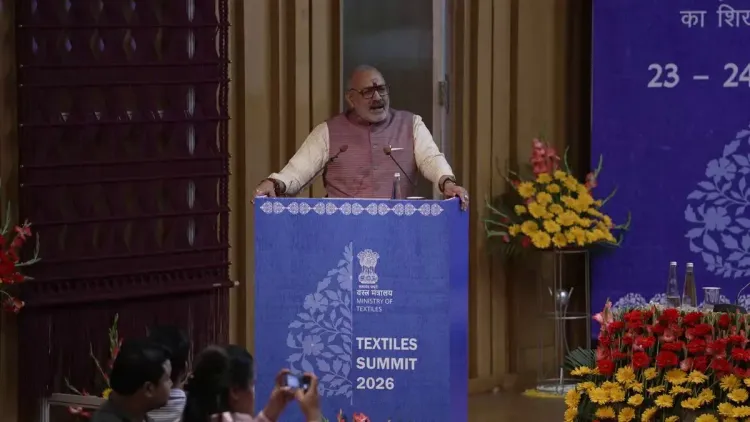
Giriraj Singh Calls for Centre-State Push on $100 Bn Textile Export Goal
Synopsis
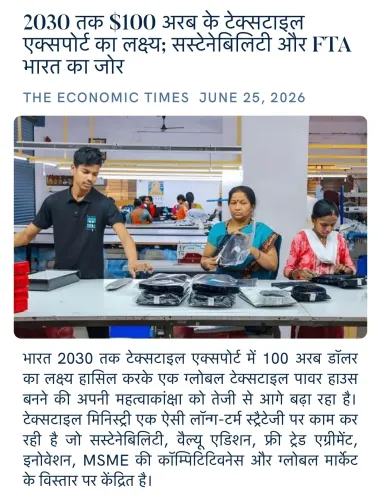
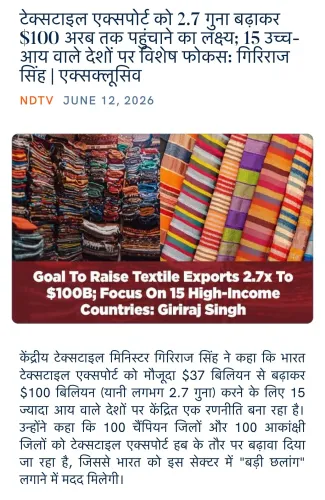
Union Textiles Minister Giriraj Singh has called for joint Centre-state action to develop new champion districts and exporters, positioning coordinated effort and a clear roadmap as the path to India's $100 billion textile and apparel export ambition under the Viksit Bharat 2047 vision.
Key Takeaways
Giriraj Singh on June 25, 2026 called for Centre-state collaboration to achieve a $100 billion textile and apparel export target.
The minister emphasised developing new 'champion districts' and new exporters beyond existing clusters.
The push is anchored in the Viksit Bharat 2047 vision, framing sectoral growth as part of India's broader development goal.
The PLI Scheme for Textiles (2021) with an outlay of Rs 10,683 crore and the RoSCTL scheme (2019) form the existing policy backbone for export promotion.
The champion-district model mirrors approaches previously used in agriculture and skill development for decentralised growth.
Textiles is a priority sector under Atmanirbhar Bharat and Make in India for employment generation and reducing import dependence.
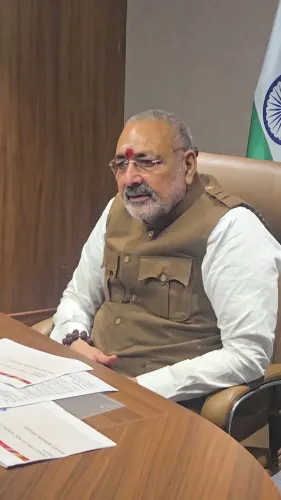
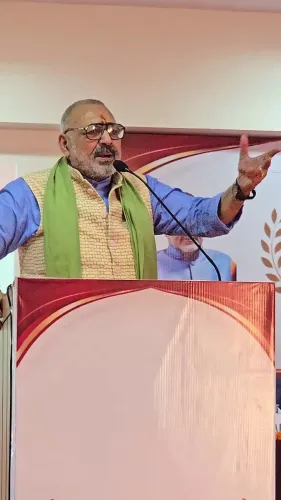
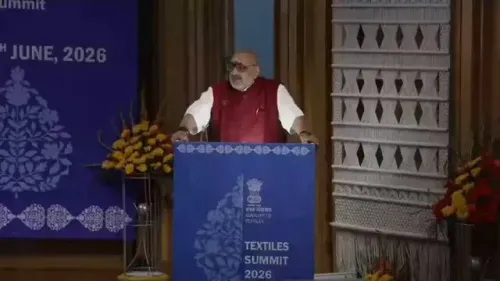
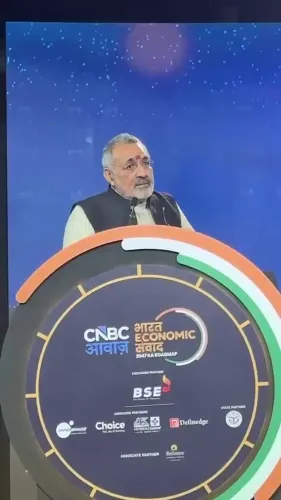
Union Textiles Minister Giriraj Singh on Thursday, June 25, 2026, called for coordinated action between the central and state governments to develop new champion districts and exporters, framing it as essential to reaching India's $100 billion textile and apparel export target. The minister made the appeal in a post on X, invoking the Viksit Bharat 2047 vision as the broader national framework for the sector's ambitions.
Context
Posting in Hindi, Giriraj Singh wrote that to take India's textile and apparel sector to a $100 billion export target, both the Centre and states must work together to build new champion districts and new exporters. 'प्रतिभा को अवसर, मार्गदर्शन और सही मंच मिले तो नए कीर्तिमान स्थापित होते हैं' — 'When talent gets opportunity, guidance, and the right platform, new records are set,' he wrote. He added that with shared effort, a clear roadmap, and strong resolve, India will achieve this goal and continue advancing as a global power.
The post carried hashtags including #TextileSector, #ViksitBharat2047, and #RisingIndia, signalling the government's intent to anchor sectoral ambitions within the larger national development narrative tied to the centenary of India's independence in 2047.
Policy Backdrop
The call comes against a well-established policy architecture aimed at boosting textile exports. The Production Linked Incentive (PLI) Scheme for Textiles, approved in 2021 with an outlay of Rs 10,683 crore, was designed to promote investment and manufacturing in man-made fibre and technical textiles. The scheme was a direct attempt to shift India's export mix toward higher-value segments.
Separately, the Rebate of State and Central Taxes and Levies (RoSCTL) scheme, introduced in 2019 and subsequently extended, has helped apparel and made-ups exporters remain price-competitive in global markets by reimbursing embedded taxes. Together, these instruments form the backbone of the Centre's export-promotion strategy for the sector.
The minister's emphasis on 'champion districts' echoes a model previously applied in agriculture and skill development, where district-level focus was used to decentralise growth beyond established industrial clusters. Extending this approach to textiles would mean identifying and nurturing export capacity in geographies currently outside the mainstream trade ecosystem.
Stakeholders and Impact
The constituencies most directly affected by the proposed push are textile exporters, MSME manufacturers, weavers and artisans, and state governments that host emerging textile clusters. For states, the champion-district model implies a role not just in infrastructure but in facilitating market linkages and skilling pipelines.
Textiles remain one of India's most employment-intensive sectors, and scaling exports to $100 billion would require significant expansion of the labour force engaged in production and finishing. The minister's framing — that talent needs opportunity, guidance, and the right platform — suggests the government sees human capital development as central to the export push, not just capital investment or incentive schemes.
The broader strategic context is Atmanirbhar Bharat and Make in India, both of which identify textiles as a priority for reducing import dependence and generating large-scale employment, particularly in semi-urban and rural districts.
What's Next
Observers will watch for formal announcements on the identification of new champion districts, any structured centre-state review mechanisms under the textiles ministry or NITI Aayog, and updates to the National Textile Policy. Quarterly trade data will be a key indicator of whether export momentum is building toward the stated target.
If the government moves from intent to institutional action — through dedicated export roadmaps, state-level partnerships, and district-specific support programmes — the $100 billion goal could shift from a headline ambition to a tracked policy deliverable with clear milestones.
Point of View
Implying that the next phase of textile export growth must come from second-tier clusters rather than established hubs like Surat or Tiruppur. Framing the goal within Viksit Bharat 2047 also serves a long-horizon political purpose, tying near-term sectoral policy to a national identity project that transcends electoral cycles. The real test will be whether this rhetoric translates into measurable institutional mechanisms — identified districts, state MOUs, and tracked export milestones.
NationPress
23 Sept 2026
Frequently Asked Questions
What is India's textile export target mentioned by Giriraj Singh?
Union Textiles Minister Giriraj Singh has referenced a target of $100 billion in textile and apparel exports, calling for Centre-state coordination to achieve it through new champion districts and exporters.
What are champion districts in the textile sector?
Champion districts are geographies identified by the government for focused support to develop export capacity in textiles, extending growth beyond established industrial clusters to newer, emerging regions.
What is the PLI Scheme for Textiles?
The Production Linked Incentive (PLI) Scheme for Textiles was approved in 2021 with a central outlay of Rs 10,683 crore to boost investment and manufacturing in man-made fibre and technical textiles, with a focus on increasing exports.
What is Viksit Bharat 2047 and how does it relate to textiles?
Viksit Bharat 2047 is the Government of India's vision to make India a developed nation by 2047 , the centenary of independence. The textiles sector's $100 billion export goal is being positioned as a contribution to this larger national development target.
What is the RoSCTL scheme for textile exporters?
The Rebate of State and Central Taxes and Levies (RoSCTL) scheme, introduced in 2019 and extended subsequently, reimburses embedded taxes for apparel and made-ups exporters to improve their price competitiveness in global markets.