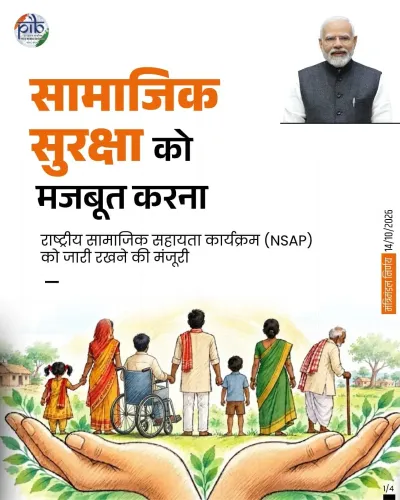
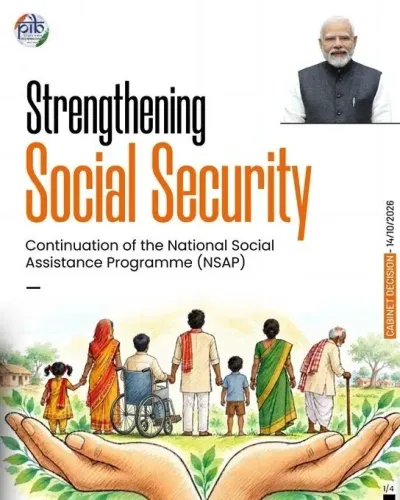
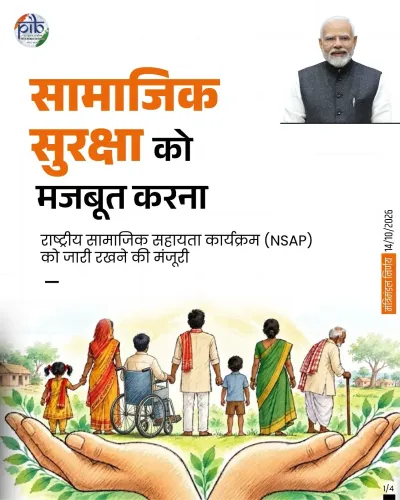
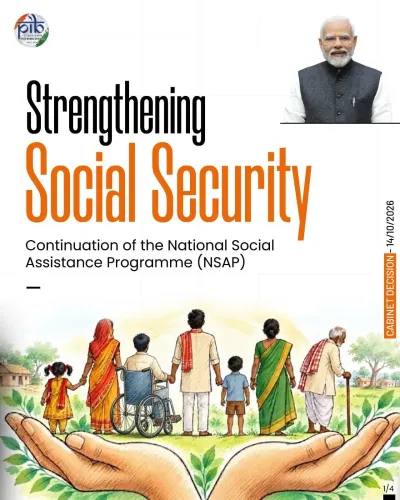
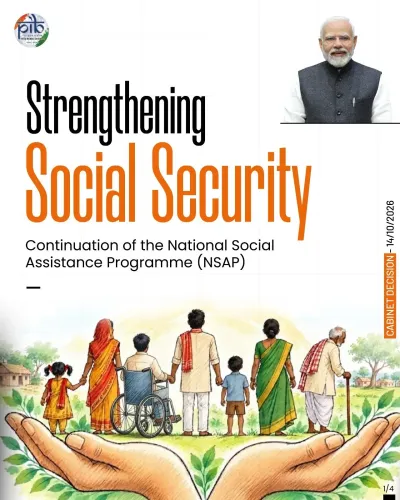
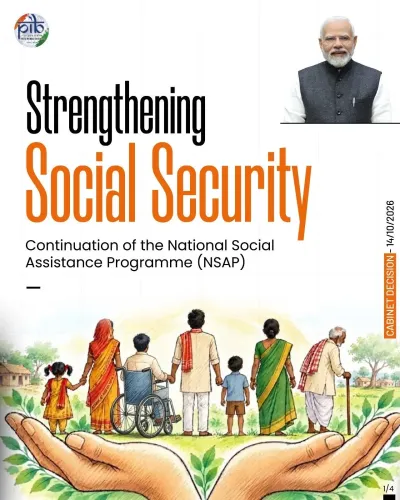
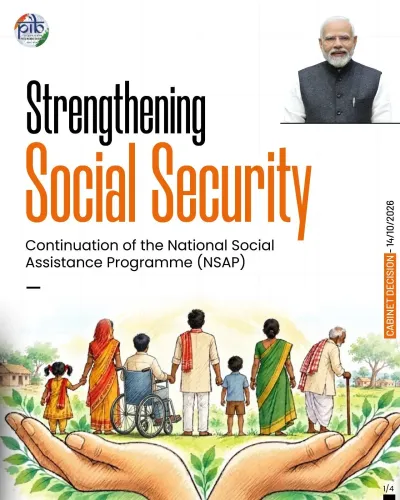
Cabinet Clears ₹53,428 Cr NSAP Extension for 3.20 Cr Beneficiaries
Synopsis
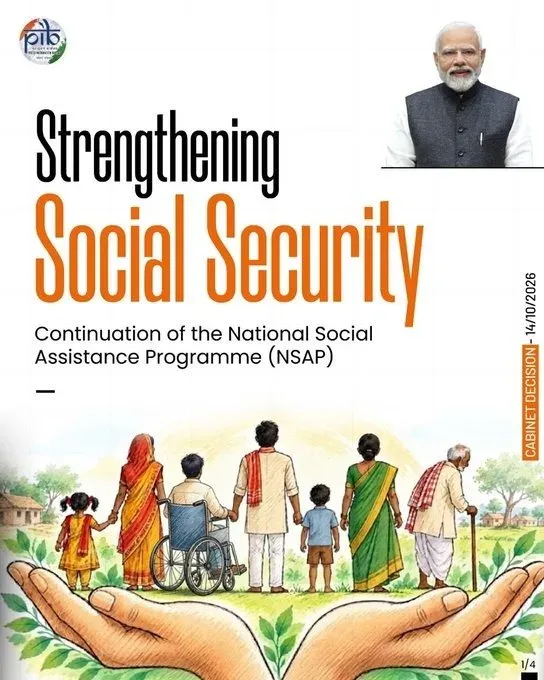
The Union Cabinet has approved a ₹53,428 crore extension of the National Social Assistance Programme for 2026-31, sustaining direct cash transfers to 3.20 crore elderly, widowed and disabled beneficiaries across all 36 Indian states and Union Territories.
Key Takeaways
The Union Cabinet approved continuation of the National Social Assistance Programme (NSAP) on 14 October 2026 .
Total outlay approved: ₹53,428 crore for the five-year period 2026-27 to 2030-31 .
The programme covers 3.20 crore beneficiaries — elderly persons, widows, and disabled individuals below the poverty line.
All 36 states and Union Territories are covered under the centrally sponsored, state-implemented scheme.
NSAP was originally launched in August 1995 and has been periodically extended by successive governments as a core social protection instrument.
Detailed implementation guidelines and state-wise allocations are expected ahead of the 2026-27 financial year .
India's most enduring cash-transfer safety net just got a five-year lease of life — and a serious infusion of funds. Union Consumer Affairs Minister Pralhad Joshi announced on Wednesday, 14 October 2026 that the Union Cabinet, chaired by Prime Minister Narendra Modi, has approved the continuation of the National Social Assistance Programme (NSAP) with a total outlay of ₹53,428 crore for the period 2026-27 to 2030-31, covering 3.20 crore beneficiaries across all 36 states and Union Territories.
What NSAP does — and who it reaches
Launched in August 1995 as a fully centrally funded scheme, NSAP was designed to provide a basic floor of social security to India's most vulnerable citizens: elderly persons below the poverty line, widows, and people with disabilities. The scheme delivers direct cash transfers routed through state governments, making it one of the oldest and most widely distributed social protection instruments in the country.
Three decades on, the architecture remains the same — a centrally sponsored model where the Union Government allocates funds and state governments handle last-mile delivery. The scale, however, keeps growing. The fresh five-year approval signals that the Cabinet sees NSAP not as a legacy programme winding down, but as active infrastructure for the country's social protection floor.
₹53,428 crore over five years: the weight of the number
The approved outlay works out to a sustained commitment across five consecutive Union Budgets. For 3.20 crore beneficiaries — elderly widows in rural Rajasthan, disabled individuals in Northeastern states, destitute seniors in urban slums — this translates into continued monthly cash support that, for millions, is the only formal income they receive.
The programme's reach spans every corner of the federal map: all 36 states and UTs are covered, meaning no administrative unit is excluded from implementation obligations. States will await detailed allocation orders and implementation guidelines from the nodal ministry ahead of the 2026-27 financial year.
A pattern of continuity — and why it matters now
Successive governments have treated periodic five-year extensions of NSAP as routine but essential. What the latest approval does is lock in spending commitments at a defined scale, giving state administrations the forward visibility they need to plan disbursement cycles, enrol new beneficiaries, and maintain existing transfer pipelines without gap-year uncertainty.
Minister Joshi framed the decision in terms of 'social security, inclusive welfare and support for vulnerable sections of society' — language that places NSAP squarely within the broader welfare narrative the current government has built around direct-benefit schemes. The Cabinet clearance also arrives as the government moves into the second half of its term, a period when social-spending decisions carry both policy and political weight.
For the 3.20 crore Indians at the receiving end, the arithmetic is simple: the cheques will keep coming. That, in the language of social policy, is a big deal.
Point of View
₹53,428 crore over five years, signals a deliberate elevation of the programme's footprint rather than a mere rollover. Locking in multi-year funding ahead of the 2026-27 Budget cycle gives state governments rare planning certainty on a scheme that serves citizens with no other formal income. Politically, the timing — mid-term for the current government — reinforces a direct-benefit, welfare-visible narrative that has become central to the BJP's electoral communication. The real test, as with every NSAP cycle, will be whether the state-level delivery machinery can convert the Centre's fiscal commitment into timely, leak-free transfers to the 3.20 crore people who depend on them.
NationPress
14 Oct 2026
Frequently Asked Questions
What is the National Social Assistance Programme (NSAP)?
NSAP is a centrally funded scheme launched in August 1995 that provides direct cash transfers — in the form of monthly pensions — to elderly persons, widows, and disabled individuals living below the poverty line. It is implemented through state governments across all 36 states and Union Territories.
How much money has been approved for NSAP and for how long?
The Union Cabinet has approved a total outlay of ₹53,428 crore for NSAP covering the five-year period from 2026-27 to 2030-31.
How many people benefit from NSAP?
The approved extension covers 3.20 crore beneficiaries spread across all 36 Indian states and Union Territories.
Who announced the NSAP Cabinet approval?
Union Minister Pralhad Joshi, who holds the Consumer Affairs, Food and Public Distribution portfolio, announced the Cabinet decision on X on 14 October 2026.
When will the new NSAP cycle begin and what happens next?
The new cycle begins with the 2026-27 financial year. The nodal ministry is expected to release detailed implementation guidelines and state-wise allocation orders ahead of the year's start.