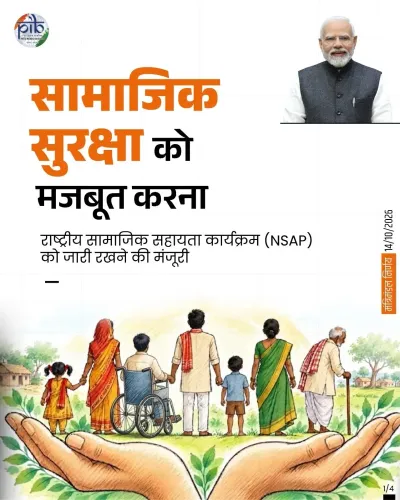
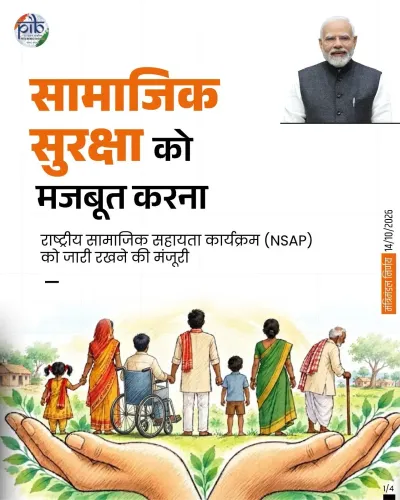
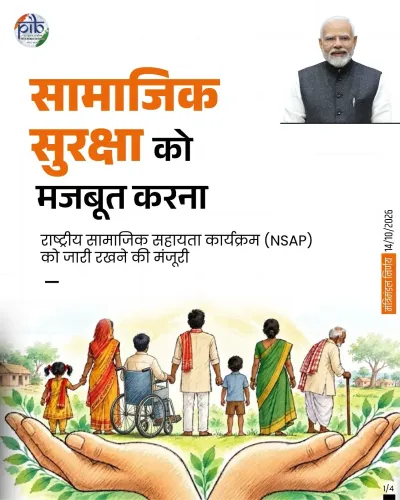
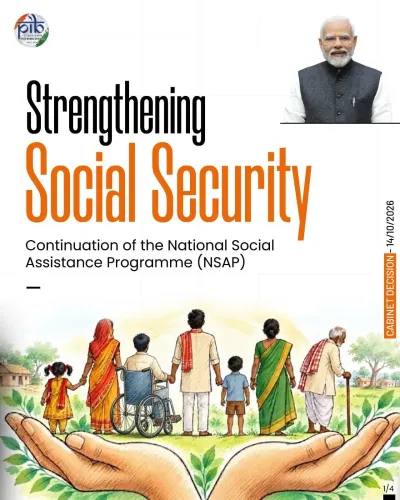
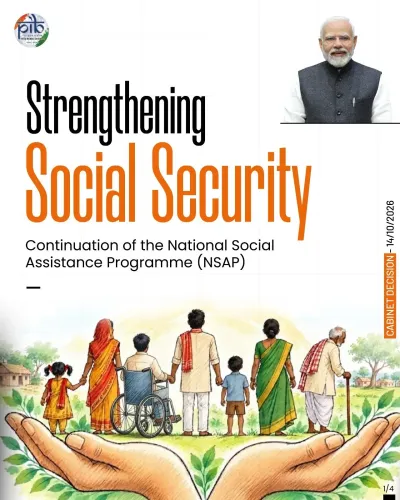
Cabinet Clears NSAP Continuation for 5 Years, ₹53,428 Cr Outlay
Synopsis
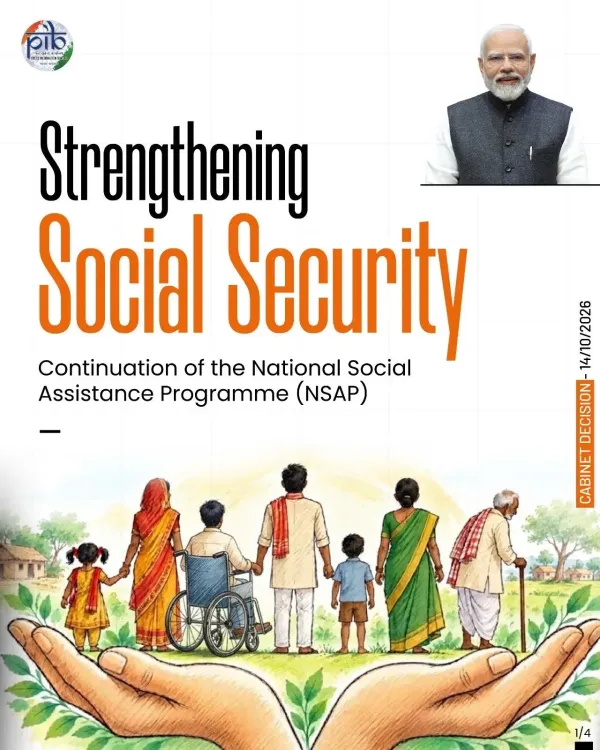
The Union Cabinet has approved continuation of the National Social Assistance Programme for 2026-31 with a ₹53,428 crore outlay, benefiting 3.20 crore vulnerable Indians across all 36 states and UTs, Union Minister Shivraj Singh Chouhan announced.
Key Takeaways
The Union Cabinet, under PM Narendra Modi , has approved continuation of NSAP for five years: 2026-27 to 2030-31 .
Total financial outlay approved: ₹53,428 crore .
Scheme covers 3.20 crore beneficiaries across 36 states and Union Territories .
NSAP was originally launched in August 1995 and provides monthly pensions to elderly, widows, and persons with disabilities from BPL families.
The five-year block approval ensures uninterrupted pension disbursements without a funding gap between cycles.
State-level fund releases and beneficiary verification drives will be the next key implementation steps ahead of the April 2026 rollout.
Over 3.20 crore elderly citizens, widows, and persons with disabilities across India are set to keep receiving monthly pension support after the Union Cabinet, under Prime Minister Narendra Modi, approved the continuation of the National Social Assistance Programme (NSAP) for the next five years — from 2026-27 to 2030-31 — with a total outlay of ₹53,428 crore. Union Agriculture Minister Shivraj Singh Chouhan announced the decision on Wednesday, October 14, 2026.
Posting in Hindi on X, Chouhan welcomed the approval: 'यह पहल जरूरतमंदों को सामाजिक सुरक्षा और आर्थिक संबल प्रदान करने में सहायक होगी' — 'This initiative will help provide social security and economic support to the needy.' The coverage spans all 36 states and Union Territories.
What NSAP actually does — and who it reaches
Launched in August 1995, NSAP is one of India's oldest centrally sponsored welfare schemes. It delivers monthly pensions and lump-sum assistance to the most economically vulnerable — those living below the poverty line — through four primary components targeting the aged, widows, the disabled, and families of the deceased.
The programme is not a new design; it is a tried and tested pipeline. Funding flows from the Centre to states, which then disburse benefits down to individual beneficiaries. That architecture means the cabinet's periodic renewal is the critical moment — without it, payments stall across the country's most fragile households.
Five-year approval keeps payments uninterrupted
Cabinet approvals for NSAP come in multi-year cycles, and this five-year block covering 2026-31 follows the same pattern successive governments have used to ensure continuity without redesigning the scheme from scratch. The ₹53,428 crore envelope locks in funding certainty for all 36 states and Union Territories — removing any gap in coverage between the end of the previous cycle and the next Union Budget.
What to watch next: state-level fund-release orders and beneficiary re-verification drives will determine how smoothly the new cycle rolls out from April 2026. Parliamentary scrutiny during the winter session could also probe utilisation rates from the last approval period.
For tens of millions of Indians who have no other income safety net, this cabinet signature is not a bureaucratic formality. It is next month's pension.
Point of View
Named benefit rather than an abstract entitlement. By securing a five-year block well in advance of the cycle's expiry, the government avoids any optics of a lapse in payments to the poorest households, a politically sensitive risk. At roughly ₹53,428 crore over five years, the outlay signals fiscal commitment but also invites scrutiny: pension amounts under NSAP have historically been modest, and advocacy groups have long pushed for inflation-linked revisions. Whether this renewal comes with any enhancement to monthly pension amounts — or simply rolls over existing rates — will be the real test of the scheme's evolving ambition.
NationPress
14 Oct 2026
Frequently Asked Questions
What is NSAP and who benefits from it?
NSAP, the National Social Assistance Programme, is a centrally sponsored scheme launched in August 1995 that provides monthly pensions and lump-sum assistance to elderly citizens, widows, and persons with disabilities living below the poverty line across India.
How much money has the government approved for NSAP 2026-31?
The Union Cabinet has approved a total outlay of ₹53,428 crore for NSAP covering the five-year period from 2026-27 to 2030-31.
How many people will benefit from the renewed NSAP?
Approximately 3.20 crore beneficiaries spread across all 36 states and Union Territories of India will benefit from the renewed NSAP.
Who announced the NSAP cabinet approval?
Union Agriculture and Rural Development Minister Shivraj Singh Chouhan announced the cabinet decision on X on October 14, 2026, crediting Prime Minister Narendra Modi's leadership for the approval.
When will the new NSAP cycle begin?
The new NSAP cycle is set to begin in the financial year 2026-27, starting April 2026, and will run through 2030-31.