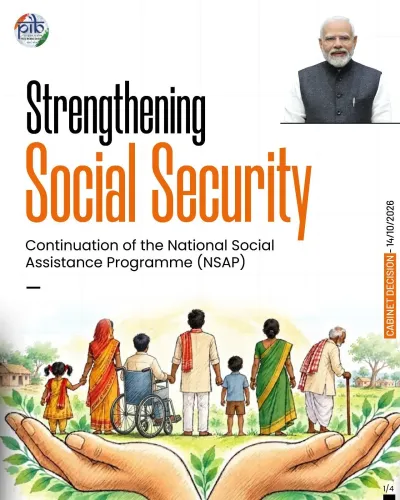
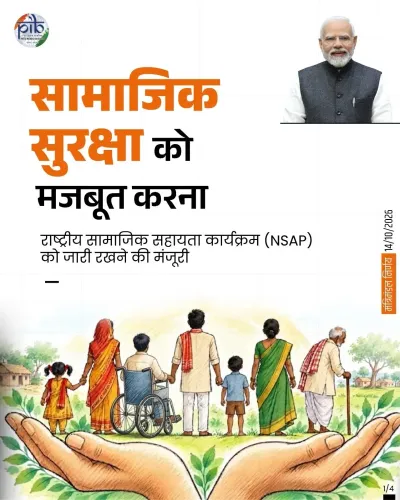
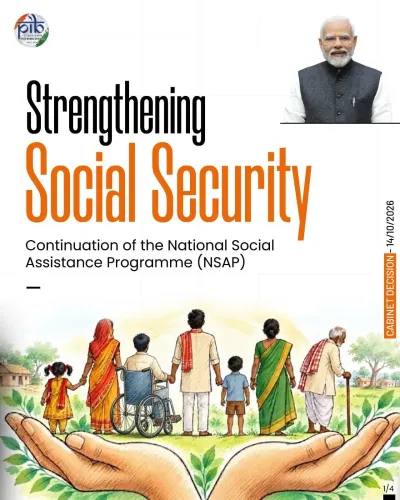
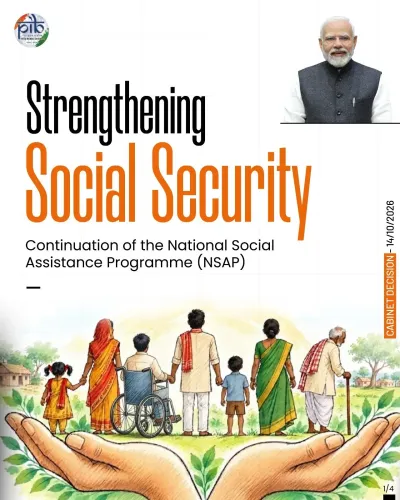
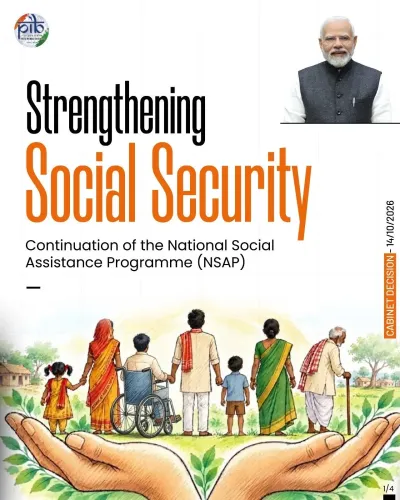
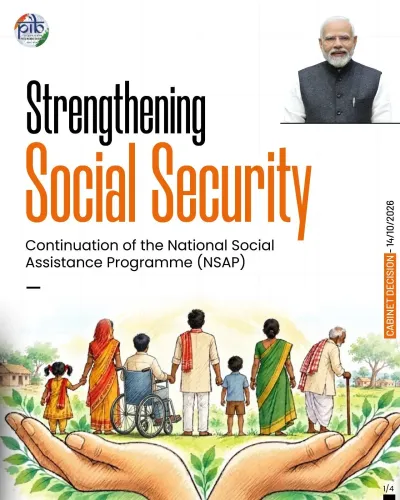
Cabinet clears NSAP extension for 5 years, ₹53,428 cr outlay
Synopsis
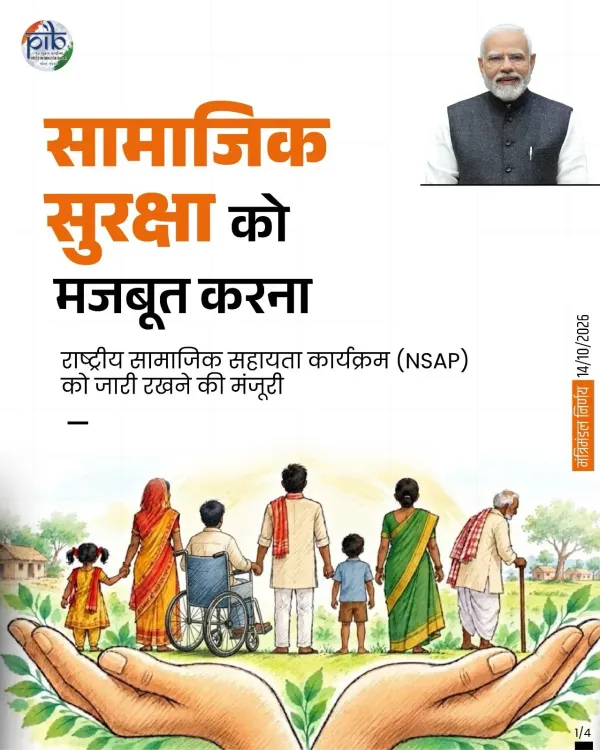
The Union Cabinet has extended the National Social Assistance Programme for five years from 2026-27 to 2030-31 with an outlay of ₹53,428 crore, benefiting around 3.20 crore BPL elderly, widow, and disabled pensioners across all 36 states and union territories.
Key Takeaways
The Union Cabinet has approved the continuation of NSAP for five years: 2026-27 to 2030-31 .
Total outlay approved: ₹53,428 crore for the five-year period.
Approximately 3.20 crore beneficiaries across all 36 states and union territories will be covered.
NSAP is a non-contributory centrally sponsored scheme providing old-age, widow, and disability pensions to BPL households, launched in August 1995 .
Union Minister Gajendra Singh Shekhawat announced the decision, framing it as aligned with PM Narendra Modi 's vision of a more secure, dignified life for the poor.
Key watch points include state-wise fund releases and any revision in monthly pension amounts during the new cycle.
India's most enduring social-security safety net just got a fresh five-year lease — and a six-digit crore price tag to back it. The Union Cabinet has approved the continuation of the National Social Assistance Programme (NSAP) for the period 2026-27 to 2030-31, committing ₹53,428 crore to keep pension support flowing to the country's most vulnerable households.
Union Culture and Tourism Minister Gajendra Singh Shekhawat shared the decision on Wednesday, 14 October 2026, noting that roughly 3.20 crore beneficiaries spread across all 36 states and union territories will continue to receive direct assistance under the programme — pensions that arrive every month in the hands of elderly citizens, widows, and persons with disabilities living below the poverty line.
Thirty years of non-contributory pensions — and counting
NSAP was first launched in August 1995, making it one of India's oldest centrally sponsored welfare programmes. The scheme is non-contributory by design — beneficiaries pay nothing into it. Funds flow from the Centre through state governments directly to BPL households in three streams: old-age pensions, widow pensions, and disability pensions.
Successive governments have maintained the programme through periodic extensions, adjusting coverage and budgetary allocations along the way. The new five-year sanction keeps that unbroken chain intact, now stretching into the 2030-31 fiscal year — a milestone that will mark more than three-and-a-half decades of continuous operation.
₹53,428 crore and 3.20 crore lives
The approved outlay of ₹53,428 crore over five years works out to roughly ₹10,685 crore per year — a significant but steady commitment in the Union's social-sector spending architecture. The beneficiary base of 3.20 crore spans every corner of the country, from the Himalayan states to the island territories, with state governments acting as the delivery pipeline.
Shekhawat framed the renewal as consistent with Prime Minister Narendra Modi's vision of providing social security to the economically weaker sections and ensuring a life that is, in his words, 'adhik surakshit aur sammanjanaka' — more secure and more dignified. The watch now shifts to whether the coming years will bring an upward revision in the monthly pension amounts themselves, which welfare advocates have long argued lag behind the actual cost of living.
For 3.20 crore Indians who depend on NSAP not as a benefit but as a lifeline, that question will define whether the programme's next chapter truly earns the word 'dignified'.
Point of View
That gap between sanctioned outlay and actual per-beneficiary transfer will be the line of attack through the 2029 electoral cycle.
NationPress
14 Oct 2026
Frequently Asked Questions
What is the National Social Assistance Programme (NSAP)?
NSAP is a centrally sponsored, non-contributory social-security scheme launched in August 1995 that provides monthly pensions to below-poverty-line elderly persons, widows, and people with disabilities across India.
How much has the government approved for NSAP from 2026 to 2031?
The Union Cabinet has approved an outlay of ₹53,428 crore for the National Social Assistance Programme for the five-year period from 2026-27 to 2030-31.
How many people benefit from NSAP?
Approximately 3.20 crore beneficiaries across all 36 states and union territories of India receive assistance under NSAP.
Who is eligible for NSAP pensions?
Persons from below-poverty-line households who are elderly (old-age pension), widows (widow pension), or have disabilities (disability pension) are eligible for assistance under NSAP.
Will pension amounts increase under the renewed NSAP?
The cabinet approval confirmed the programme's continuation and total outlay, but any upward revision in monthly pension amounts during the 2026-31 cycle has not yet been announced and will be a key factor to watch.