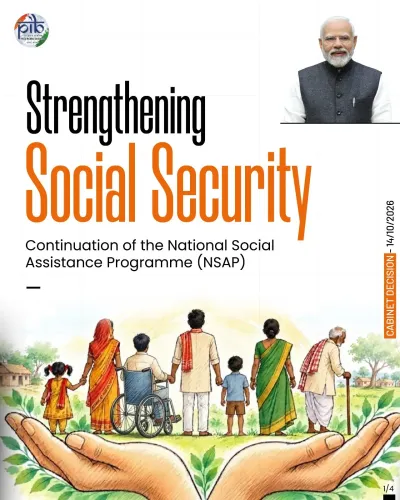
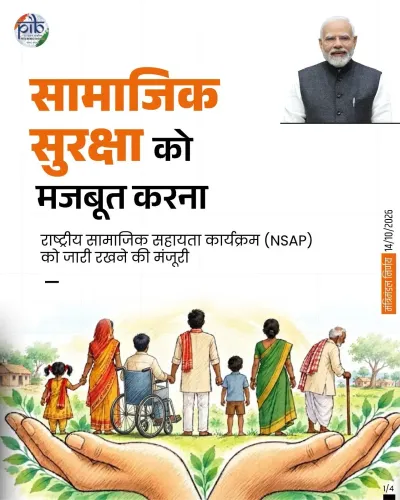
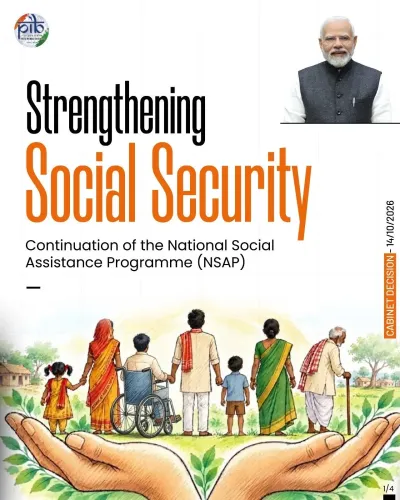
Cabinet Extends NSAP Welfare Scheme Till 2030-31, Covers 3.20 Cr Beneficiaries
Synopsis
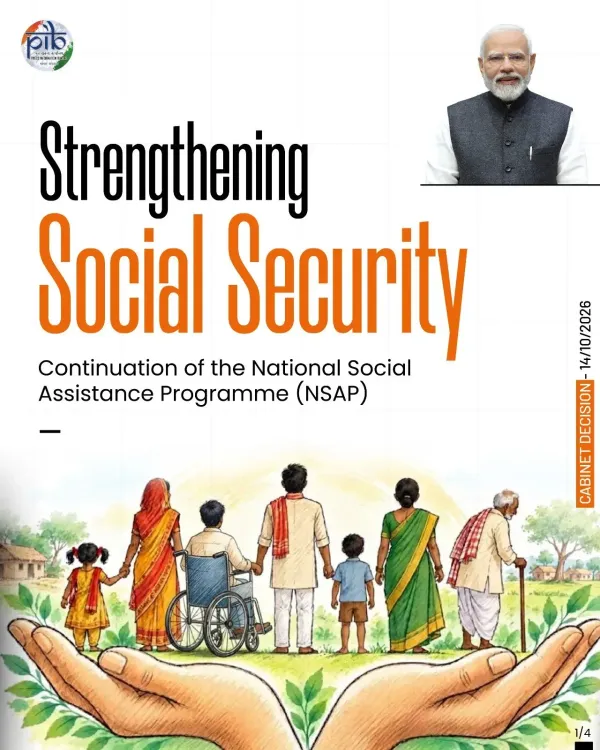
The Union Cabinet has approved the continuation of the National Social Assistance Programme (NSAP) for 2026-27 to 2030-31, reaching 3.20 crore elderly, widow and disabled beneficiaries across all 36 states and Union Territories of India.
Key Takeaways
The Union Cabinet approved the continuation of NSAP for the five-year period 2026-27 to 2030-31 .
The scheme will benefit 3.20 crore beneficiaries across all 36 states and Union Territories .
NSAP was originally launched in August 1995 to provide social pensions to the elderly, widows, and persons with disabilities.
The extension follows the government's practice of renewing the scheme in five-year cycles.
The decision is framed under the Antyodaya philosophy of reaching the last person in society.
Budget allocations and state-level implementation guidelines for the new phase are awaited.
A welfare net that has kept millions of India's most vulnerable citizens from falling through the cracks just got five more years of life. The Union Cabinet has approved the continuation of the National Social Assistance Programme (NSAP) for the period 2026-27 to 2030-31, covering 3.20 crore beneficiaries across all 36 states and Union Territories — Union Petroleum Minister Hardeep Singh Puri announced the decision on Wednesday, October 14, 2026.
Posting in Hindi, Puri described the decision as an embodiment of the Antyodaya philosophy — the idea that governance must reach the very last person in society. 'The Modi government's decision advances the spirit of Antyodaya — extending assistance and dignity to the person standing on the last rung of society,' he wrote, adding the hashtag #CabinetDecisions.
What NSAP Does — and Who It Serves
Launched in August 1995, the National Social Assistance Programme is a centrally sponsored scheme that delivers direct pension support to three categories of people with the least cushion against hardship: the elderly, widows, and persons with disabilities. It operates as a floor-level income guarantee for those who have no formal employment history or family support to fall back on.
The scheme functions through direct cash transfers, channelled to beneficiaries in every corner of the country. Its reach across all 36 states and UTs makes it one of the broadest social-pension delivery mechanisms in the country's welfare architecture.
A Five-Year Cycle, Renewed Again
The Cabinet's approval follows a well-established pattern: NSAP has historically been extended in five-year tranches, aligned with India's Plan or budget-cycle frameworks. The current extension carries the programme through the next half-decade, providing continuity of support to its existing beneficiary base while allowing states to plan implementation without disruption.
The Antyodaya framing — drawn from Deendayal Upadhyaya's philosophy of prioritising the weakest — has been a recurring ideological anchor for the Modi government's welfare messaging since 2014, applied to schemes ranging from food security to housing and now reaffirmed in social pensions.
Budget Allocations and State Guidelines: The Work Ahead
The headline approval is one step. What follows — the actual budget provisioning for each of the five years, and the implementation guidelines issued to states — will determine how effectively the expanded mandate translates into rupees reaching beneficiaries. Both will be watched closely as the Union Budget cycle for 2027-28 and beyond takes shape.
For 3.20 crore elderly, widowed, and disabled Indians, the Cabinet's green light means the monthly pension does not stop when the current phase expires. That is not a small thing.
Point of View
High optics value — that the Modi government has deployed consistently since 2014 to reinforce its Antyodaya welfare brand ahead of budget cycles. The five-year extension signals administrative intent but stops short of expanding coverage or raising pension amounts, which critics of the programme have long argued are inadequate in real terms. Extending an existing scheme is politically safer than redesigning it, and the framing around 'dignity for the last person' allows the government to project moral seriousness without committing to structural reforms in the social security floor. The real test will be in the annual budget allocations that follow.
NationPress
14 Oct 2026
Frequently Asked Questions
What is the National Social Assistance Programme (NSAP)?
NSAP is a centrally sponsored scheme launched in August 1995 that provides direct pension support to elderly citizens, widows, and persons with disabilities who have no significant income or family support.
How long has the NSAP been extended?
The Union Cabinet has approved a five-year extension of NSAP, continuing the scheme from 2026-27 through 2030-31.
How many people benefit from NSAP?
According to the Cabinet decision announced on October 14, 2026, approximately 3.20 crore beneficiaries across all 36 states and Union Territories will benefit from the programme.
What is the Antyodaya philosophy mentioned in connection with NSAP?
Antyodaya, rooted in the thought of Deendayal Upadhyaya, means prioritising the welfare of the very last and most marginalised person in society. The Modi government has repeatedly used this framework to describe its welfare-delivery approach.
Who is eligible for benefits under NSAP?
NSAP covers three groups: elderly citizens, widows, and persons with disabilities — particularly those who lack formal employment histories or other income support.