CM Saini Backs Stand-Up India Extension to 2031
Synopsis
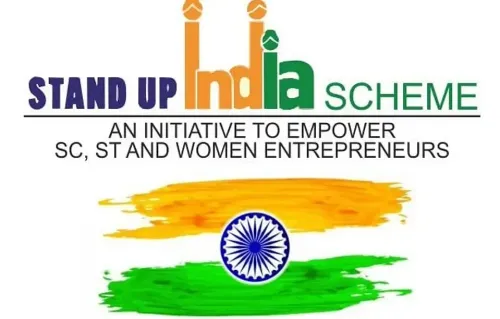
The Union Cabinet has approved a five-year extension of the Stand-Up India scheme to 31 March 2031, targeting 2.5 lakh additional SC/ST and women entrepreneurs with bank loans. Haryana CM Nayab Singh Saini credited PM Modi for the decision.
Key Takeaways
The Union Cabinet approved the continuation of Stand-Up India until 31 March 2031 — a five-year extension.
The scheme targets 2.5 lakh additional entrepreneurs from SC, ST, and women communities over the next five years.
Stand-Up India provides bank loans of Rs 10 lakh to Rs 1 crore for greenfield enterprises in manufacturing, services, or trading.
The scheme was originally launched on 5 April 2016 by the Modi government to promote financial inclusion among underrepresented groups.
Haryana CM Nayab Singh Saini thanked PM Narendra Modi for the extension, highlighting job creation and economic self-reliance as key goals.
Stand-Up India operates alongside Mudra Yojana as part of a layered credit framework for first-time entrepreneurs.
A decade after it first opened bank doors for India's most underserved entrepreneurs, the Stand-Up India scheme is getting five more years — and a fresh mandate to reach 2.5 lakh additional beneficiaries by 31 March 2031. Haryana Chief Minister Nayab Singh Saini welcomed the Union Cabinet's decision on Wednesday, 11 November 2026, crediting Prime Minister Narendra Modi for the extension and calling it a vital step toward economic self-reliance for women, Scheduled Caste, and Scheduled Tribe entrepreneurs.
Posting in Hindi, CM Saini wrote: 'Kendriya mantrimandal ne Stand-Up India yojana ko 31 March 2031 tak... jaari rakhne ki manzuri di hai' — 'The Union Cabinet has approved the continuation of the Stand-Up India scheme until 31 March 2031 for the next five years.' He thanked PM Modi 'wholeheartedly' for the decision and outlined the scheme's renewed promise: bank loans, new enterprises, jobs, and financial independence.
What Stand-Up India Actually Does — and Who It Reaches
Launched on 5 April 2016, Stand-Up India was designed with a precise, structural logic: at least one woman borrower and one SC or ST borrower at every scheduled commercial bank branch in the country, each eligible for a loan between Rs 10 lakh and Rs 1 crore to set up a greenfield enterprise in manufacturing, services, or trading. The scheme does not scatter credit broadly — it channels it deliberately, to first-time entrepreneurs from communities that have historically had the least access to formal finance.
The extended scheme targets 2.5 lakh additional entrepreneurs over the next five years. That is not just a headline number — it represents bank relationships, collateral frameworks, and business registrations that many in these communities would otherwise never navigate alone.
Where Stand-Up India Sits in India's Credit Architecture
Stand-Up India does not operate in isolation. It sits alongside Pradhan Mantri Mudra Yojana and a wider financial-inclusion architecture that the central government has built since 2014 — each scheme targeting a distinct band of borrowers. Mudra covers micro-loans for the smallest businesses; Stand-Up India focuses specifically on SC, ST, and women entrepreneurs starting larger greenfield ventures. Together, they form a layered credit ladder for underrepresented communities.
The continuation signals that the government views targeted credit — not just generic loan-mela outreach — as the instrument of choice for closing structural gaps in entrepreneurship. The real test, as always, will be in the disbursement data: how many of the targeted 2.5 lakh loans are actually sanctioned, and to whom, before 2031.
Point of View
Identity-targeted credit is more effective than broad-based loan outreach for closing entrepreneurship gaps among SC, ST, and women communities. By committing to 2.5 lakh additional beneficiaries by 2031, the government is essentially stress-testing that thesis with a measurable outcome. For CM Saini, amplifying this announcement from Haryana — a state with a significant SC population — carries obvious political resonance ahead of future election cycles. The harder question is implementation: loan sanction rates and enterprise survival data will ultimately determine whether the scheme's renewed mandate delivers structural change or remains a well-intentioned credit window.
NationPress
11 Nov 2026
Frequently Asked Questions
What is the Stand-Up India scheme?
Stand-Up India is a central government scheme launched on 5 April 2016 that provides bank loans between Rs 10 lakh and Rs 1 crore to SC/ST and women entrepreneurs for setting up greenfield enterprises in manufacturing, services, or trading.
How long has Stand-Up India been extended?
The Union Cabinet approved a five-year extension of the Stand-Up India scheme, continuing it until 31 March 2031.
How many entrepreneurs will benefit from the Stand-Up India extension?
The extended scheme aims to provide financial support to 2.5 lakh additional entrepreneurs over the next five years, up to 2031.
Who is eligible for a loan under Stand-Up India?
Women entrepreneurs and entrepreneurs from Scheduled Caste or Scheduled Tribe communities who want to start a greenfield enterprise are eligible for loans under the Stand-Up India scheme.
What did Haryana CM Nayab Singh Saini say about the Stand-Up India extension?
CM Nayab Singh Saini welcomed the Union Cabinet's decision and thanked PM Narendra Modi, saying the scheme will help SC/ST and women entrepreneurs access bank loans, start businesses, create jobs, and achieve economic self-reliance.