CM Sukhu opens 40-bed de-addiction centre at Tanda Medical College
Synopsis
Chief Minister Sukhvinder Singh Sukhu has announced a 40-bed de-addiction and rehabilitation centre at Tanda Medical College in Kangra, Himachal Pradesh, offering specialist inpatient care to people battling substance dependence and aiming to reintegrate them into mainstream society.
Key Takeaways
A 40-bed de-addiction and rehabilitation centre has been established at Dr.
Rajendra Prasad Government Medical College, Tanda in Kangra district.
CM Sukhvinder Singh Sukhu announced the facility on 11 November 2026 , emphasising specialist care and advanced medical infrastructure.
The centre will help people with substance use disorders reconnect with mainstream society through structured inpatient treatment.
Embedding the facility within a medical college campus ensures access to multidisciplinary clinical support — psychiatrists, physicians, and counsellors — in one location.
The initiative aligns with the Centre's National Action Plan for Drug Demand Reduction (NAPDDR) framework, which has supported similar state-level facilities since 2014.
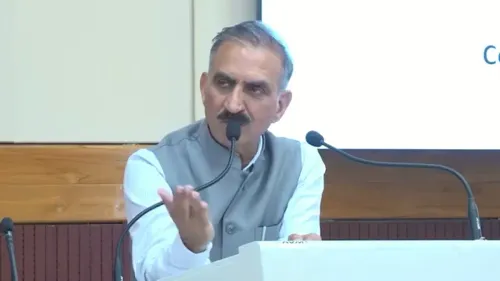
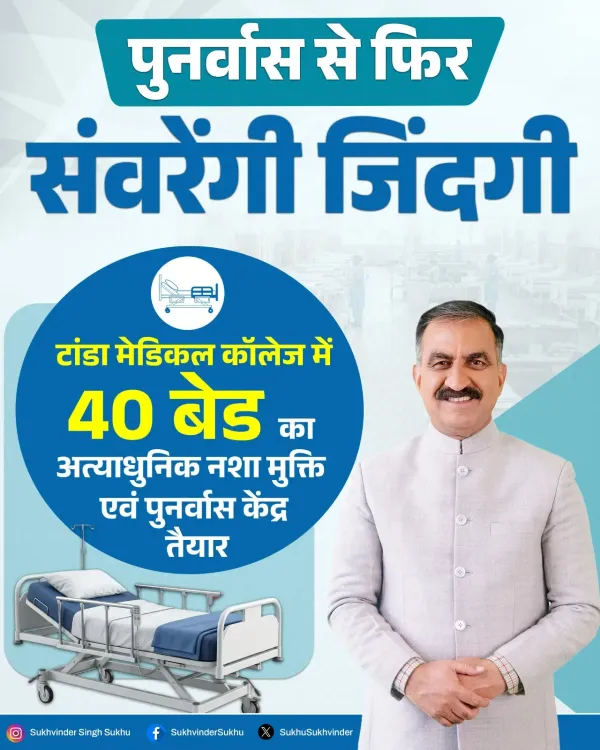
A 40-bed state-of-the-art de-addiction and rehabilitation centre is now ready at Dr. Rajendra Prasad Government Medical College, Tanda — giving Himachal Pradesh its most equipped public-sector facility yet for treating substance dependence. Himachal Pradesh Chief Minister Sukhvinder Singh Sukhu announced the development on Wednesday, 11 November 2026, framing it as a government commitment to returning people trapped by addiction to the mainstream of society.
Posting in Hindi, CM Sukhu said: 'नशे की गिरफ्त में फंसे लोगों को बेहतर भविष्य देने के लिए हमारी सरकार ने टांडा मेडिकल कॉलेज में 40 बिस्तर का अत्याधुनिक नशामुक्ति एवं पुनर्वास केंद्र तैयार किया है।' ('To give a better future to people caught in the grip of addiction, our government has prepared a 40-bed state-of-the-art de-addiction and rehabilitation centre at Tanda Medical College.') The centre, he added, will help those battling addiction reconnect with the mainstream through advanced medical facilities and specialist care.
Why Tanda Medical College, and why now
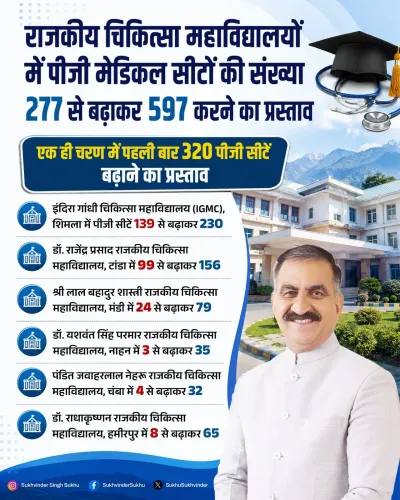
Tanda Medical College — formally Dr. Rajendra Prasad Government Medical College in Kangra district — is Himachal Pradesh's principal hub for tertiary government healthcare and specialist training. Embedding a de-addiction facility within an existing medical college campus is a deliberate public-health strategy: it anchors rehabilitation inside a full-service clinical environment rather than an isolated centre, giving patients access to psychiatrists, physicians, and counsellors under one roof. The model is gaining traction across northern India, where state governments have increasingly co-located substance-abuse treatment with established medical college infrastructure.
Himachal Pradesh sits in a region where drug dependence has drawn sustained official concern. Northern states have faced documented pressures from both pharmaceutical misuse and trafficking routes, pushing health departments to move beyond awareness campaigns toward structured inpatient care. A 40-bed inpatient capacity — with specialist oversight — represents a meaningful upgrade from the patchwork of outpatient counselling services that have historically been the first resort for families seeking help.
NAPDDR and the national framework behind state action
The Centre's National Action Plan for Drug Demand Reduction (NAPDDR), operated by the Ministry of Social Justice and Empowerment, has since 2014 channelled funds to states for exactly this kind of infrastructure — integrated de-addiction and rehabilitation services within government health facilities. Himachal Pradesh's Tanda project fits squarely within that national architecture, though specific funding details for this centre have not been officially confirmed.
What the Sukhu government is signalling here is as much political as it is clinical: health investment that is visible, verifiable, and rooted in a district hospital that ordinary families already trust. For the Congress-led state administration, a finished facility speaks louder than a policy paper. The real test now is speed of operationalisation — how quickly beds fill, staff are posted, and the first patients complete treatment and return home.
Point of View
The Sukhu administration is following a clinically sound and politically savvy model — one that maximises specialist overlap while lending the initiative the institutional credibility of a trusted district hospital. This move also slots neatly into the Congress government's broader effort to highlight tangible welfare deliverables ahead of any electoral cycle. The northern Indian drug crisis has long demanded a public-health response rather than a purely law-enforcement one; a 40-bed inpatient unit with specialist care is a step in that direction, though scale and sustained staffing will determine whether it becomes a model or a footnote.
NationPress
11 Nov 2026
Frequently Asked Questions
Where is the new de-addiction centre in Himachal Pradesh located?
The centre is located at Dr. Rajendra Prasad Government Medical College (Tanda Medical College) in Kangra district, Himachal Pradesh.
How many beds does the Tanda de-addiction centre have?
The facility has 40 beds and is described as a state-of-the-art de-addiction and rehabilitation centre offering advanced medical facilities and specialist care.
Who announced the Tanda Medical College de-addiction centre?
Himachal Pradesh Chief Minister Sukhvinder Singh Sukhu announced the centre on 11 November 2026 through a post on X.
What is NAPDDR and how does it relate to this facility?
The National Action Plan for Drug Demand Reduction (NAPDDR), run by the Ministry of Social Justice and Empowerment, has since 2014 supported states in setting up de-addiction centres; the Tanda facility aligns with this national framework.
Why is the de-addiction centre placed inside a medical college?
Co-locating the centre within Tanda Medical College gives patients access to multidisciplinary specialists — psychiatrists, physicians, and counsellors — in one institution, rather than relying on an isolated standalone facility.