Kishan Reddy: Cabinet okays ₹1,491 cr postal modernisation
Synopsis
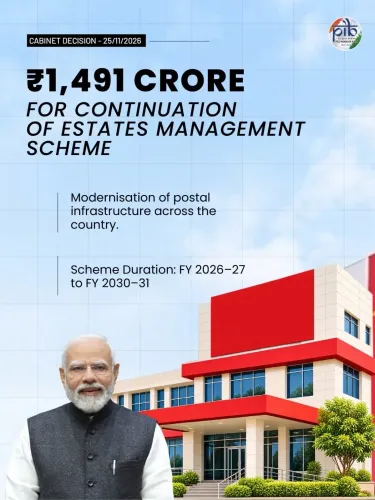
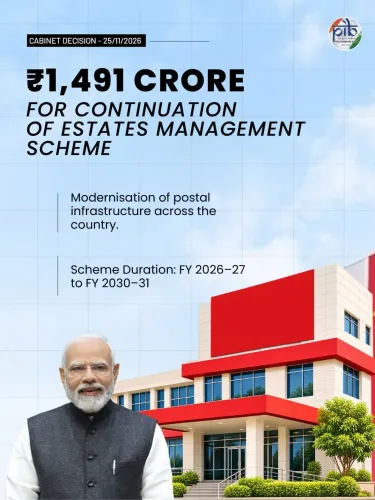
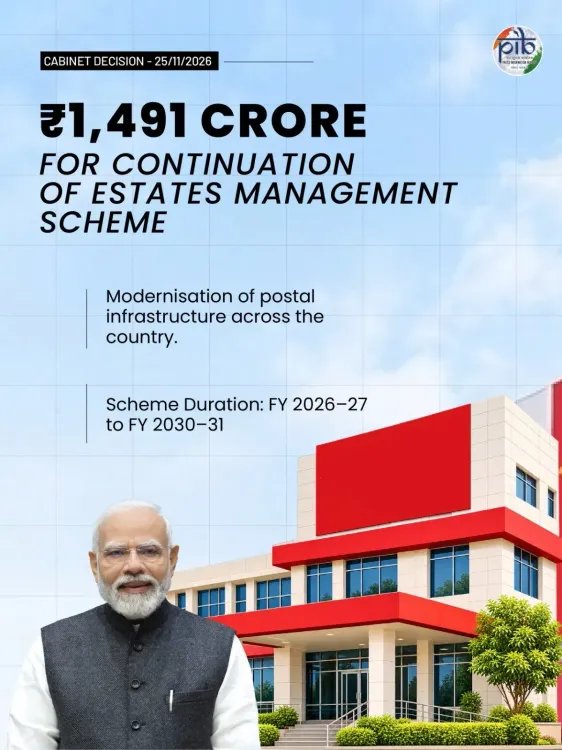
Union Coal and Mines Minister G. Kishan Reddy said the Cabinet, chaired by PM Narendra Modi, approved continuing the Estates Management Scheme for the Department of Posts from FY 2026-27 to FY 2030-31 with a ₹1,491 crore outlay for buildings, renovations and a Bengaluru CEPT.
Key Takeaways
Union Coal and Mines Minister G.
Kishan Reddy announced Cabinet approval to continue the Estates Management Scheme for the Department of Posts.
The period he cited is FY 2026-27 to FY 2030-31, with an outlay of ₹1,491 crore.
Works listed: 190 new postal buildings, reconstruction of 50, renovation and branding of 5,050 post offices.
20 heritage postal buildings to be preserved and 150 colonies to be revamped.
A permanent Centre for Excellence in Postal Technology is planned in Bengaluru.
The Cabinet was chaired by Prime Minister Narendra Modi, according to the post.
India's post offices are being promised a five-year physical reset. Union Coal and Mines Minister G. Kishan Reddy said on 25 November 2026 that the Union Cabinet, chaired by Prime Minister Narendra Modi, has approved continuation of the Estates Management Scheme for the Department of Posts from FY 2026-27 to FY 2030-31, with an outlay of ₹1,491 crore.
Reddy called it a major boost to modernise India Post infrastructure. In his post he said the scheme aims to modernise postal infrastructure, enhance citizen-centric delivery, and boost financial inclusion nationwide.
The works he listed are specific. New construction of 190 postal buildings. Reconstruction of 50. Renovation and uniform branding of 5,050 post offices. Preservation of 20 heritage postal buildings. A revamp of 150 colonies. And a new permanent Centre for Excellence in Postal Technology, or CEPT, in Bengaluru.
190 new buildings, 5,050 offices to be rebranded
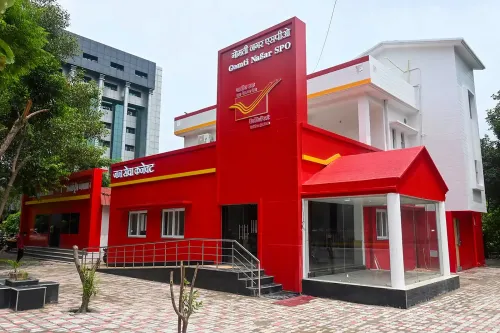
The renovation number is what will show up on the street. 5,050 post offices, if the plan is executed, would mean a nationwide wave of counters, facades and uniform branding across the last-mile state.
Postal users and rural citizens still walk into those buildings for savings accounts, pensions and government transfers. Reddy framed the estates work as citizen-centric delivery, not only civil works.
Bengaluru to host permanent CEPT campus
The technology piece is parked in Bengaluru. A permanent CEPT is meant to sit at the junction of postal operations and digital tools — the same logic that has run through Digital India since 2015, when the flagship programme treated government service points as both physical and digital.
Reddy tied the Cabinet nod to accelerating Digital India, Atmanirbhar Bharat and Viksit Bharat. The estates scheme is the brick layer under that slogan stack.
The FY 2026-27 to 2030-31 construction window
The continuation covers five financial years. Construction of 190 new buildings and reconstruction of 50 will be the visible test of whether the ₹1,491 crore outlay, as announced by Reddy, actually lands in towns and tehsils.
Heritage work on 20 postal buildings and the revamp of 150 colonies speak to staff housing and the older architectural stock of India Post — a network that still carries last-mile financial inclusion where bank branches thin out.
Watchpoints are utilisation: how fast renovations start, when Bengaluru's permanent CEPT is ready, and whether financial-inclusion counters feel the upgrade. The announcement is the start of a five-year build, not the finish.
If the buildings catch up with the digital brief, India Post's next chapter will be counted in renovated counters as much as in parcels.
Point of View
Launched in 2015, treated the post office as both a digital node and a physical last-mile. Successive central efforts have tried to keep that dual identity: counters for savings and subsidies, wires for e-governance. An estates outlay of this scale is a bet that bricks still matter when inclusion is the metric. The test is execution between 2026 and 2031, not the announcement.
NationPress
25 Nov 2026
Frequently Asked Questions
What did the Union Cabinet approve for India Post?
Union Coal and Mines Minister G. Kishan Reddy said the Cabinet approved continuation of the Estates Management Scheme for the Department of Posts from FY 2026-27 to FY 2030-31. He put the outlay at ₹1,491 crore for modernising postal buildings and related infrastructure.
How many post offices will be renovated under the scheme?
Reddy said the plan includes renovation and uniform branding of 5,050 post offices. He also listed new construction of 190 buildings and reconstruction of 50.
Where will the Centre for Excellence in Postal Technology be located?
A new permanent Centre for Excellence in Postal Technology (CEPT) is proposed in Bengaluru, according to the minister's announcement. It is meant to support postal technology and digital delivery.
What is the Estates Management Scheme?
It is an estates initiative of the Department of Posts for construction, reconstruction, renovation and management of postal buildings and colonies, including heritage structures. Reddy said it is also meant to improve citizen delivery and financial inclusion.
How is this linked to Digital India?
Reddy said the scheme would accelerate Digital India, Atmanirbhar Bharat and Viksit Bharat. The physical upgrade of post offices is presented as complementary to digital last-mile services.