Kishan Reddy Highlights India's Security Gains Under Modi
Synopsis
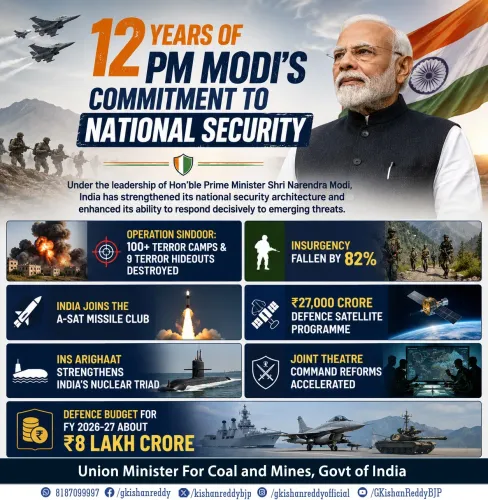
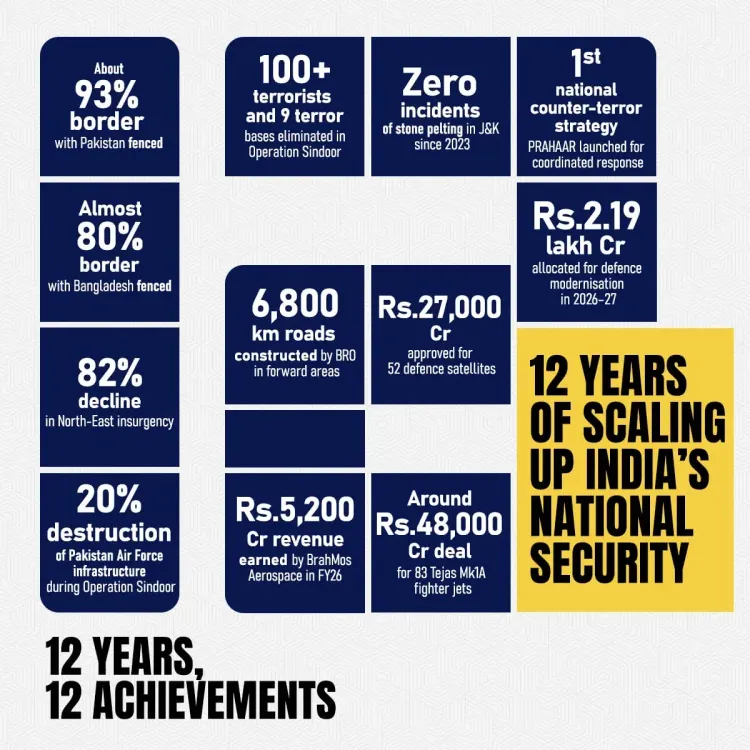
BJP's G. Kishan Reddy marked 12 years of Modi-led governance by citing zero stone-pelting in J&K, an 82% insurgency drop in the North-East, a ₹2.19 lakh crore defence modernisation budget for FY 2026-27, and ₹27,000 crore approved for 52 military satellites.
Key Takeaways
Kishan Reddy posted on June 17, 2026 under the hashtag #12YearsOfSurakshitBharat , cataloguing security gains under PM Modi.
The government claims zero stone-pelting incidents in Jammu and Kashmir and an 82% reduction in insurgency in the North-East . ₹2.19 lakh crore has been earmarked for defence modernisation in FY 2026-27 , one of the largest capital allocations in India's defence history. ₹27,000 crore has been approved for a constellation of 52 defence satellites to bolster surveillance and secure military communications.
The figures build on the Atmanirbhar Bharat indigenisation framework and the Defence Space Agency groundwork laid between 2019 and 2022.
Parliamentary scrutiny of revised estimates and the satellite tender's integration timeline remain key milestones to watch.
Union Coal and Mines Minister and BJP Telangana state president G. Kishan Reddy on Wednesday, June 17, 2026, highlighted what the ruling dispensation describes as a sweeping transformation of India's security architecture under Prime Minister Narendra Modi, citing internal security improvements in Jammu and Kashmir and the North-East alongside significant defence spending commitments for the current fiscal year.
Context
Marking the hashtag #12YearsOfSurakshitBharat (12 Years of a Secured India), Reddy's post catalogues a set of security metrics the government attributes to 12 years of BJP-led governance. He points to zero stone-pelting incidents in Jammu and Kashmir and an 82% reduction in insurgency in the North-East as evidence of stabilisation on two of India's most sensitive internal-security frontiers.
On the capital expenditure side, Reddy cited ₹2.19 lakh crore earmarked for defence modernisation in FY 2026-27 and a separate approval of ₹27,000 crore for 52 defence satellites as markers of a forward-looking security posture. The post frames these figures as part of 'New India securing its future with confidence.'
Policy Backdrop
The internal-security claims trace their lineage to two landmark policy moments. The abrogation of Article 370 in August 2019 reorganised Jammu and Kashmir into a Union Territory and preceded reported improvements in law-and-order metrics in the region. In the North-East, the Ministry of Home Affairs signed multiple peace agreements with insurgent groups between 2019 and 2023, which the government credits with the reported violence reduction.
On defence spending, capital outlay for the armed forces has risen progressively since FY 2014-15, underpinned by the Atmanirbhar Bharat indigenisation drive launched in 2020. The satellite approval cited by Reddy builds on earlier Defence Space Agency projects and satellite launches between 2019 and 2022 that established the groundwork for a dedicated military space constellation aimed at surveillance, secure communications, and intelligence, surveillance and reconnaissance (ISR) capabilities.
Stakeholders and Impact
The figures, if realised, carry direct implications for India's armed forces, the domestic defence manufacturing sector, and residents of Jammu and Kashmir and the North-Eastern states. A ₹2.19 lakh crore modernisation budget would be among the largest single-year capital allocations in India's defence history, with downstream benefits for indigenous platforms and private-sector defence firms operating under Atmanirbhar Bharat frameworks.
The proposed 52-satellite constellation would significantly expand India's military space footprint, giving the armed forces persistent overhead coverage for border monitoring and real-time battlefield communications — capabilities considered critical after the lessons of recent regional conflicts.
What's Next
Parliamentary scrutiny of the FY 2026-27 defence budget estimates will be a key test of whether the ₹2.19 lakh crore figure survives revised estimates. Progress on the 52-satellite constellation tender — including integration timelines with the Defence Space Agency — will determine how quickly the approved funds translate into operational capability. The broader #12YearsOfSurakshitBharat messaging campaign is expected to intensify as the government approaches the Independence Day cycle, with security metrics likely to feature prominently in official communications.
Point of View
Timed to the '12 years of Modi government' milestone and designed to anchor the BJP's security-governance narrative ahead of the Independence Day communications cycle. By pairing internal-security metrics — stone-pelting in J&K, insurgency in the North-East — with hard rupee figures on defence modernisation and space, the message bridges the government's law-and-order record with its technological ambition, appealing simultaneously to nationalist and development-oriented voter segments. The invocation of Atmanirbhar Bharat-linked spending also serves to reinforce the party's economic-sovereignty pitch within the security domain. Whether the specific budget and satellite figures withstand parliamentary scrutiny will determine how durable this narrative proves in the months ahead.
NationPress
15 Sept 2026
Frequently Asked Questions
What is the defence modernisation budget for India in FY 2026-27?
According to Minister G. Kishan Reddy's post, ₹2.19 lakh crore has been earmarked for defence modernisation in FY 2026-27 . This figure is subject to parliamentary approval and possible revision in revised estimates.
What are the 52 defence satellites India approved and how much will they cost?
The government has approved ₹27,000 crore for a constellation of 52 defence satellites intended to provide the armed forces with persistent surveillance, secure communications, and ISR capabilities. The project builds on earlier Defence Space Agency initiatives.
Why is stone-pelting in Jammu and Kashmir significant?
Stone-pelting was a recurring feature of unrest in Jammu and Kashmir for over a decade. The government's claim of zero stone-pelting incidents is cited as evidence of improved law and order following the abrogation of Article 370 in August 2019 and sustained security operations.
How has insurgency in the North-East reduced under the Modi government?
The government attributes an 82% reduction in insurgency in the North-East to multiple peace agreements signed with insurgent groups between 2019 and 2023 under the Ministry of Home Affairs, alongside enhanced connectivity and development spending.
What is #12YearsOfSurakshitBharat?
#12YearsOfSurakshitBharat (12 Years of a Secured India) is a BJP communication campaign marking 12 years of Narendra Modi-led governance , highlighting security achievements ranging from internal stabilisation in J&K and the North-East to defence capital expenditure and space capabilities.