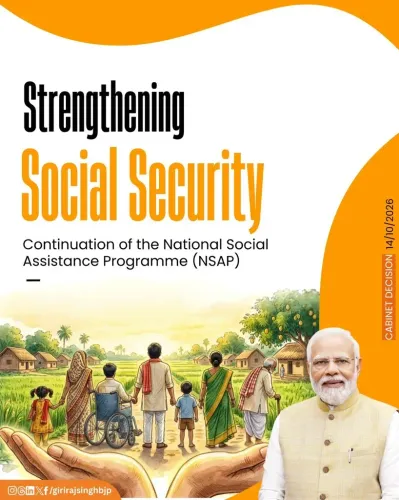
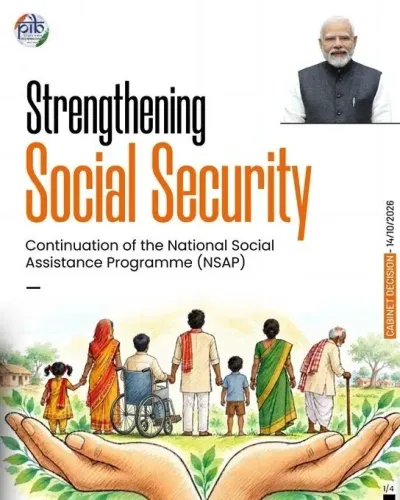
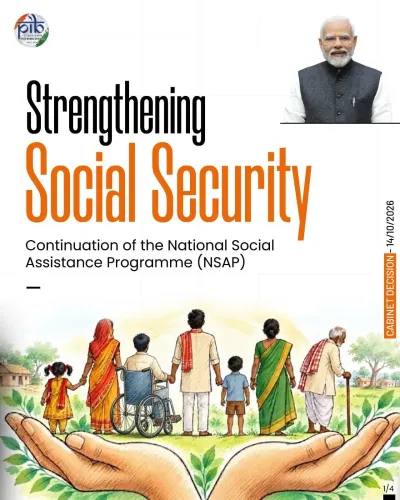
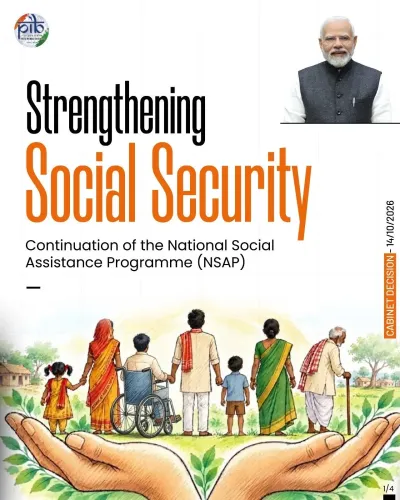
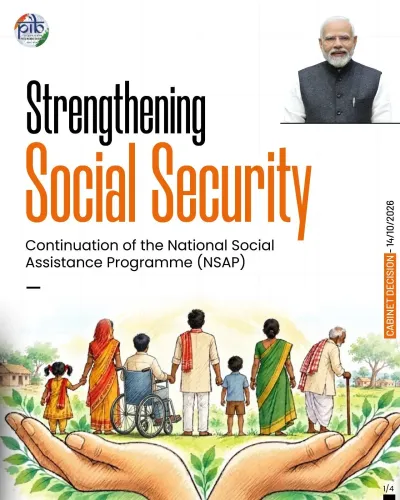
Cabinet Clears ₹53,428 Cr NSAP Extension for Five Years
Synopsis
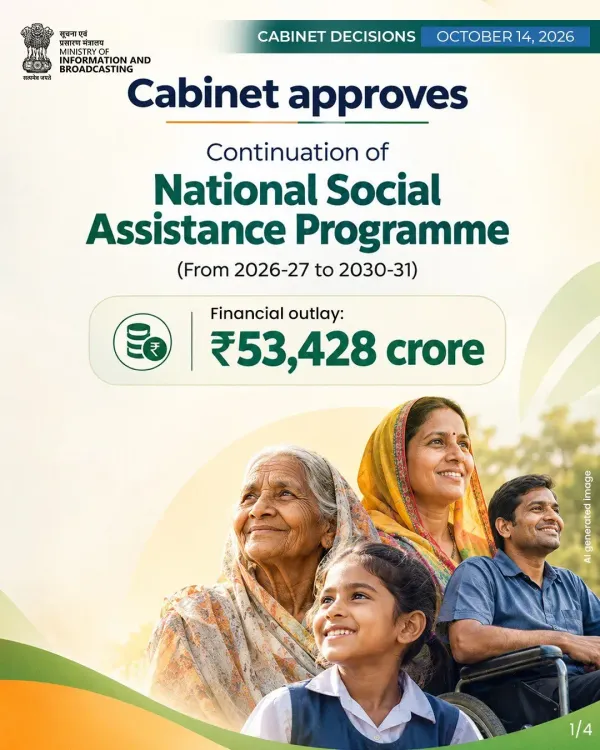
The Union Cabinet approved the continuation of the National Social Assistance Programme with a ₹53,428 crore outlay for 2026-27 to 2030-31, ensuring pension support for elderly, widows and persons with disabilities continues for five more years.
Key Takeaways
The Union Cabinet , chaired by PM Narendra Modi , approved the continuation of the National Social Assistance Programme (NSAP) .
The approved outlay is ₹53,428 crore covering five fiscal years from 2026-27 to 2030-31 .
NSAP was originally launched in August 1995 as a centrally sponsored direct-transfer scheme for destitute citizens.
Primary beneficiaries are elderly persons, widows, and persons with disabilities without other income support.
Funds are routed through state governments , which manage beneficiary identification and last-mile delivery.
State-wise fund releases and any revision to pension rates ahead of 2026-27 will signal the programme's implementation scale.
Tens of millions of India's most vulnerable citizens — elderly, widowed, and disabled — will continue to receive direct pension support after the Union Cabinet, chaired by Prime Minister Narendra Modi, approved the continuation of the National Social Assistance Programme (NSAP) with a total outlay of ₹53,428 crore for five years spanning 2026-27 to 2030-31, Union Environment Minister Bhupender Yadav announced on Wednesday, October 14, 2026.
Three Decades of Direct Transfers — and Counting
The NSAP is no newcomer to India's welfare architecture. Launched in August 1995, it was one of India's earliest centrally sponsored schemes to extend a formal social security net to the destitute — a direct cash transfer to those with no other income source or family support. Over three decades, it has become the floor beneath which the state promises no citizen will fall.
The scheme's primary beneficiaries are elderly persons, widows, and persons with disabilities — populations that are often outside the formal labour market and least equipped to absorb economic shocks. Central funds flow through state governments, which handle last-mile delivery and beneficiary management.
What the ₹53,428 Crore Approval Means in Practice
Cabinet continuations of this kind are not automatic — they require fresh fiscal commitment and inter-ministerial clearance at the end of each plan cycle, making this approval both a policy signal and a budgetary guarantee. The ₹53,428 crore figure, spread over five fiscal years from 2026-27, sets the funding envelope for monthly pension disbursements to eligible households across the country.
Implementation runs through state governments, which means the pace and reach of the renewed programme will depend on timely central fund releases and state-level administrative capacity. Any revision to monthly pension amounts or eligibility norms ahead of the 2026-27 rollout will be among the key markers of how this extension translates from cabinet room to doorstep.
A Welfare Renewal in a Consequential Political Season
The decision arrives as the central government signals continued commitment to targeted welfare spending. Periodic NSAP renewals have historically tracked five-year planning cycles, and this extension follows that established rhythm — but the scale of the outlay and the explicit five-year horizon underscore the programme's locked-in status as a core pillar of India's social protection framework.
For the families who depend on these monthly transfers, the Cabinet decision is not a policy footnote — it is the assurance that the support continues.
Point of View
Highly visible direct-transfer programme well before the next electoral cycle and shielding it from budgetary uncertainty for a full five years. At ₹53,428 crore, the outlay is substantial enough to constitute a credible commitment, but the real test will be whether monthly pension amounts — largely unchanged for years — are revised upward to keep pace with inflation. The continuation also reinforces the Centre's preference for centrally sponsored, state-implemented schemes as its primary welfare delivery vehicle, a model that keeps Delhi in control of the fiscal envelope while leaving states to absorb administrative and political costs.
NationPress
14 Oct 2026
Frequently Asked Questions
What is the National Social Assistance Programme (NSAP)?
The NSAP is a centrally sponsored scheme launched in August 1995 that provides monthly pension and financial assistance to elderly persons, widows, and persons with disabilities who lack other income support. Central funds are released to state governments, which handle beneficiary enrolment and disbursement.
How much has the Cabinet approved for NSAP and for which period?
The Union Cabinet has approved a total outlay of ₹53,428 crore for the continuation of NSAP covering five fiscal years from 2026-27 to 2030-31.
Who benefits from the National Social Assistance Programme?
The primary beneficiaries are elderly citizens, widows, and persons with disabilities — particularly those below the poverty line who have no significant income or family support. The programme is delivered through state governments across India.
Who announced the NSAP cabinet approval?
Union Environment Minister Bhupender Yadav announced the Cabinet decision on his official X account on October 14, 2026, linking to the official Press Information Bureau press release.
Will NSAP pension amounts change after this cabinet approval?
The Cabinet decision approves the continuation and the overall financial outlay, but specific changes to monthly pension rates or eligibility norms — if any — would be notified separately ahead of the 2026-27 rollout. State-wise fund release schedules will be a key indicator of implementation pace.