Cabinet passes resolution on Modi's 25 years of executive leadership
Synopsis
The Union Cabinet on Tuesday formalised a resolution marking PM Modi's 25 consecutive years in executive office — drawing on a standing ovation and a ten-point accounting of his tenure from SWAGAT to Chandrayaan-3 and Operation Sindoor. It is as much a political document as a administrative one, calibrated to cement a legacy narrative ahead of upcoming elections.
Key Takeaways
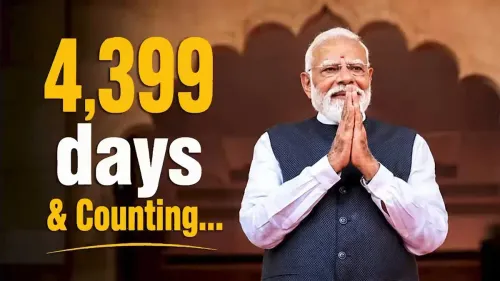
The Union Cabinet on 6 October 2026 passed a resolution marking PM Narendra Modi's 25 consecutive years in executive office as head of government.
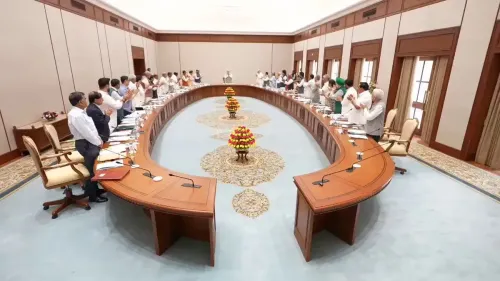
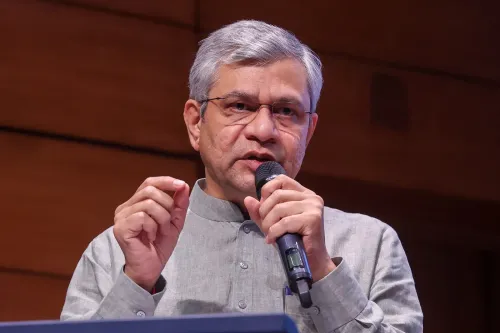
The Cabinet rose in a standing ovation ; Union Minister Ashwini Vaishnaw briefed the media on the resolution's contents.
The resolution cites nearly 60 crore Jan Dhan accounts , over 4 crore homes , and 25 crore people reportedly lifted out of poverty.
Public capital expenditure rose from ₹2 lakh crore to over ₹12 lakh crore ; electronics production grew from ₹2 lakh crore to over ₹13 lakh crore .
The 2016 surgical strikes , 2019 Balakot air strikes , and 2025 Operation Sindoor are cited as national security milestones.
The resolution closes with a commitment to Modi's vision of a developed, self-reliant India by 2047 .
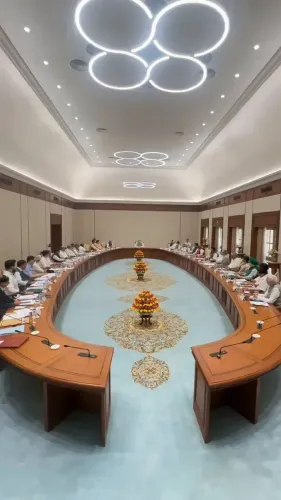
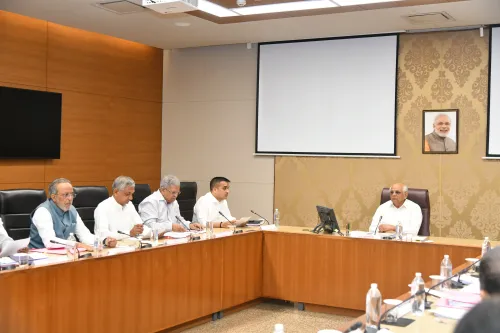
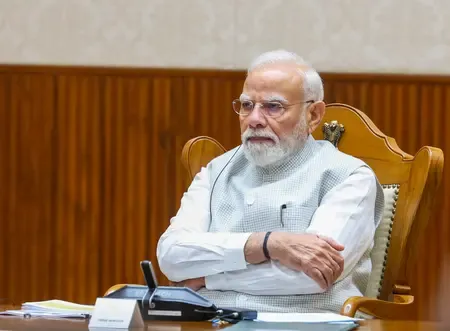
The Union Cabinet on Tuesday, 6 October 2026, passed a formal resolution congratulating Prime Minister Narendra Modi on completing 25 consecutive years in executive office as head of government — a milestone the Cabinet described as unique among world democracies. The meeting also saw members rise in a standing ovation in his honour.
Union Minister Ashwini Vaishnaw, briefing reporters after the Cabinet meeting in New Delhi, said the achievement spans three successive electoral mandates in Gujarat and three consecutive Lok Sabha victories, reflecting what the resolution termed 'enduring public trust.' 'People in very few countries of the world have continuously supported one leader,' Vaishnaw said, calling the feat 'unique.' 'That faith has come from his style of work, the right policies, and pure intentions,' he added.
Key Highlights of the Resolution
The ten-point resolution draws a direct line between Modi's tenure as Gujarat Chief Minister and his years as Prime Minister, tracing how state-level initiatives became national policy. His SWAGAT programme — a public grievance-redressal mechanism that won the United Nations Public Service Award in 2010 — reportedly served as a precursor to the Centre's PRAGATI platform, which coordinates review of stalled infrastructure projects. Similarly, Gujarat's Jyotigram initiative of separate agricultural electricity feeders was cited as the template for the national rural electrification approach.
The resolution connected Modi's stated personal awareness of poverty — rooted, it noted, in watching his mother's hardships and his own travels — to flagship welfare programmes. It cited nearly 60 crore Jan Dhan accounts, over 4 crore homes delivered, and 25 crore people reportedly lifted out of poverty as evidence of personal conviction translating into public policy outcomes.
Women, Youth and Farmers
The Cabinet resolution highlighted that approximately 3.5 crore women have become 'Lakhpati Didis' under self-help group schemes, while the Nari Shakti Vandan Adhiniyam legislated women's reservation in Parliament and state assemblies. On youth, it pointed to growth in startups, skills development and education reform. For farmers, PM-KISAN transfers have cumulatively exceeded ₹4 lakh crore, while PM-JANMAN was cited as a targeted initiative for particularly vulnerable tribal communities.
Economic and Technological Milestones
The resolution noted that public capital expenditure rose from ₹2 lakh crore to over ₹12 lakh crore under Modi's watch, accompanied by significant highway expansion and near-complete railway electrification. Electronics production reportedly grew from approximately ₹2 lakh crore to more than ₹13 lakh crore. Defence production and the emergence of domestic semiconductor manufacturing were cited as indicators of a broader self-reliance push.
On technology, the resolution pointed to the Jan Dhan-Aadhaar-Mobile (JAM) trinity improving welfare delivery, UPI transforming digital payments, development of India's own COVID-19 vaccines, and the successful landing of Chandrayaan-3 near the Moon's south pole as markers of an 'Atmanirbhar Bharat' vision. Participation in private space, artificial intelligence, quantum technology and biotechnology were also cited as forward-looking elements of that vision.
National Security and Diplomacy
The resolution recalled the 2016 surgical strikes, 2019 Balakot air strikes, and 2025 Operation Sindoor as illustrations of decisive national security leadership and what it described as red lines established under Modi. The abrogation of Article 370, implementation of One Rank One Pension, creation of the Chief of Defence Staff post, and efforts against Maoist terrorism and in Northeast peace initiatives were listed alongside these.
On the international stage, the resolution credited Modi with elevating India's global standing, citing the G20 consensus achieved during India's presidency, BRICS engagement, advocacy for the Global South, and securing the African Union's G20 membership. The 'Vaccine Maitri' initiative and honours received from 36 countries were offered as evidence of India's growing international influence.
What Comes Next
The resolution concluded by reposing commitment to Modi's vision of a prosperous, self-reliant and developed India by 2047 — the centenary of independence. It is the latest in a series of formal gestures by the ruling establishment marking significant milestones in the Prime Minister's political career, and is expected to set the tone for the Bharatiya Janata Party's (BJP) campaign messaging ahead of upcoming state elections.
Point of View
By design, a political instrument as much as an administrative one — and reading it only as news misses that dimension. The ten-point framing, the carefully curated numbers and the invocation of 2047 together constitute an early salvo in the legacy-building exercise that precedes any major electoral cycle. Notably, the resolution elides questions that critics have persistently raised: whether the poverty-reduction and Jan Dhan figures reflect genuine consumption gains or statistical reclassification, and whether the jump in electronics production reflects deep manufacturing capability or largely assembly-level activity. The juxtaposition of Operation Sindoor with welfare data is also deliberate — it signals that the BJP's pitch for 2029 will fuse national security credibility with development delivery. The real test of these numbers lies not in the resolution but in independent audits that the resolution does not call for.
NationPress
6 Oct 2026
Frequently Asked Questions
What did the Union Cabinet resolution on PM Modi say?
The Union Cabinet on 6 October 2026 passed a resolution congratulating PM Narendra Modi on 25 consecutive years in executive office. It outlined ten themes spanning welfare delivery, economic growth, technology, national security and diplomacy, and concluded with a commitment to a developed India by 2047.
Why is 25 years of continuous executive leadership considered significant?
The Cabinet resolution described the milestone as 'unique,' noting that very few leaders globally have received continuous electoral support across three state mandates in Gujarat and three successive national Lok Sabha elections. Union Minister Ashwini Vaishnaw said this reflected sustained public trust in Modi's governance.
What economic milestones does the resolution highlight?
The resolution states that public capital expenditure grew from ₹2 lakh crore to over ₹12 lakh crore, and electronics production rose from approximately ₹2 lakh crore to more than ₹13 lakh crore. PM-KISAN transfers are cited as having exceeded ₹4 lakh crore cumulatively.
Which national security events are mentioned in the Cabinet resolution?
The resolution specifically names the 2016 surgical strikes, the 2019 Balakot air strikes, and the 2025 Operation Sindoor as examples of decisive leadership under Modi. It also cites the abrogation of Article 370, One Rank One Pension, and the creation of the Chief of Defence Staff post.
How does the resolution address India's international standing?
The resolution credits Modi with strengthening India's global voice through the G20 consensus achieved during India's presidency, BRICS engagement, the inclusion of the African Union in the G20, and the 'Vaccine Maitri' initiative. It notes that Modi has received honours from 36 countries.