CARICOM backs India's UNSC 2028-29 bid at New York ministerial meet
Synopsis
All 15 CARICOM nations have backed India's bid for a UNSC non-permanent seat for 2028-29 — a bloc-level endorsement secured at a single ministerial forum on the sidelines of UNGA 81. With Jaishankar invoking shared colonial history, digital solidarity, and India's expanding development footprint from BHISHM Cubes to solar power, this is India's Global South strategy crystallising into counted votes.
Key Takeaways
CARICOM formally endorsed India's candidature for the UNSC 2028-29 non-permanent term at the India-CARICOM FMM on 24 September 2026 in New York .
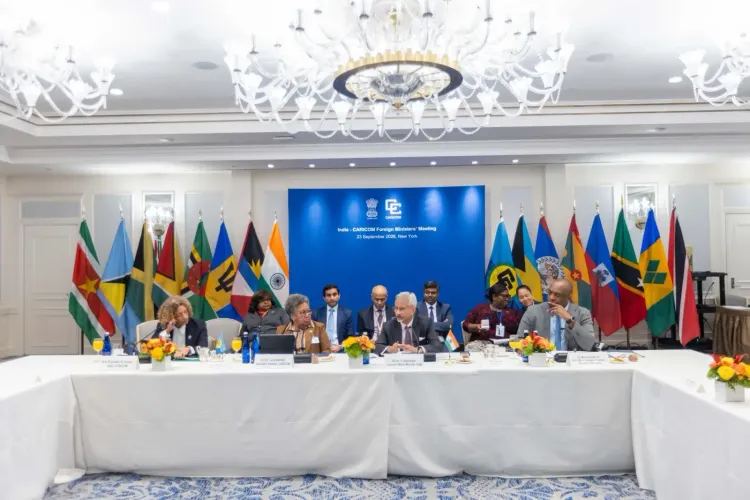
EAM S Jaishankar and Suriname's Melvin W J Bouva co-chaired the meeting, attended by foreign ministers from 12 Caribbean nations plus representatives of Grenada, Belize, and CARICOM Secretariat.
Discussions covered trade, digital governance, climate resilience, energy cooperation, UN reforms , counter-terrorism, and transnational crime.
India highlighted its development assistance including solar power promotion , the BHISHM Cube portable hospital, haemodialysis units, and digital training programmes.
Jaishankar invited CARICOM nations to join the International Solar Alliance and the Global Biofuels Alliance , both headquartered in India.
The meeting followed the 2nd India-CARICOM Summit chaired by PM Modi in Guyana in November 2024 .
The 15-member Caribbean Community (CARICOM) has formally conveyed its decision to support India's candidature for a non-permanent seat on the United Nations Security Council (UNSC) for the 2028-29 term, a significant diplomatic endorsement secured at the India-CARICOM Foreign Ministers' Meeting (FMM) held on 24 September 2026 on the sidelines of the 81st UN General Assembly (UNGA) in New York. The Ministry of External Affairs (MEA) confirmed the outcome on Thursday, describing the meeting as a follow-up to the landmark 2nd India-CARICOM Summit chaired by Prime Minister Narendra Modi in Guyana in November 2024.
Who Was in the Room
External Affairs Minister S Jaishankar and Suriname's Minister of Foreign Affairs, International Business and Cooperation, Melvin W J Bouva, co-chaired the meeting. Foreign ministers from Barbados, Dominica, Bahamas, Guyana, Jamaica, St Vincent and Grenadines, Trinidad and Tobago, Suriname, Haiti, St. Lucia, St. Kitts and Nevis, and Antigua and Barbuda were present, alongside the Finance Minister of Grenada, the CEO of the Ministry of Foreign Affairs of Belize, and CARICOM Secretary General Carla Natalie Barnett.
Key Areas of Engagement
According to the MEA statement, both sides expressed satisfaction at the steady progress in bilateral cooperation. Discussions covered deepening political engagement, increasing trade and investment, and cooperation in agriculture and food security, digital governance, climate resilience, and energy cooperation. The two sides also agreed to continue working together on UN reforms, counter-terrorism, transnational crime, and combating climate change.
Jaishankar, in a post on X, said he 'emphasised that we must further deepen our ties, especially in economic, digital and mobility domains' and 'highlighted our solidarity derived from our shared history and developmental challenges.' He also urged CARICOM countries to utilise India-provided training slots and offered customised programmes in areas of their interest.
India's Development Footprint in the Caribbean
Jaishankar outlined India's ongoing assistance to the region, noting the promotion of solar power installation and inviting CARICOM nations to join the International Solar Alliance and the Global Biofuels Alliance — both headquartered in India. He noted the completion of Small and Medium Enterprise programmes and Quick Impact Projects (QIPs) across several Caribbean nations. In the health space, India has conducted artificial limb fitment camps, gifted haemodialysis units, and provided the portable BHISHM Cube — India's compact disaster-response hospital system — to select CARICOM partners.
Notably, three CARICOM members — Suriname, Trinidad and Tobago, and Guyana — carry substantial populations of Indian descent, lending the partnership a civilisational depth that extends beyond diplomatic formality. India and the broader CARICOM membership also share a common history of colonisation, a thread that Jaishankar referenced in underscoring solidarity through developmental challenges.
India's UNSC Ambitions and the Global South Play
The CARICOM endorsement adds weight to India's long-running campaign for a permanent seat on a reformed UNSC, even as the immediate candidature is for the 2028-29 non-permanent term. This comes amid India's sustained effort to position itself as the leading voice of the Global South — a framing Jaishankar reinforced directly at the meeting, assuring CARICOM leaders that 'India will be a strong voice of the Global South.' The backing of 15 Caribbean nations at a single forum is a tangible bloc-level endorsement ahead of the UNGA vote cycle. India's engagement with small island states has intensified since the 2024 summit, reflecting a strategic recognition that multilateral majorities are built through sustained outreach, not just bilateral power.
What Comes Next
Both sides agreed to maintain momentum on all agreed priorities, with India's training programmes in digital technologies continuing to serve as a key soft-power instrument across the Global South. The next India-CARICOM engagement is expected to build further on the November 2024 summit framework, with sectoral cooperation timelines to be firmed up through diplomatic channels.
Point of View
Not the destination India ultimately wants. The more consequential question is whether this momentum translates into support for permanent UNSC reform, where the blocking arithmetic is far harder. India's development toolkit — BHISHM Cubes, solar incentives, digital training — is clearly doing diplomatic work, yet the relationship remains asymmetric: India is the provider, CARICOM the recipient. For true strategic depth, the partnership will need trade flows and investment commitments to match the goodwill.
NationPress
24 Sept 2026
Frequently Asked Questions
What did CARICOM agree to at the India-CARICOM Foreign Ministers' Meeting?
CARICOM's 15-member bloc formally conveyed its decision to support India's candidature for a non-permanent seat on the United Nations Security Council for the 2028-29 term. The endorsement came at the India-CARICOM FMM held on 24 September 2026 on the sidelines of the 81st UNGA in New York.
Who co-chaired the India-CARICOM Foreign Ministers' Meeting?
External Affairs Minister S Jaishankar and Suriname's Minister of Foreign Affairs, International Business and Cooperation, Melvin W J Bouva, co-chaired the meeting. It was attended by foreign ministers and senior representatives from 14 CARICOM member states and the CARICOM Secretary General.
Why is the CARICOM endorsement significant for India?
The backing of 15 Caribbean nations as a unified bloc strengthens India's vote count for the UNSC non-permanent seat election cycle for 2028-29. It also reflects the broader success of India's Global South outreach strategy, building on the 2nd India-CARICOM Summit held in Guyana in November 2024.
What development assistance has India provided to CARICOM countries?
India has promoted solar power installation in the Caribbean region, conducted artificial limb fitment camps, gifted haemodialysis units, provided the portable BHISHM Cube disaster-response hospital system, and completed Small and Medium Enterprise programmes and Quick Impact Projects across several Caribbean nations. India also offers training slots in digital technologies for Global South countries.
What is the BHISHM Cube mentioned at the India-CARICOM meeting?
The BHISHM Cube is a compact, portable hospital system developed by India, designed for rapid deployment in disaster-affected areas. India has gifted BHISHM Cube units to select CARICOM partner nations as part of its health and humanitarian assistance programme.