Joshi: CCPA Penalises PhysicsWallah, McAfee Over Dark Patterns
Synopsis
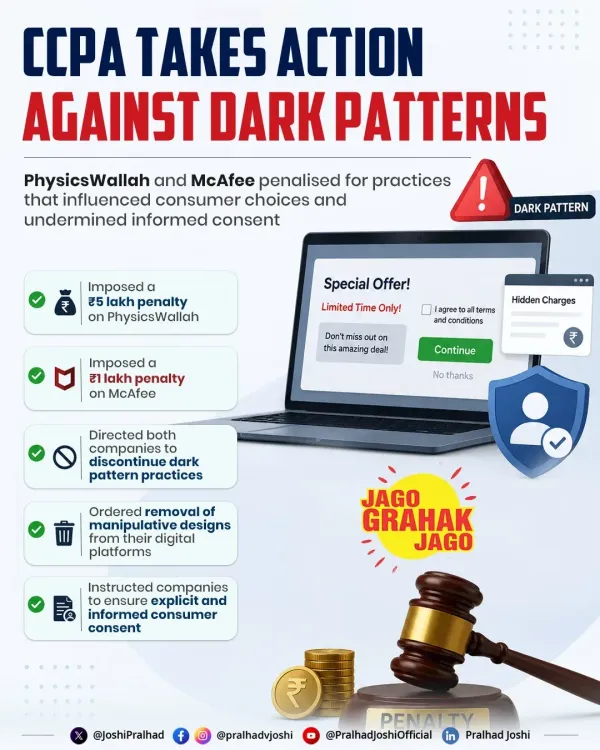
Union Consumer Affairs Minister Pralhad Joshi said the Central Consumer Protection Authority has imposed penalties on PhysicsWallah and McAfee for dark patterns that compromised informed consumer consent, calling the orders part of a wider push for a fair and transparent digital marketplace in India.
Key Takeaways
CCPA has penalised PhysicsWallah and McAfee for dark patterns affecting consumer consent.
Action announced by Union Consumer Affairs Minister Pralhad Joshi on social media.
Orders draw on the CCPA's 2023 Guidelines for Prevention and Regulation of Dark Patterns.
Framework rooted in the Consumer Protection Act, 2019 , which covers e-commerce.
Minister stressed consumer consent must be 'explicit, informed and free from manipulative design'.
Signals tighter scrutiny of subscription, checkout and renewal flows on digital platforms.
Union Consumer Affairs Minister Pralhad Joshi on Wednesday announced that the Central Consumer Protection Authority (CCPA) has imposed penalties on edtech platform PhysicsWallah and cybersecurity firm McAfee for deploying so-called 'dark patterns' on their digital interfaces. The minister said the orders target design practices that compromised informed consumer choice and consent, and form part of a wider clampdown on manipulative online experiences in India's digital marketplace.
In his post, Joshi said the action underlined the CCPA's 'commitment to ensuring a fair, transparent and consumer-friendly digital marketplace', adding that 'consumer consent must always be explicit, informed and free from manipulative design practices'. He tagged the development with hashtags including #CCPA, #ConsumerRights, #DigitalTransparency and #DarkPatterns, and linked to an official press release.
Context
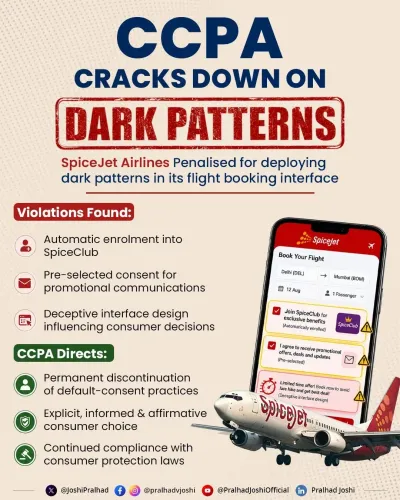
Dark patterns are interface choices that nudge or trick users into decisions they might not otherwise make — for instance, pre-ticked boxes, hidden charges, confirm-shaming, drip pricing, or hard-to-find unsubscribe buttons. The CCPA has, over the past two years, sharpened scrutiny of such practices on e-commerce, edtech, travel and software-subscription platforms.
PhysicsWallah is among India's largest home-grown edtech firms, offering test-preparation courses for engineering and medical entrance examinations. McAfee is a global cybersecurity company whose antivirus and identity-protection subscriptions are sold widely to Indian consumers, often through auto-renewal flows.
Policy backdrop
The CCPA was set up as a statutory regulator under the Consumer Protection Act, 2019, which replaced the 1986 legislation and for the first time brought e-commerce and direct selling formally under consumer-rights enforcement. The Authority has powers to investigate violations, order recalls, impose penalties and issue directions to discontinue unfair trade practices.
In 2023, the CCPA notified the Guidelines for Prevention and Regulation of Dark Patterns, listing specific manipulative interface practices and classifying them as unfair trade practices. The guidelines covered categories such as false urgency, basket sneaking, subscription traps, forced action, interface interference and bait-and-switch — providing the legal scaffolding for enforcement actions of the kind announced by the minister.
Stakeholders and impact
For consumers, the orders signal that regulators are willing to penalise large platforms — both Indian and multinational — when consent flows or pricing displays are found to be misleading. Subscription-heavy categories, including edtech course bundles and security-software auto-renewals, have drawn repeated complaints over cancellation hurdles and unclear billing.
For industry, the action raises compliance stakes. Platforms operating in India will face pressure to audit checkout journeys, default settings and renewal disclosures against the CCPA's published list. Legal teams at digital firms have, in recent quarters, been re-examining interface choices that were earlier treated as routine growth or retention tools.
The political messaging is also notable. By personally amplifying the CCPA's orders, Joshi — who also holds the New and Renewable Energy and Food and Public Distribution portfolios and is a senior BJP leader from Karnataka — is positioning consumer protection as a visible plank of the Union government's digital-governance agenda.
What's next
Attention will turn to whether the CCPA follows up with further show-cause notices to other major platforms in e-commerce, travel aggregation, food delivery and over-the-top streaming, where dark-pattern complaints have been documented. Any move to tighten the Consumer Protection (E-Commerce) Rules or to issue binding standards — rather than guidelines — would further raise the compliance bar.
For now, the orders against PhysicsWallah and McAfee serve as a benchmark: regulators are prepared to convert the 2023 dark-patterns framework into concrete penalties, and digital businesses operating in India can expect interface design to be treated as a consumer-rights issue rather than a purely commercial choice.
Point of View
And the choice of targets is telling: one large domestic edtech and one global cybersecurity brand, signalling that the CCPA is willing to act across origin and sector. Politically, the consumer-protection portfolio is being used to project a citizen-facing face of digital governance, complementing data-protection and platform-liability debates. Watch for whether penalties scale up enough to alter platform design incentives or remain symbolic. The next test will be travel, food-delivery and streaming aggregators, where consent and pricing complaints have been persistent.
NationPress
18 Oct 2026
Frequently Asked Questions
What are dark patterns on digital platforms?
Dark patterns are deceptive interface designs that nudge users into choices they might not otherwise make, such as pre-ticked consent boxes, hidden charges, difficult cancellation flows, false urgency timers and subscription traps. India's CCPA has classified such practices as unfair trade practices under its 2023 guidelines.
Why has CCPA penalised PhysicsWallah and McAfee?
According to Union Minister Pralhad Joshi, the Central Consumer Protection Authority found that the two platforms used design practices that affected informed consumer choice and consent. The orders were issued to enforce rules against manipulative interfaces on digital platforms.
What law empowers the CCPA to act against dark patterns?
The Central Consumer Protection Authority is a statutory regulator established under the Consumer Protection Act, 2019. It enforces the 2023 Guidelines for Prevention and Regulation of Dark Patterns, which list specific manipulative practices as unfair trade practices.
Who is Pralhad Joshi?
Pralhad Joshi is the Union Minister of Consumer Affairs, Food and Public Distribution, and Minister of New and Renewable Energy. He is a senior BJP leader from Karnataka and has been amplifying consumer-protection enforcement actions taken by the CCPA.
What does this mean for online consumers in India?
It signals that regulators will penalise platforms whose checkout, consent or subscription flows are found misleading. Consumers can expect clearer disclosures, easier cancellations and more explicit opt-ins as platforms revise interfaces to comply with the CCPA's dark-patterns framework.