CCPA fines PhysicsWallah ₹5 lakh, McAfee ₹1 lakh for dark patterns

Synopsis
India's consumer watchdog has finally put real money behind its 2023 dark patterns rulebook. PhysicsWallah's ₹10 pre-ticked donation and McAfee's renewal traps drew ₹5 lakh and ₹1 lakh fines respectively — small numbers, but a loud signal to edtech and SaaS players that pre-selected checkboxes, confirm shaming and forced data collection are now enforceable offences.
Key Takeaways
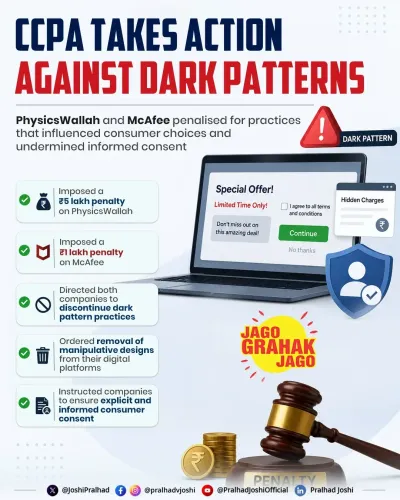
The CCPA fined PhysicsWallah ₹5 lakh and McAfee India ₹1 lakh on 3 June for dark pattern practices.
PhysicsWallah was found auto-adding a ₹10 donation to PW Foundation at checkout without explicit consent.
The regulator identified basket sneaking , confirm shaming and forced action on the edtech platform.
McAfee was penalised for misleading subscription renewal practices on its digital platform.
Action taken under the Consumer Protection Act, 2019 and the Dark Patterns Guidelines, 2023 .
Both firms have been directed to remove the flagged practices from their platforms.
The Central Consumer Protection Authority (CCPA) on Wednesday, 3 June imposed a penalty of ₹5 lakh on PhysicsWallah Limited and ₹1 lakh on McAfee Software India Private Limited for deploying ‘dark pattern' practices that allegedly misled consumers and manipulated their purchase decisions. The action, taken from New Delhi, marks one of the most prominent enforcement steps yet under India's 2023 dark patterns framework.
What the regulator found
The CCPA, headed by Chief Commissioner Nidhi Khare and Commissioner Anupam Mishra, said both firms have been directed to discontinue the flagged practices and ensure that consumers can make informed choices ‘without manipulation or pressure'.
The action was taken under the Consumer Protection Act, 2019, the Consumer Protection (E-Commerce) Rules, 2020, and the Guidelines for Prevention and Regulation of Dark Patterns, 2023.
The PhysicsWallah case
The watchdog took suo motu cognisance of practices on the edtech platform and found that interface designs were influencing users' ability to make free and informed decisions. A ₹10 donation to the PW Foundation was reportedly pre-selected at checkout and added to the payable amount without explicit consent.
Users were also shown emotional messages linked to children's education, healthcare and marriages — content the authority said discouraged them from removing the donation. Courses advertised as ‘free' could only be accessed after users shared personal details such as mobile numbers and email addresses, even though the CCPA found the course content was identical across accounts, suggesting data collection was not essential.
Dark patterns identified
The regulator flagged multiple categories of dark patterns on PhysicsWallah's platform — ‘basket sneaking' via auto-added donations, ‘confirm shaming' through emotionally charged prompts, and ‘forced action' by gating free content behind personal data submission.
In McAfee's case, the CCPA cited misleading subscription renewal practices on its digital platform, a recurring concern in the cybersecurity software segment where auto-renewals and opaque cancellation flows have drawn global scrutiny.
What happens next
Both companies have been directed to remove the flagged design elements and align their platforms with the 2023 guidelines. The orders are likely to set a benchmark for compliance reviews across India's edtech and SaaS subscription industries, with further suo motu actions expected as the CCPA expands its digital-market surveillance.
Point of View
And that is the real story. India's 2023 dark patterns framework finally has enforcement teeth, but without proportionate penalties it risks becoming a compliance checkbox rather than a deterrent. The PhysicsWallah case is particularly revealing: pre-ticked donations and gated ‘free' courses are industry-standard tactics across Indian edtech, which means this order is effectively a warning shot to an entire sector. The next test is whether the CCPA scales enforcement to the platforms whose revenue depends most heavily on these very designs.
NationPress
18 Oct 2026
Frequently Asked Questions
Why did the CCPA fine PhysicsWallah ₹5 lakh?
The CCPA found that PhysicsWallah was deploying dark patterns on its edtech platform, including a pre-selected ₹10 donation to PW Foundation at checkout without explicit user consent, emotionally charged messages discouraging users from removing the donation, and gating ‘free' courses behind mandatory personal data submission. These were classified as basket sneaking, confirm shaming and forced action.
What was McAfee penalised for?
McAfee Software India was fined ₹1 lakh for using misleading subscription renewal practices on its digital platform. The CCPA has directed the company to discontinue these practices and ensure consumers can make informed renewal choices.
What are dark patterns under Indian law?
Dark patterns are deceptive user-interface designs that manipulate consumer choice. India's Guidelines for Prevention and Regulation of Dark Patterns, 2023, list categories such as basket sneaking, confirm shaming, forced action, false urgency and subscription traps as prohibited practices under the Consumer Protection Act, 2019.
What action have the companies been directed to take?
Both PhysicsWallah and McAfee have been directed to remove the flagged dark pattern practices from their platforms and ensure that consumers can make informed choices without pressure or manipulation. The CCPA is expected to monitor compliance.
Who leads the CCPA action against PhysicsWallah and McAfee?
The Central Consumer Protection Authority is headed by Chief Commissioner Nidhi Khare, with Commissioner Anupam Mishra. The action was taken under the Consumer Protection Act, 2019, the Consumer Protection (E-Commerce) Rules, 2020, and the Dark Patterns Guidelines, 2023.