CCPA Penalises SpiceJet for Dark Patterns in Booking
Synopsis
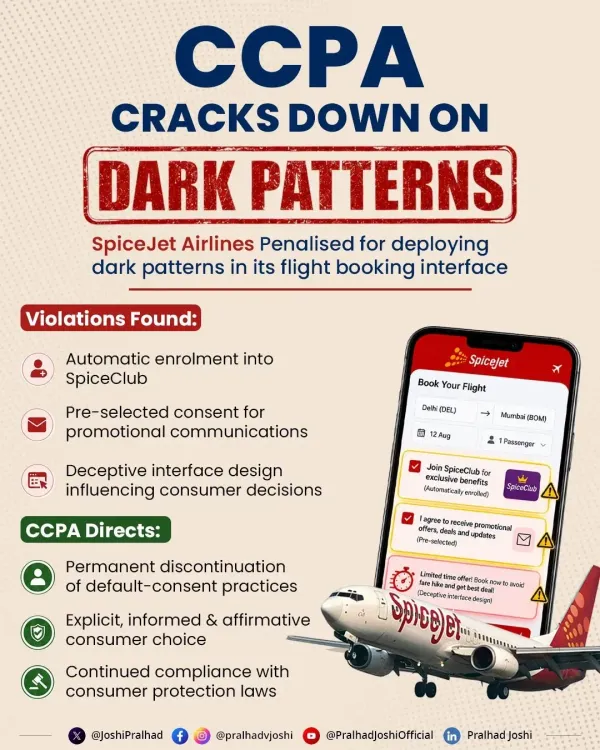
The CCPA has penalised SpiceJet for deploying deceptive dark patterns on its flight booking platform and directed the airline to permanently end default-consent practices, Union Consumer Affairs Minister Pralhad Joshi announced on 17 July 2026, reinforcing that consumer consent must be explicit and freely given.
Key Takeaways
The Central Consumer Protection Authority (CCPA) has imposed a penalty on SpiceJet for using dark patterns on its flight booking platform.
The CCPA has directed SpiceJet to permanently discontinue default-consent practices on its booking interface.
The action is grounded in the Consumer Protection Act, 2019 and the CCPA's 2023 Guidelines for Prevention and Regulation of Dark Patterns .
Union Minister Pralhad Joshi stated that 'consumer consent must always be explicit, informed and freely given.' The ruling sets a precedent for other airlines and online travel aggregators operating similar default opt-in mechanisms in India.
Union Consumer Affairs Minister Pralhad Joshi announced on Friday, 17 July 2026 that the Central Consumer Protection Authority (CCPA) has imposed a penalty on SpiceJet for deploying deceptive 'dark patterns' on its flight booking platform and has directed the airline to permanently discontinue default-consent practices.
Context
Posting on X, Minister Joshi stated: 'Consumer choice must be informed, not manipulated.' He added that the CCPA's action 'reinforces that consumer consent must always be explicit, informed and freely given.' The post, tagged with #ConsumerProtection and the government's consumer-awareness handle @jagograhakjago, signals that the authority is actively enforcing its mandate against manipulative digital design in the travel sector.
Dark patterns are interface design techniques that nudge or trick users into actions they did not intend — such as pre-ticking boxes to add paid services during a booking flow without clear, affirmative consent from the user.
Policy Backdrop
The CCPA was established under the Consumer Protection Act, 2019, which replaced the decades-old 1986 legislation and specifically introduced provisions to address e-commerce and digital consumer rights. The 2019 law gave the authority powers to investigate unfair trade practices, issue directions, and impose penalties on businesses operating in the digital space.
In 2023, the CCPA notified the Guidelines for Prevention and Regulation of Dark Patterns, explicitly cataloguing manipulative interface designs — including 'trick questions', 'hidden costs', and 'forced action' — that undermine informed consumer consent. The action against SpiceJet is among the more prominent enforcement steps taken under those guidelines in the aviation booking segment.
Since the 2019 consumer law overhaul, Indian regulators have increased enforcement against opaque digital design practices across e-commerce, travel, and service sectors, with the consistent principle that consent must be opt-in rather than opt-out.
Stakeholders and Impact
SpiceJet, one of India's established low-cost carriers, operates a high-volume online booking platform used by millions of passengers annually. The CCPA's direction to permanently discontinue default-consent practices means the airline must redesign any booking flow that automatically pre-selects paid add-ons or ancillary services unless the passenger explicitly chooses them.
For airline passengers and digital consumers broadly, the ruling sets a precedent: any service bundled into a booking without an affirmative user action constitutes a violation of consumer protection norms. Consumer-rights advocates have long flagged that default opt-ins inflate effective ticket prices and erode trust in online travel platforms.
The action also puts other airlines and online travel aggregators on notice. Similar enforcement actions have previously targeted online platforms in adjacent sectors for comparable interface violations, and the CCPA's stated mandate covers all digital commerce.
What's Next
Compliance with the CCPA's direction will require SpiceJet to audit and overhaul its booking interface to ensure every consent point is explicit and freely given. Failure to comply with CCPA orders can attract further penalties under the Consumer Protection Act, 2019.
Regulators and consumer groups will watch whether the authority issues similar notices to other airlines and booking portals operating default-consent mechanisms. As India's digital consumer base continues to expand, enforcement of anti-dark-pattern norms is likely to intensify across all sectors where digital interfaces mediate consumer choice.
Point of View
Signalling a shift from rule-making to active prosecution. Minister Joshi's public announcement via social media — framed in the language of consumer rights rather than regulatory procedure — suggests the government is keen to project consumer protection as a political priority ahead of a rapidly digitising economy. The permanent discontinuation order, rather than a mere fine, raises the compliance stakes for the entire online travel industry. If the CCPA follows through with similar actions against other carriers and aggregators, it could reshape how ancillary services are sold across India's digital commerce landscape.
NationPress
16 Oct 2026
Frequently Asked Questions
What are dark patterns and why did CCPA penalise SpiceJet?
Dark patterns are deceptive interface design techniques that manipulate users into unintended actions, such as pre-ticking boxes for paid add-ons during booking. The CCPA penalised SpiceJet for deploying such patterns on its flight booking platform and directed the airline to permanently stop default-consent practices.
What is the CCPA and what powers does it have?
The Central Consumer Protection Authority (CCPA) is a regulatory body established under the Consumer Protection Act, 2019. It has powers to investigate unfair trade practices, issue directions, and impose penalties on businesses, including those operating digital platforms.
What are the CCPA guidelines on dark patterns?
In 2023, the CCPA notified the Guidelines for Prevention and Regulation of Dark Patterns, which explicitly list manipulative interface designs — such as trick questions, hidden costs, and forced action — that undermine informed consumer consent and are prohibited under Indian consumer law.
What does the CCPA order mean for SpiceJet passengers?
SpiceJet must redesign its booking platform so that no paid service or add-on is automatically pre-selected without the passenger's explicit, affirmative choice. Passengers should no longer find services bundled into their bookings without their clear consent.
Will other airlines also face action for dark patterns?
The CCPA's mandate covers all digital commerce, and the SpiceJet action puts other airlines and online travel aggregators on notice. Regulators and consumer groups are expected to watch whether similar enforcement notices are issued to other platforms using default-consent mechanisms.