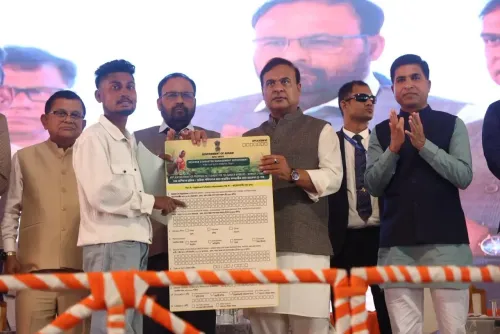
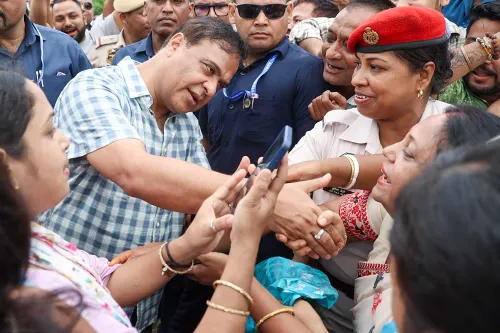
CM Himanta Expands CMAAA Mentee Training for Atmanirbhar Assam
Synopsis
Assam Chief Minister Himanta Biswa Sarma announced that 75,000 CMAAA mentees are receiving structured training in business and customer acquisition, framing financial incentives as a starting point rather than the end goal of the state's Atmanirbhar Assam entrepreneurship push.
Key Takeaways
75,000 mentees are enrolled under the CMAAA programme and are being trained in business modules and customer acquisition.
CM Himanta Biswa Sarma stated that financial incentives are the starting point, not the endpoint, of the government's responsibility to entrepreneurs.
The programme is part of the Atmanirbhar Assam framework, aligned with the national Atmanirbhar Bharat mission launched in May 2020 .
The initiative targets Assam MSMEs and aspiring entrepreneurs, combining monetary support with structured capacity-building.
The Northeast context makes the programme significant as a tool to reduce out-migration and build local value chains.
Conversion of mentees into operational businesses will be the key metric to watch in upcoming quarterly progress reviews.
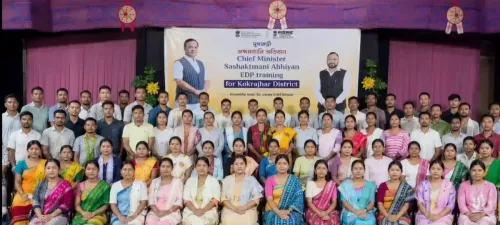
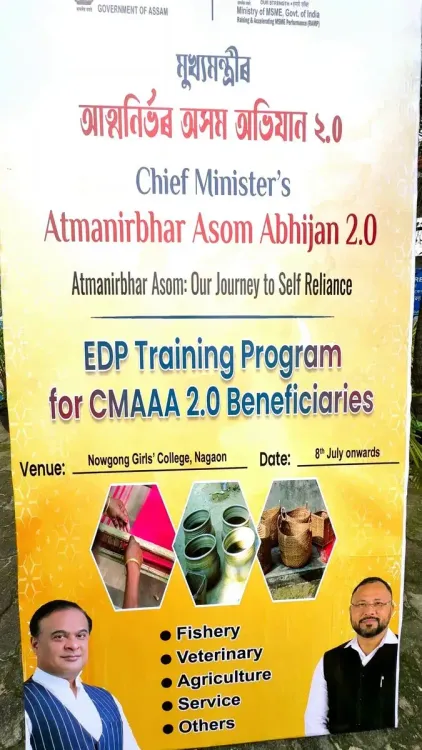
Assam Chief Minister Himanta Biswa Sarma on Friday, 17 July 2026, reaffirmed his government's commitment to going beyond financial incentives for entrepreneurs, stating that 75,000 mentees under the Chief Minister's Atmanirbhar Asom Abhijan (CMAAA) programme are being trained in business modules and customer acquisition to build a self-reliant Assam.
Context
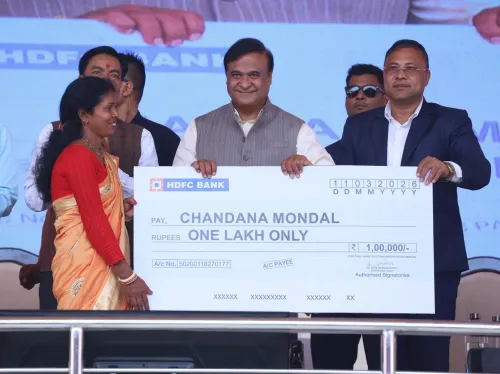
Posting on X, CM Sarma articulated a shift in the government's entrepreneurship philosophy: 'Our responsibility towards entrepreneurs doesn't end at giving financial incentives but starts from there.' The statement signals that the Assam government views direct financial support as a floor, not a ceiling, for enterprise development. The remark comes as the state deepens its focus on structured capacity-building alongside monetary assistance.
The CMAAA programme, anchored in the Chief Minister's office, targets selected Assam entrepreneurs with structured training covering business fundamentals, market development, and customer acquisition strategies. The enrolment of 75,000 mentees represents a significant scale of outreach for a northeastern state.
Policy Backdrop
The Atmanirbhar Assam framework draws directly from the national Atmanirbhar Bharat programme announced by the Government of India in May 2020, which stressed local manufacturing, skilling, and reduced import dependence. Assam has translated this into a state-level architecture combining financial incentives for MSMEs and startups with structured mentoring, mirroring a broader national shift away from pure subsidy models.
Across several BJP-governed states since 2020, integrated support programmes pairing finance with training have become a defining feature of MSME policy. Assam's approach is particularly notable in the northeastern context, where reducing out-migration for employment and building local value chains remain persistent development challenges.
Stakeholders and Impact
The primary beneficiaries are aspiring entrepreneurs and existing Assam MSME operators enrolled in the CMAAA cohort. Training in customer acquisition and business modules is designed to improve the survival rate of new enterprises beyond the initial funding phase, addressing a common failure point for first-generation entrepreneurs. For the broader Northeast economy, successful conversion of mentees into operational businesses could meaningfully reduce dependence on central transfers and government employment.
CM Sarma, who also serves as convenor of the North-East Democratic Alliance (NEDA), has consistently positioned Assam as a model for regional economic self-reliance. The CMAAA programme fits within that narrative, linking entrepreneurship support to the state's identity as a development anchor for the Northeast.
What's Next
Observers will watch quarterly progress reports tracking how many of the 75,000 CMAAA mentees convert into fully operational businesses — a metric that will determine the programme's real-world impact beyond enrolment numbers. Any expansion of CMAAA-style training in the next Assam budget cycle will indicate whether the government intends to deepen this model or broaden it to new sectors. The success of the integrated incentive-plus-training approach could also influence similar programme designs across other NEDA-member states in the Northeast.
Point of View
The CMAAA programme reinforces his positioning as a development-oriented administrator in the Northeast, not merely a political manager of coalition arithmetic. The real test will be outcome data: whether mentee-to-entrepreneur conversion rates justify the programme's scale and validate the integrated model over simpler cash-transfer alternatives.
NationPress
17 Jul 2026
Frequently Asked Questions
What is the CMAAA programme in Assam?
CMAAA, or the Chief Minister's Atmanirbhar Asom Abhijan, is an Assam government initiative that provides structured business training and mentoring to selected entrepreneurs, complementing direct financial incentives to help them build sustainable enterprises.
How many mentees are enrolled in CMAAA?
According to CM Himanta Biswa Sarma's post on 17 July 2026, 75,000 mentees are currently being trained under the CMAAA programme in business modules and customer acquisition.
What is Atmanirbhar Assam?
Atmanirbhar Assam is a state-level self-reliance framework that combines financial support for MSMEs and startups with capacity-building programmes, aligned with the national Atmanirbhar Bharat mission announced in May 2020.
What does CMAAA training cover?
CMAAA mentees are trained in business modules and customer acquisition strategies, equipping them with practical skills to run and grow enterprises beyond the initial phase of receiving government financial support.
Why is entrepreneurship training important for Assam?
Assam faces persistent challenges of out-migration for employment and dependence on central transfers. Structured entrepreneurship training aims to improve the survival rate of new businesses and build local value chains across the Northeast.