Livestock Insurance Portal launch: Centre digitises farmer coverage in 13 languages
Synopsis
The Centre is launching a unified Livestock Insurance Portal on Monday in 13 languages, streamlining policy issuance and claims for small farmers who pay just 15% of premiums. With 60.8 lakh animals insured in five years and RFID tagging under consideration, the platform could significantly sharpen rural risk protection — if uptake matches ambition.
Key Takeaways
The Livestock Insurance Portal will be launched on Monday, 29 September 2026 by Union Minister Lalan Singh .
The portal will be available in 13 languages — Hindi, English, and 11 regional languages .
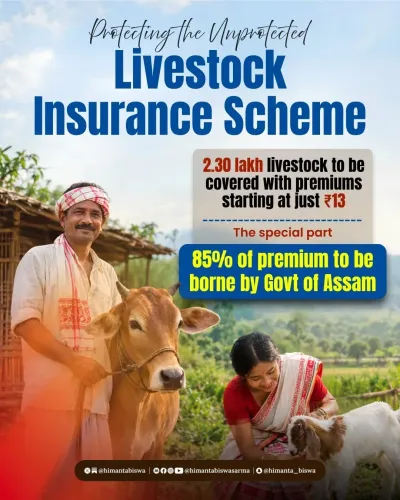
Small and marginal farmers pay only 15% of the insurance premium; the remaining 85% is shared by the Centre and states.
Coverage extends to up to 10 cattle units per beneficiary household for most eligible animals.
The latest five-year period recorded 60.8 lakh insured animals and ₹161.07 crore released under the scheme.
The government is exploring RFID tagging for improved animal identification and faster claim settlement.
The Centre's Department of Animal Husbandry and Dairying is set to launch the Livestock Insurance Portal on Monday, 29 September 2026, in a move aimed at digitising end-to-end livestock insurance services for farmers across India. The platform will serve as a single, integrated digital interface for policy issuance, claim processing, monitoring, and reporting under the government's Livestock Insurance Scheme.
Key Features of the Portal
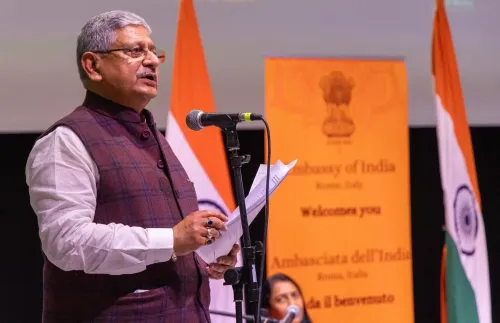
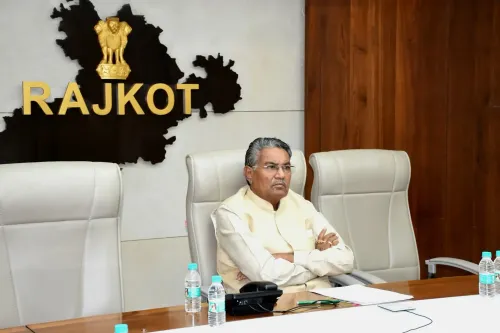
Union Minister for Fisheries, Animal Husbandry and Dairying Rajiv Ranjan Singh alias Lalan Singh will formally launch the portal. Beyond Hindi and English, the platform will be accessible in 11 regional languages, making it one of the more linguistically inclusive government insurance portals to date.
The portal is being developed as a web-based workflow under the National Livestock Mission, and is designed to cover registration, insurance coverage, and related protection services, while providing beneficiaries online access to scheme information.
How the Subsidy Structure Works
Under the existing framework, small and marginal farmers — the primary beneficiaries — contribute only 15 per cent of the insurance premium. The remaining 85 per cent is jointly funded by the Centre and state governments. Subsidised coverage extends to up to 10 cattle units per beneficiary household for most eligible animals, with separate limits applicable to pigs and rabbits.
According to government data, the programme's latest five-year reference period recorded 60.8 lakh insured animals, with ₹161.07 crore released under the scheme during the same period.
Technology Push: RFID Tagging on the Table
The Union government is also evaluating the possible use of radio-frequency identification (RFID) tagging to sharpen animal identification and assist in faster claim settlement. If adopted, this would mark a significant upgrade to the current identification infrastructure and reduce fraudulent claims — a longstanding challenge in livestock insurance programmes.
Notably, this initiative arrives at a time when rural digital access has expanded considerably, improving the practical reach of web-based government services in tier-2 and tier-3 districts.
What This Means for Livestock Farmers
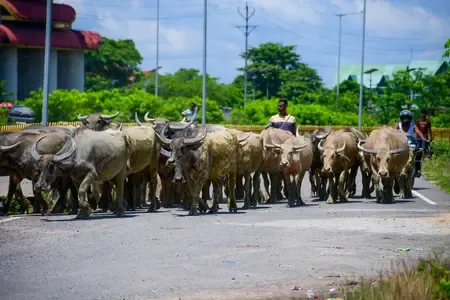
The portal promises better coordination and real-time monitoring of insurance programmes, with the stated objective of improving service delivery at the ground level. For millions of livestock-dependent households, timely claim settlement and transparent processing can directly determine livelihood stability — particularly in the event of disease outbreaks, accidents, or natural disasters affecting cattle.
The broader context is significant: livestock contributes roughly 4.11 per cent of India's GDP and supports the incomes of over 20 crore rural families, according to government estimates, making the efficiency of insurance delivery a matter of wider economic consequence. With the portal set to go live on Monday, implementation and farmer uptake will be the next critical test.
Point of View
But the harder challenge has never been the platform — it has been awareness and last-mile reach. India's livestock insurance penetration remains low relative to the scale of animal husbandry, with tens of crore households dependent on cattle income yet outside formal insurance coverage. Regional language support addresses one real barrier, but without dedicated field-level outreach — particularly in states where animal losses are most frequent — the portal risks becoming another well-designed government service that underperforms on uptake. The RFID angle is worth watching: fraud in claim settlement has historically blunted the scheme's effectiveness, and a credible identification system could change that calculus significantly.
NationPress
27 Sept 2026
Frequently Asked Questions
What is the Livestock Insurance Portal being launched by the Centre?
The Livestock Insurance Portal is a single, integrated digital platform for livestock insurance under the Department of Animal Husbandry and Dairying's Livestock Insurance Scheme. It will handle policy issuance, claim processing, monitoring, and reporting, and will be available in 13 languages including Hindi, English, and 11 regional languages.
Who will launch the Livestock Insurance Portal and when?
Union Minister for Fisheries, Animal Husbandry and Dairying Rajiv Ranjan Singh alias Lalan Singh will launch the portal on Monday, 29 September 2026. The announcement was made through an official government statement issued on Sunday.
How much do farmers have to pay for livestock insurance under this scheme?
Small and marginal farmers pay only 15 per cent of the insurance premium. The remaining 85 per cent is jointly subsidised by the Centre and state governments, making the scheme highly accessible for lower-income rural households.
How many animals have been insured under the Livestock Insurance Scheme so far?
According to government data, the scheme recorded 60.8 lakh insured animals in its latest five-year reference period, with ₹161.07 crore released under the scheme during the same period.
What is the role of RFID tagging in the new livestock insurance system?
The Union government is evaluating radio-frequency identification (RFID) tagging as a tool to improve animal identification and assist in faster, more accurate claim settlement. A decision on adoption has not yet been announced, but it is under active consideration.