Amit Shah: Rajasthan livestock insurance opens dairy export doors
Synopsis
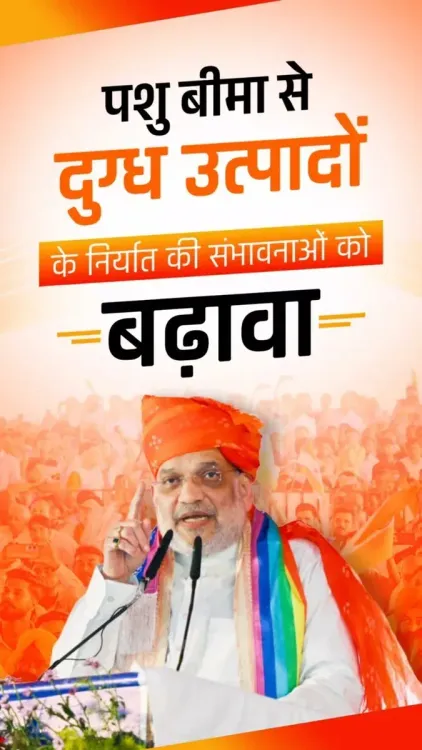
Union Home Minister Amit Shah, speaking at a development event in Alwar on 17 August 2026, said CM Bhajanlal Sharma's livestock insurance initiative will open pathways for dairy product exports, framing a state welfare scheme as an economic growth engine for Rajasthan.
Key Takeaways
Union Minister Amit Shah addressed an inauguration and foundation-laying event in Alwar district, Rajasthan on 17 August 2026 .
CM Bhajanlal Sharma's livestock insurance scheme was credited with creating conditions for expanded dairy product exports .
The event was amplified by the Chief Minister's Office of Rajasthan under the campaign tag #आपणो_अग्रणी_राजस्थान .
Livestock insurance is positioned as both a rural safety net for dairy farmers and livestock owners and a supply-side enabler for export-grade dairy production.
Specific details on scheme coverage and the development works inaugurated have not been officially disclosed.
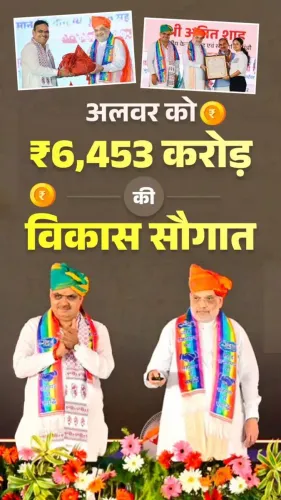
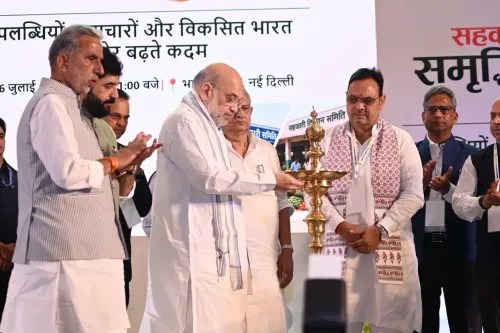
At a development inauguration event in Alwar district on Monday, 17 August 2026, Union Home and Cooperation Minister Amit Shah credited Chief Minister Bhajanlal Sharma's livestock insurance initiative with unlocking fresh possibilities for dairy export — a pointed signal that a state-level welfare scheme is being framed as an economic lever with national reach.
Addressing the programme for the inauguration and foundation-laying of various development works in Alwar, Shah said, in his words: 'The work that Chief Minister Bhajanlal Sharma has done in getting animals insured will open the doors of possibilities for the export of dairy products in the coming days.' The remark, delivered at a district-level event, was amplified by the Chief Minister's Office of Rajasthan under the hashtag #आपणो_अग्रणी_राजस्थान — 'Our Leading Rajasthan.'
Livestock insurance as a rural safety net in Rajasthan
Rajasthan's push on livestock insurance sits within a long tradition of state governments using animal husbandry schemes as rural welfare anchors. For a state where cattle and buffaloes are primary assets for millions of small farmers, insurance coverage reduces the financial shock of animal loss — and, crucially, keeps dairy herds intact. CM Bhajanlal Sharma, who took office in December 2023, has positioned the scheme as a flagship rural measure.
The logic Shah articulated is straightforward: insured livestock means more stable herds, more consistent milk output, and a supply base reliable enough to attract export-grade dairy processing investment. India is already one of the world's largest milk producers; the gap between production scale and export share remains wide, and state-level herd security schemes are seen as one lever to close it.
Why Alwar, and why now
Alwar, in eastern Rajasthan, sits within the milk-shed belt that feeds processing units across the region. Union ministers routinely attend district-level inauguration events to lend national visibility to state programmes — but Shah's explicit linkage of a welfare scheme to export potential is a deliberate upgrade in the scheme's political and economic framing. It positions Rajasthan's animal husbandry policy not merely as farmer relief, but as industrial groundwork.
Details on the specific development works inaugurated and the precise scale of the insurance scheme's current coverage remain to be officially disclosed. What is clear is that the BJP's dual leadership — Shah at the Centre, Sharma in Jaipur — is presenting a unified narrative: welfare spending as export infrastructure.
If the dairy export pipeline materialises, Rajasthan's livestock owners stand to gain a market premium on top of the safety net they already hold. That is the bet Shah placed publicly in Alwar.
Point of View
The BJP leadership in Rajasthan elevates a routine animal insurance programme into a national economic narrative. It also pre-empts criticism that the scheme is merely expenditure by anchoring it to measurable future outcomes — dairy export growth. For CM Bhajanlal Sharma, who is still consolidating his first full year in office, the endorsement from the Union Home Minister at a high-visibility district event is significant political capital. The broader pattern — Centre amplifying state BJP schemes — is now standard operating procedure ahead of any electoral cycle.
NationPress
1 Oct 2026
Frequently Asked Questions
What did Amit Shah say about Rajasthan's livestock insurance scheme?
At an Alwar event on 17 August 2026, Amit Shah said CM Bhajanlal Sharma's livestock insurance initiative will open doors for dairy product exports in the coming days.
What is the livestock insurance scheme in Rajasthan?
It is a state-level animal insurance initiative introduced under CM Bhajanlal Sharma's government to protect livestock owners from financial loss due to animal death, while also stabilising dairy herd sizes.
How does livestock insurance help dairy exports from Rajasthan?
Insured herds mean more stable milk supply, which can support export-grade dairy processing investment — the link Amit Shah drew at the Alwar event.
Where did Amit Shah make this statement about dairy exports?
He made the statement at a development works inauguration and foundation-laying programme in Alwar district, eastern Rajasthan, on 17 August 2026.
Who is CM Bhajanlal Sharma?
Bhajanlal Sharma is the Chief Minister of Rajasthan, in office since December 2023, representing the BJP.