Rajasthan CM Bhajanlal Drives Dairy Jobs for Rural Youth
Synopsis
The Rajasthan Chief Minister's Office says CM Bhajanlal Sharma's government is generating local employment for rural youth in the dairy sector under the 'Aapno Agrani Rajasthan' campaign, building on the state's cooperative dairy infrastructure and large livestock base.
Key Takeaways
The Rajasthan CMO announced on 13 July 2026 that local dairy-sector jobs are being created for rural youth.
CM Bhajanlal Sharma is personally tagged, indicating direct political ownership of the employment drive.
The initiative operates under the Aapno Agrani Rajasthan ('Our Leading Rajasthan') campaign banner.
The Rajasthan Cooperative Dairy Federation (RCDF) and its Saras brand form the institutional backbone for milk procurement and processing.
Rajasthan's large livestock population makes dairy a high-potential, low-investment route to rural income and a check on seasonal migration.
Future budget allocations and skill tie-ups with NDDB or RCDF will determine the scale of the programme.
The Chief Minister's Office of Rajasthan announced on Sunday, 13 July 2026 that the state government is actively generating local employment for rural youth in the dairy sector, crediting Chief Minister Bhajanlal Sharma with spearheading the initiative under the banner Aapno Agrani Rajasthan ('Our Leading Rajasthan').
Context
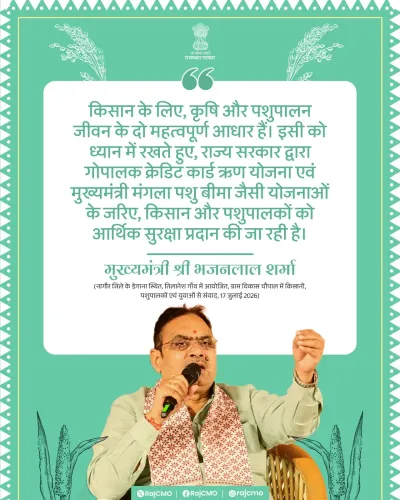
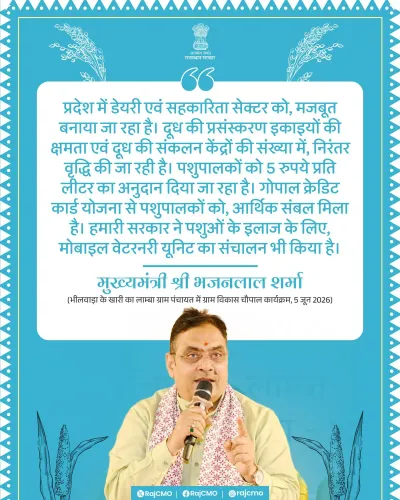
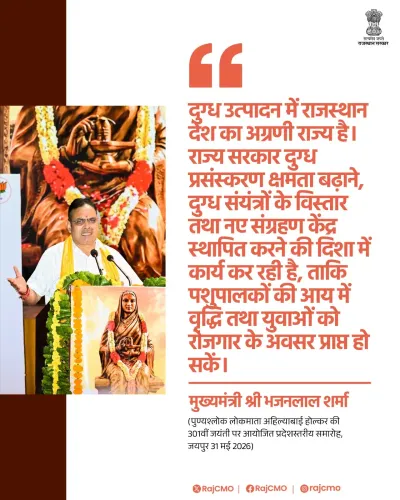
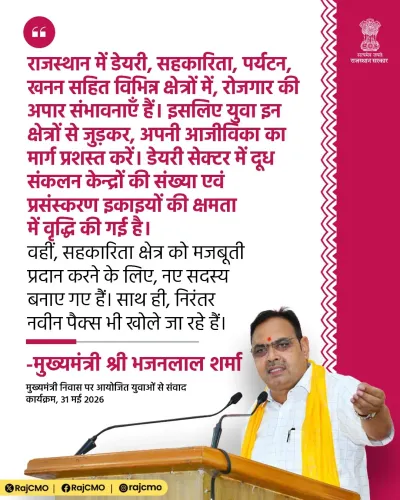
The post, shared from the official Rajasthan Chief Minister's Office handle, states: 'Dairy kshetre mein gramin yuvaon ko sthaniya star par, rozgar uplabdh karvaya ja raha hai' — 'Employment is being provided to rural youth at the local level in the dairy sector.' The message tags CM Bhajanlal Sharma directly, signalling personal ownership of the employment push.
The emphasis on local-level job creation is deliberate: it addresses the longstanding problem of seasonal migration among rural youth in Rajasthan, where limited off-farm income options have historically pushed workers toward cities in Gujarat, Delhi, and Maharashtra.
Policy Backdrop
Rajasthan has one of India's largest livestock populations, making dairy a natural anchor for rural livelihood programmes. The Rajasthan Cooperative Dairy Federation (RCDF), which manages the well-known Saras brand, forms the institutional backbone of the state's milk procurement and processing network, connecting village-level cooperatives to urban consumers.
India's dairy cooperative model traces its roots to Operation Flood, launched nationally in 1970, which established village dairy cooperatives and proved that organised milk collection could raise rural incomes sustainably. Rajasthan has built on this foundation across successive governments, integrating dairy with animal husbandry schemes to monetise the state's cattle wealth.
The current BJP administration, which took office in December 2023, has continued this emphasis, focusing on local value chains — milk chilling, processing, packaging, and distribution — as entry points for youth employment that require limited capital but yield steady income.
Stakeholders and Impact
Rural youth and dairy farmers are the primary beneficiaries. By anchoring jobs at the village or block level rather than in distant industrial clusters, the approach reduces relocation costs and keeps income circulating within rural communities. Women-led self-help groups involved in milk collection and cooperative management also stand to benefit from expanded dairy infrastructure.
For the broader rural economy, a stronger local dairy value chain can raise the floor price farmers receive for milk, reduce post-harvest losses through better chilling facilities, and create ancillary demand for feed, veterinary services, and equipment — multiplying the employment effect beyond direct dairy work.
What's Next
Analysts will watch the next Rajasthan state budget for specific allocations to animal husbandry and dairy processing, and for any formal skill-development tie-ups with the National Dairy Development Board (NDDB) or RCDF to train youth in dairy processing unit operations. The Aapno Agrani Rajasthan campaign framing suggests the government intends to position dairy employment as a flagship achievement ahead of future electoral cycles, making sustained funding commitments the key variable to watch.
Point of View
The BJP administration is building a narrative of proactive rural governance ahead of the next electoral cycle. The focus on local-level job creation, rather than aggregate milk-production figures, reflects a sharper political calculus: rural youth unemployment is a more visceral voter concern than dairy output statistics. Whether the initiative translates into measurable, verifiable employment numbers will determine how durable this messaging proves to be.
NationPress
10 Oct 2026
Frequently Asked Questions
What is the Rajasthan government doing for dairy sector employment?
The Rajasthan government, led by CM Bhajanlal Sharma, is creating local employment opportunities for rural youth in the dairy sector, focusing on village- and block-level roles in milk collection, chilling, processing, and distribution under the Aapno Agrani Rajasthan initiative.
Who is Bhajanlal Sharma and what is his role in Rajasthan dairy policy?
Bhajanlal Sharma is the Chief Minister of Rajasthan, serving since December 2023 after the BJP's victory in the state assembly elections. He has been tagged directly by the CMO as the driver of the dairy employment push.
What is the Rajasthan Cooperative Dairy Federation (RCDF)?
The RCDF is the apex cooperative body in Rajasthan that manages the Saras dairy brand and oversees milk procurement, processing, and distribution infrastructure across the state, supporting rural milk producers.
What is 'Aapno Agrani Rajasthan'?
'Aapno Agrani Rajasthan', meaning 'Our Leading Rajasthan', is a campaign slogan used by the Bhajanlal Sharma government to brand its governance and development initiatives, including the dairy employment drive.
How does dairy employment help reduce rural migration in Rajasthan?
By anchoring jobs at the local village or block level within the dairy value chain, the government aims to provide steady income without requiring workers to relocate to distant cities, directly addressing the seasonal migration that has long affected Rajasthan's rural economy.