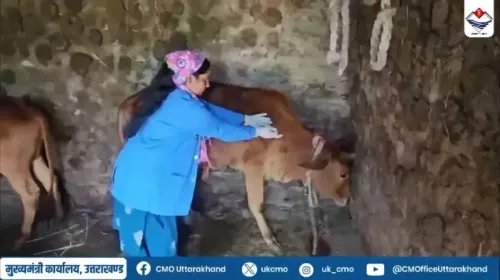
CM Dhami's Office Vows Stronger Animal Health Services in Uttarakhand
Synopsis
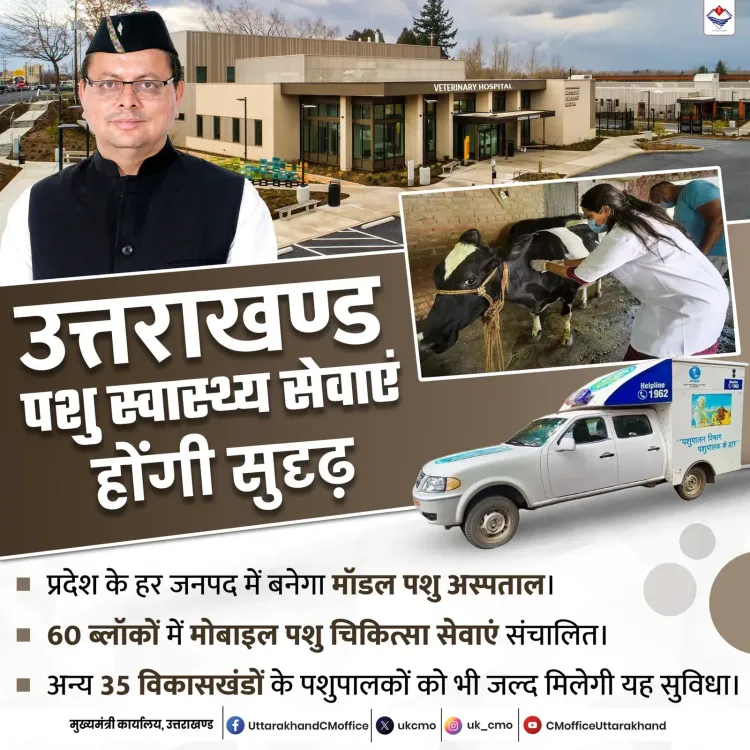
The Chief Minister's Office of Uttarakhand has announced that animal health services in the state will be strengthened, signalling a policy push by the Dhami government to upgrade veterinary infrastructure and support the state's livestock-dependent rural communities.
Key Takeaways
The Chief Minister's Office of Uttarakhand announced on 29 May 2026 that animal health services in the state will be strengthened.
Uttarakhand 's mountainous terrain creates unique challenges in delivering consistent veterinary care to remote farming communities.
The Department of Animal Husbandry is the nodal body for veterinary services, livestock health, and dairy development in the state.
The National Livestock Mission (launched 2014 ) provides a central government framework that states like Uttarakhand use to upgrade animal health infrastructure.
Livestock farmers, dairy producers, and veterinary staff across the state's thirteen districts are the primary stakeholders.
No specific budget, timeline, or scheme has been disclosed; concrete allocations and tender notices are the next milestones to watch.
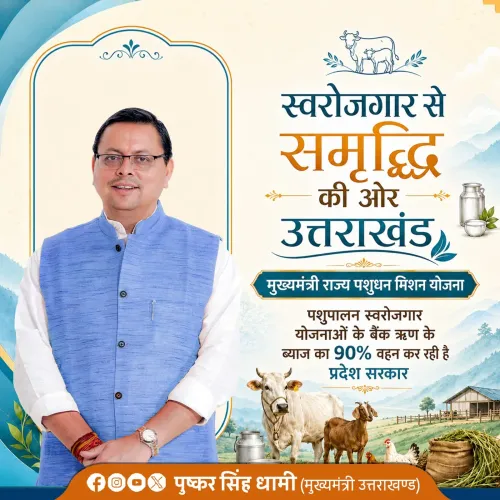
The Chief Minister's Office of Uttarakhand announced on Friday, 29 May 2026 that animal health services across the state will be strengthened, signalling a renewed push by the Pushkar Singh Dhami government to improve veterinary infrastructure for livestock-dependent communities.
Context
The post, shared by the official CMO handle, carried the message 'Uttarakhand mein pashu swasthya sevaen hongi sudridh' ('Animal health services in Uttarakhand will be strengthened'). While the announcement is brief, it signals a policy intent from the state government to address longstanding gaps in veterinary service delivery across the hill state.
Uttarakhand, formed in 2000, has a substantial rural population whose livelihoods depend on livestock and dairy. The state's mountainous terrain has historically made it difficult to deliver consistent veterinary care to remote villages, making any upgrade to animal health infrastructure particularly significant for farming households.
Policy Backdrop
The Department of Animal Husbandry is the nodal state body responsible for veterinary services, livestock health, and dairy development in Uttarakhand. Periodic upgrades to its capacity — including mobile clinics, disease surveillance, and breed improvement — have been part of the state's rural development agenda.
At the national level, the National Livestock Mission, launched by the central government in 2014, provides a framework for states to strengthen animal health infrastructure, covering breed improvement, feed and fodder development, and veterinary facilities. Uttarakhand has been among the states drawing on this framework to address rural income support through the livestock sector.
Indian hill states face a distinct challenge: terrain-related barriers mean that disease outbreaks can spread before veterinary teams reach affected herds, and livestock losses translate directly into income shocks for marginal farmers. Announcements of this nature typically precede budget allocations or tender notices for new facilities.
Stakeholders and Impact
The primary beneficiaries of improved animal health services are livestock farmers and dairy producers spread across Uttarakhand's thirteen districts, many of whom rely on cattle, goats, and sheep as their principal economic assets. Stronger veterinary infrastructure reduces the risk of disease-related herd losses and supports milk yield and quality.
Veterinary staff and field workers of the Department of Animal Husbandry also stand to benefit from upgraded equipment, better-equipped hospitals, and improved logistical support. For rural women, who manage a large share of livestock care in Uttarakhand's villages, accessible veterinary services carry particular importance.
What's Next
The announcement does not specify timelines, budgets, or particular schemes. Observers will watch for concrete follow-through in the form of state budget allocations, tender notices for new veterinary hospitals or mobile clinics, and disease-control programme launches in the coming fiscal cycle. The Dhami government's ability to translate this intent into measurable infrastructure on the ground will determine its impact on the state's rural economy.
As Uttarakhand continues to position its hill agriculture and dairy sector as drivers of rural income, sustained investment in animal health services will be central to that ambition.
Point of View
Building narrative momentum before concrete allocations are made public. For Uttarakhand, where terrain compounds the cost and complexity of veterinary delivery, the real test will be whether this translates into mobile infrastructure and decentralised disease-control capacity rather than just upgraded district hospitals. Analysts will track budget documents and tender notices as the true measure of this commitment.
NationPress
20 Sept 2026
Frequently Asked Questions
What did the Uttarakhand CMO announce about animal health services?
The Chief Minister's Office of Uttarakhand announced on 29 May 2026 that animal health services in the state will be strengthened, though specific schemes or budgets were not disclosed in the post.
Who is responsible for animal health services in Uttarakhand?
The Department of Animal Husbandry is the state government body responsible for veterinary services, livestock health, and dairy development in Uttarakhand.
How does the National Livestock Mission help Uttarakhand?
The National Livestock Mission, launched by the central government in 2014, provides a framework for states including Uttarakhand to improve breed development, feed and fodder supply, and veterinary infrastructure.
Who benefits from stronger veterinary services in Uttarakhand?
Livestock farmers, dairy producers, and rural women who manage animal care across Uttarakhand's thirteen districts are the primary beneficiaries, along with veterinary field staff who gain better support and equipment.
What challenges does Uttarakhand face in delivering animal health services?
The state's Himalayan terrain makes it difficult to reach remote villages quickly, increasing the risk that disease outbreaks spread before veterinary teams can respond, which directly threatens farm incomes.