CM Bhajan Lal Reviews Rajasthan Livestock Vaccination Drive
Synopsis
Rajasthan Chief Minister Bhajan Lal Sharma reviewed the state's animal disease prevention and vaccination programme on 14 July 2026, directing the Department of Animal Husbandry to expand coverage to every eligible animal in a time-bound, effective manner to strengthen farmer incomes and the rural economy.
Key Takeaways
CM Bhajan Lal Sharma chaired a Department of Animal Husbandry review meeting on 14 July 2026 focused on livestock vaccination progress.
He directed officials to make the vaccination drive more effective, comprehensive, and time-bound.
The stated goal is to ensure every eligible animal in Rajasthan receives vaccination coverage.
The push aligns with the central National Animal Disease Control Programme launched in September 2019 targeting 100 percent vaccination against Foot and Mouth Disease and Brucellosis.
Rajasthan has one of India's largest livestock populations, making animal health a key driver of rural income and dairy output.
Departmental coverage reports and potential new budget allocations are the next milestones to watch.
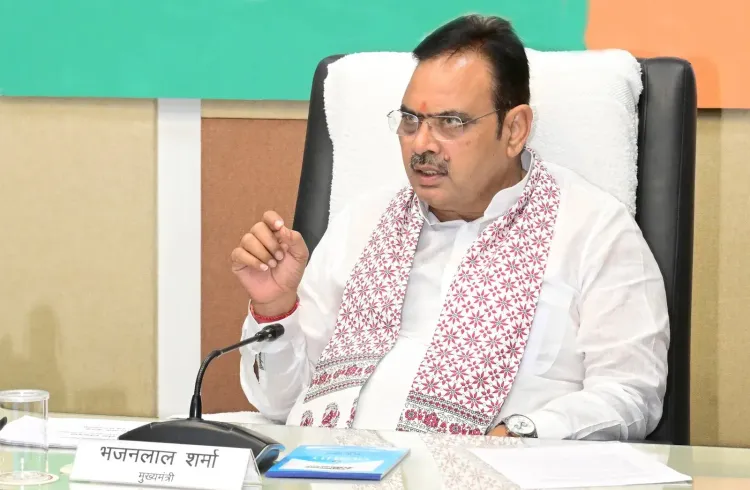
Rajasthan Chief Minister Bhajan Lal Sharma chaired a review meeting of the Department of Animal Husbandry on Tuesday, 14 July 2026, to assess the progress of the state's animal disease prevention and vaccination programme. He directed officials to make the vaccination drive more effective, wider in reach, and time-bound, with the explicit goal of ensuring every eligible animal is covered.
Context
Posting on X, CM Sharma summarised the thrust of the meeting in Hindi: 'स्वस्थ पशुधन, समृद्ध किसान और सशक्त राजस्थान की आधारशिला है' — 'Healthy livestock is the foundation of a prosperous farmer and a strong Rajasthan.' He framed the vaccination push as central to his government's commitment to rural welfare and economic resilience.
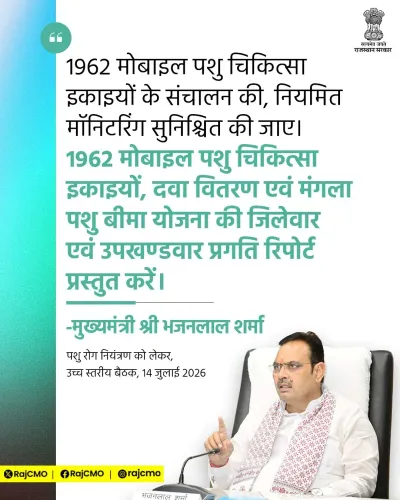
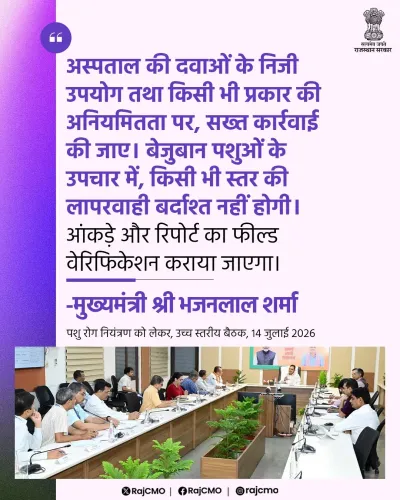
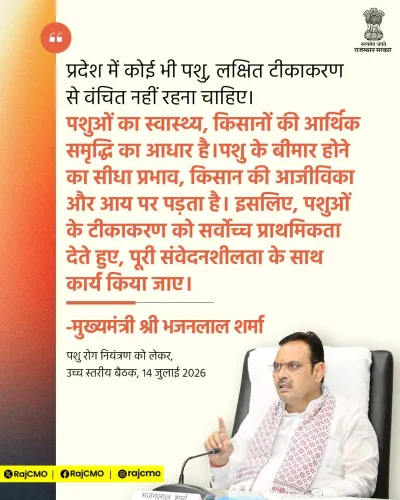
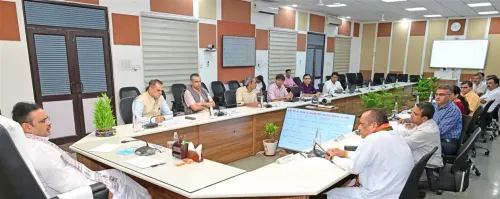
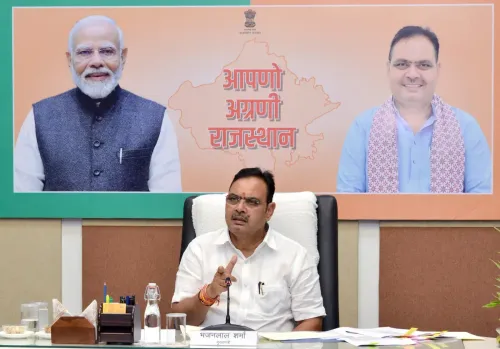
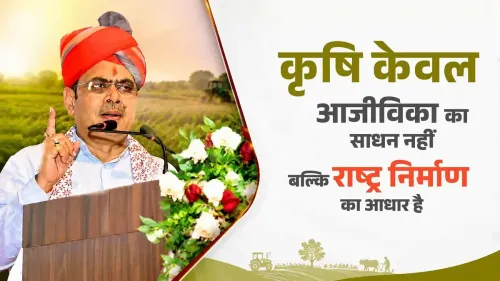
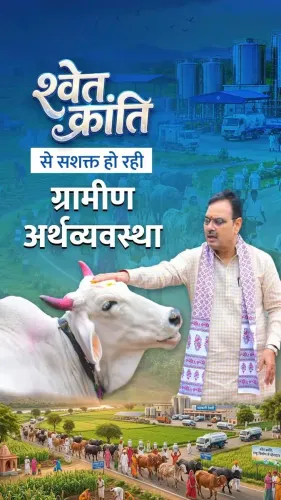
He stated that directions were issued to ensure the programme is conducted in a 'more effective, comprehensive, and time-bound manner' and that vaccination reaches every eligible animal across the state. The post was accompanied by four images from the departmental meeting.
Policy Backdrop
The review sits within a well-established national framework. The Government of India launched the National Animal Disease Control Programme (NADCP) in September 2019 to achieve 100 percent vaccination coverage against major livestock diseases, including Foot and Mouth Disease and Brucellosis. Rajasthan has also implemented periodic mass vaccination campaigns under the National Livestock Mission framework since 2014.
Rajasthan holds one of the largest livestock populations among Indian states, making animal health a direct lever for rural income. Disease outbreaks in the bovine population can cause significant economic losses for farmers and disrupt milk supply chains, which is why state-level implementation of central vaccination schemes carries outsized importance here.
Stakeholders and Impact
The primary beneficiaries of an expanded vaccination programme are livestock farmers and rural dairy producers across Rajasthan's villages. Healthier animals translate into higher milk yields, reduced veterinary costs, and more stable livelihoods for households dependent on animal husbandry.
Broader rural economic indicators — including income levels in agrarian districts — are closely tied to livestock health. Central and state governments have increasingly treated preventive animal healthcare as an integral component of agricultural growth strategy, not a peripheral welfare measure.
What's Next
The key metrics to watch will be departmental reports on vaccination coverage percentages across Rajasthan's districts and whether the state announces additional budget allocations for the programme in the next budget session. CM Sharma's directive for a 'time-bound' rollout suggests that measurable targets and deadlines may be formalised in the coming weeks.
If the state achieves significantly higher coverage under this renewed push, it could serve as a model for other high-livestock-population states and reinforce Rajasthan's standing in centrally monitored animal disease control indices.
Point of View
Not merely a bureaucratic exercise. With rural Rajasthan heavily dependent on animal husbandry, improving vaccination coverage is a low-cost, high-visibility intervention that directly links to farmer income — a core BJP electoral concern. The emphasis on 'time-bound' delivery suggests the government is aware that past campaigns have suffered from implementation gaps, and is now seeking accountability metrics. This fits a broader national pattern of state governments using preventive animal healthcare as a bridge between welfare optics and measurable rural economic outcomes.
NationPress
13 Oct 2026
Frequently Asked Questions
What did Rajasthan CM Bhajan Lal Sharma announce about the livestock vaccination programme?
CM Bhajan Lal Sharma directed the Department of Animal Husbandry on 14 July 2026 to conduct the animal disease prevention and vaccination programme in a more effective, comprehensive, and time-bound manner, ensuring every eligible animal in Rajasthan is covered.
What is the National Animal Disease Control Programme?
The National Animal Disease Control Programme is a central government scheme launched in September 2019 to achieve 100 percent vaccination coverage against major livestock diseases, including Foot and Mouth Disease and Brucellosis, across India.
Why is livestock vaccination important for Rajasthan farmers?
Rajasthan has one of India's largest livestock populations, and animal health directly affects farmer incomes through milk yields and reduced veterinary costs. Disease outbreaks can cause significant economic losses for rural dairy producers and agrarian households.
Which department oversees animal vaccination in Rajasthan?
The Department of Animal Husbandry, a Rajasthan state government body, is responsible for livestock health, disease prevention, and vaccination drives in the state.
What are the next steps after the CM's livestock vaccination review meeting?
Departmental reports on district-wise vaccination coverage percentages and any new budget allocations for the programme in the next state budget session are the key developments to watch following the 14 July 2026 review.