CM Sai: Skill Centres, Bastar Olympics Drive Naxal-Free Vision
Synopsis
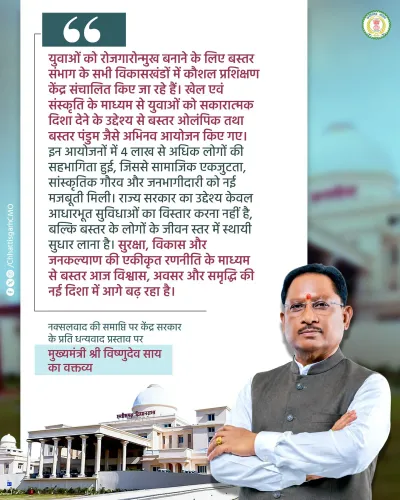
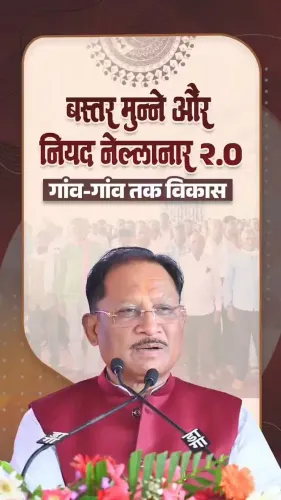
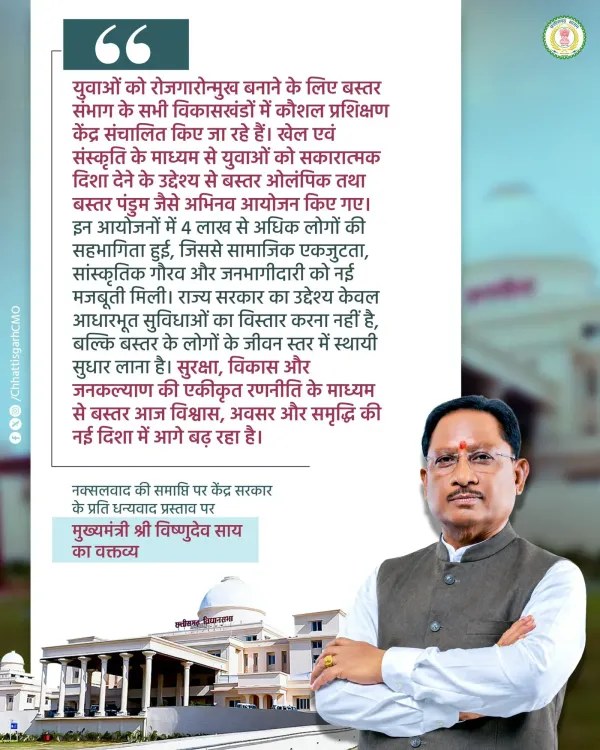
Chief Minister Vishnu Deo Sai, in a statement on a resolution thanking the central government for ending Naxalism, said skill centres are running across all Bastar blocks and events like Bastar Olympics drew over four lakh participants, anchoring an integrated security-development push.
Key Takeaways
Skill training centres are operational across all development blocks of Bastar division to make youth employment-ready.
The Bastar Olympics and Bastar Pandum cultural-sports events recorded participation of more than four lakh people .
CM Vishnu Deo Sai made the statement in the context of a resolution of thanks to the central government for its role in eliminating Naxalism.
The state government frames its approach as a unified strategy of security, development, and public welfare — not just infrastructure expansion.
The initiative targets tribal youth in Bastar, a region historically affected by Left Wing Extremism, with the goal of lasting improvement in living standards.
The Chief Minister's Office of Chhattisgarh, on 15 July 2026, shared a statement by Chief Minister Vishnu Deo Sai outlining the state government's integrated strategy for Bastar — combining skill training, sports, and cultural outreach with security operations — as part of a formal resolution of thanks to the central government for its role in ending Naxalism in the region.
Context
Speaking on a resolution of thanks to the central government over the elimination of Naxalism, CM Sai stated that skill training centres are now operational across sabhī vikāsakhaṇḍoṃ (all development blocks) of Bastar division, aimed at making youth employment-ready. He added that innovative events such as the Bastar Olympics and Bastar Pandum were organised to give youth a positive direction through sports and culture, drawing participation of more than four lakh people.
The CM described the government's goal as not merely expanding basic infrastructure, but bringing about a sthāyī sudhār (lasting improvement) in the living standards of the people of Bastar. He framed the approach as a unified strategy of security, development, and public welfare.
Policy Backdrop
Bastar, the southern division of Chhattisgarh, has for decades been the epicentre of Left Wing Extremism in India. Successive state governments since the early 2000s have paired security operations with rehabilitation and development packages targeting Naxal-affected districts.
The current BJP government, which assumed office in December 2023 under CM Vishnu Deo Sai, has positioned itself as accelerating this integrated model — combining intensified anti-Naxal operations with youth-focused economic and cultural programmes. The Bastar Olympics and Bastar Pandum are flagship cultural and sporting events designed to foster community participation and social cohesion among the region's predominantly tribal population.
This approach mirrors a nationwide shift in policy toward former Left Wing Extremism zones, moving from purely kinetic responses to sustainable development strategies that address the socio-economic roots of insurgency.
Stakeholders and Impact
The primary beneficiaries of these initiatives are the youth and tribal communities of Bastar division, which spans several districts with historically limited access to formal employment and education. Skill training centres across all development blocks aim to bridge this gap by creating a pipeline of employment-ready youth.
The Bastar Olympics and Bastar Pandum events, with their reported participation of over four lakh people, are presented as tools for building social solidarity and cultural pride — factors the government argues are essential to preventing youth radicalisation. The resolution of thanks to the central government also signals continued state-centre coordination on the Naxal issue.
What's Next
The roll-out and placement outcomes of skill training centres across Bastar's development blocks will be a key metric for assessing the programme's real-world impact. Further central-state coordination meetings on residual Naxal infrastructure are also anticipated.
As Bastar is positioned by the state government as moving toward 'a new direction of trust, opportunity, and prosperity,' the sustainability of these gains — particularly in youth employment and community participation — will determine whether the integrated model delivers lasting change in one of India's most historically troubled regions.
Point of View
Delivered in the formal context of a resolution of thanks to New Delhi, is as much a political signal as a policy update — it publicly credits the central government for the security gains in Bastar while positioning the state BJP administration as the delivery vehicle for the development dividend. The pairing of Bastar Olympics and skill centres with anti-Naxal rhetoric reflects a deliberate effort to reframe Bastar's identity from a conflict zone to an opportunity zone. This integrated model, if it demonstrates measurable placement outcomes from the skill centres, could become a template cited in other Left Wing Extremism-affected states. The real test, however, lies in whether the cultural enthusiasm generated by events like Bastar Pandum translates into sustained economic mobility for tribal youth.
NationPress
13 Oct 2026
Frequently Asked Questions
What are the skill training centres in Bastar and who can benefit?
The Chhattisgarh government has set up skill training centres across all development blocks of Bastar division to provide vocational and employment-oriented training to local youth, particularly from tribal communities.
What is Bastar Olympics?
Bastar Olympics is a state-organised sporting event in Bastar division of Chhattisgarh, designed to channel youth energy positively and build community participation; the government reports over four lakh people participated in Bastar Olympics and Bastar Pandum combined.
What is Bastar Pandum?
Bastar Pandum is a cultural festival organised by the Chhattisgarh government in the Bastar region to celebrate and preserve the tribal cultural heritage of the area, alongside the Bastar Olympics.
What did CM Vishnu Deo Sai say about Naxalism in Bastar?
CM Sai stated that through an integrated strategy of security, development, and public welfare, Bastar is moving in a new direction of trust, opportunity, and prosperity; his remarks came as part of a resolution of thanks to the central government for its role in ending Naxalism.
What is the Chhattisgarh government's strategy for Bastar development?
The government's strategy combines security operations with skill training, sports events, and cultural programmes to address the socio-economic roots of insurgency and bring lasting improvement to the living standards of Bastar's people.