CM Sai Hails Bastar's Shift from Naxal Terror to Development
Synopsis
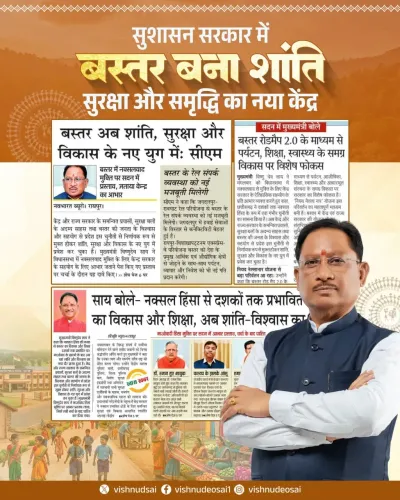
Chhattisgarh Chief Minister Vishnu Deo Sai declared on 23 June 2026 that Bastar, once the heartland of Maoist insurgency, now stands on a path of development and new possibilities, crediting PM Modi's 'Nation First' resolve and the courage of security forces for the shift.
Key Takeaways
CM Vishnu Deo Sai posted on 23 June 2026 that Bastar has transitioned from Naxal terror to development confidence.
He credited PM Narendra Modi 's 'Nation First' resolve and security forces' valour for 'closing the chapter of Naxalism' in the region.
Bastar has historically been the core of India's Left Wing Extremism belt, part of the so-called Red Corridor.
The central government's SAMADHAN doctrine (2017) and the Integrated Action Plan (2010) have guided the combined security-and-development approach in LWE-affected districts.
Road, rail, and telecom infrastructure expansion in Bastar post- 2014 has been central to both counter-insurgency and civilian welfare delivery.
Annual Ministry of Home Affairs LWE incident data for 2025-26 will be a key independent benchmark for the claims of transformation.
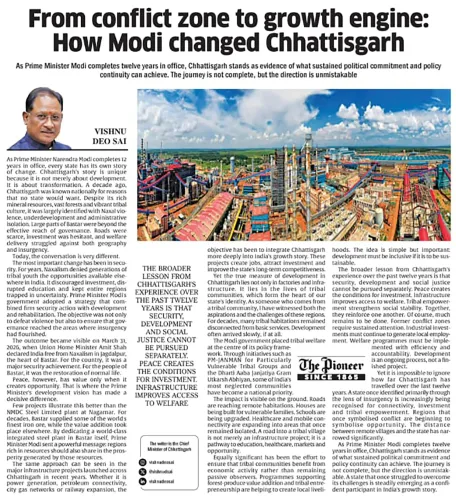
Chhattisgarh Chief Minister Vishnu Deo Sai on Tuesday, 23 June 2026 declared that Bastar, once gripped by Naxal terror, now stands on a path of development and new possibilities, crediting Prime Minister Narendra Modi's 'Nation First' resolve and the valour of security forces for the transformation.
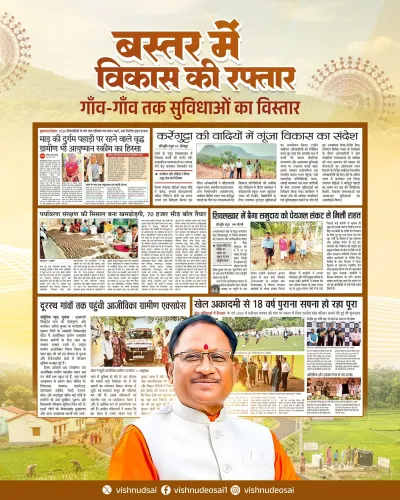
Posting in Hindi on X, Chief Minister Sai wrote: 'जहां कभी नक्सलवाद का आतंक था, वहां आज विकास का आत्मविश्वास है' — 'Where once there was the terror of Naxalism, today there is the confidence of development.' He added that PM Modi's 'Nation First' pledge and the 'indomitable courage' of security forces had 'closed the chapter of Naxalism' and set Bastar on a course of 'development, trust, and new possibilities.'
Context
Bastar, a sprawling division in southern Chhattisgarh with a predominantly tribal population, has for decades been considered the heartland of the Maoist insurgency in India. The region formed part of what security planners called the 'Red Corridor' — a belt of Left Wing Extremism (LWE) stretching across several central and eastern states. Successive governments reported a progressive shrinkage in Naxal-affected districts and violence incidents, though assessments of the insurgency's status have varied over time.
Chief Minister Sai, a BJP leader who took office in December 2023, has consistently framed Bastar's trajectory as a central achievement of the state government's tenure. His post, accompanied by a video, was made on a Tuesday morning, suggesting a deliberate communication aimed at a national audience.
Policy Backdrop
The central government's approach to LWE has evolved over more than a decade. The Integrated Action Plan (IAP), launched in 2010, targeted 60 LWE-affected districts with governance and infrastructure spending. In 2017, the Ministry of Home Affairs formalised the SAMADHAN doctrine, combining security operations, financial tracking of Maoist networks, and accelerated development works.
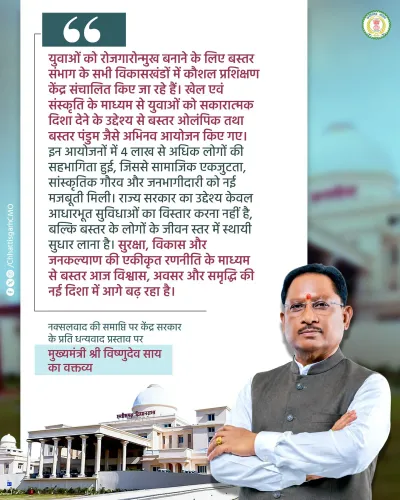
After 2014, the pace of road, rail, and telecom projects in Bastar accelerated markedly, with the central government framing connectivity investments as simultaneously economic and counter-insurgency measures. Mobile towers, all-weather roads, and banking access in previously inaccessible forest areas have been cited as key enablers of both security operations and civilian welfare delivery.
Stakeholders and Impact
The communities most directly affected by any change in Bastar's security environment are the tribal populations of the division — among the most economically marginalised groups in India. For them, the practical markers of transformation include access to schools, health centres, ration shops, and roads that were previously disrupted or inaccessible due to Maoist activity.
State police and central paramilitary forces — including the CRPF and specialised units — have sustained operations in the region over many years, often at significant human cost. CM Sai's post specifically acknowledges their role, reflecting the political importance of recognising security personnel in official communication. District administrations in Bastar have also expanded their footprint in areas that were previously off-limits.
What's Next
The annual data on LWE incidents from the Ministry of Home Affairs for 2025-26 will be closely watched as an independent measure of the security situation in Bastar and the broader Red Corridor. Any new centrally-sponsored development packages announced for the region will further test whether the governance gains CM Sai describes are being institutionalised.
For the BJP government in Raipur, Bastar's narrative — from insurgency to opportunity — is also politically significant ahead of future electoral cycles, positioning the ruling dispensation as the architect of a durable peace in one of India's most challenging regions.
Point of View
Framing Bastar's security trajectory as a vindication of the Modi government's 'security plus development' doctrine ahead of future electoral cycles. The messaging follows a well-established BJP pattern of converting counter-insurgency milestones into governance narratives, tying local outcomes to the Prime Minister's national brand. While the broader trend of declining LWE violence is documented by successive governments, the claim that the 'chapter of Naxalism' is closed remains a political assertion rather than a verified security conclusion. The post's release with a video on a weekday morning suggests a coordinated communications effort, not a spontaneous reaction, pointing to Bastar's continued centrality in the ruling party's Chhattisgarh identity.
NationPress
21 Sept 2026
Frequently Asked Questions
Has Naxalism ended in Bastar Chhattisgarh?
The Chhattisgarh government and CM Vishnu Deo Sai have asserted that the 'chapter of Naxalism' in Bastar is effectively closed, but this is a political claim; independent verification requires official LWE incident data from the Ministry of Home Affairs, which is released annually.
What is the SAMADHAN doctrine for Naxalism?
The SAMADHAN doctrine, articulated by the Ministry of Home Affairs in 2017, is a comprehensive strategy combining security operations, financial tracking of Maoist networks, and accelerated development works to address Left Wing Extremism in affected districts.
Who is Vishnu Deo Sai?
Vishnu Deo Sai is a BJP leader and the Chief Minister of Chhattisgarh, in office since December 2023. He previously served as a Union Minister in the central government.
Why is Bastar important in the context of Naxalism?
Bastar, a division in southern Chhattisgarh with a predominantly tribal population, has long been considered the heartland of India's Maoist insurgency and a core part of the Red Corridor — the belt of Left Wing Extremism-affected states.
What development work has been done in Bastar to counter Naxalism?
Since 2010, the central government's Integrated Action Plan targeted LWE-affected districts with infrastructure and governance spending. Post-2014, road, rail, and telecom projects in Bastar accelerated, framed as both economic development and counter-insurgency measures.