CM Sai Highlights Bastar's Transformation Under BJP Governance
Synopsis
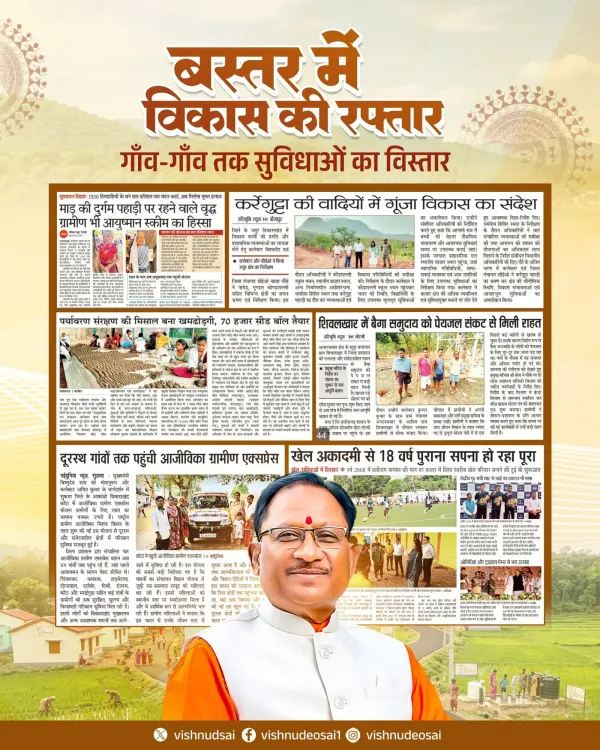
Chhattisgarh Chief Minister Vishnu Deo Sai declared on 30 May 2026 that Bastar is becoming a new symbol of development and trust, with remote tribal villages now receiving roads, schools, healthcare, housing, and livelihood opportunities under the state government's welfare programmes.
Key Takeaways
CM Vishnu Deo Sai posted on 30 May 2026 that Bastar is transforming into a symbol of development, trust, and public welfare.
Remote forest villages in Bastar, long deprived of basic amenities, are now receiving roads, education, healthcare, drinking water, housing, and livelihood support.
The government frames the change as felt in people's lives — through trust, dignity, security, self-confidence, and prosperity — not just in official figures.
The approach aligns with the national SAMADHAN doctrine , which pairs security operations with development delivery in Left-Wing Extremism-affected districts.
Chhattisgarh's BJP government, in power since December 2023 , has made Bastar outreach a flagship governance priority.
Independent verification through district-wise scheme utilisation data and state assembly scrutiny is anticipated.
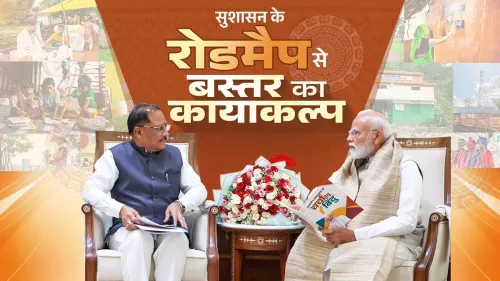
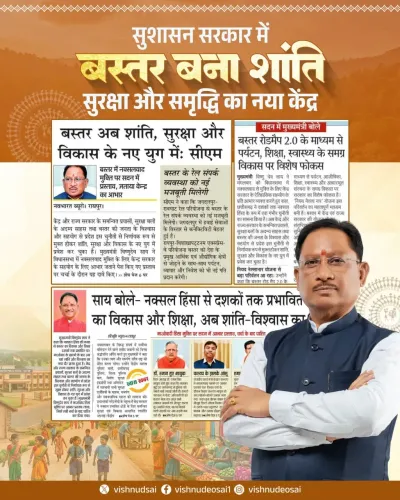
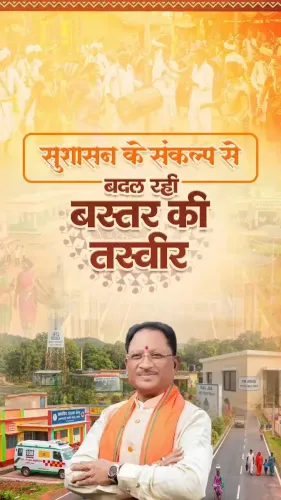
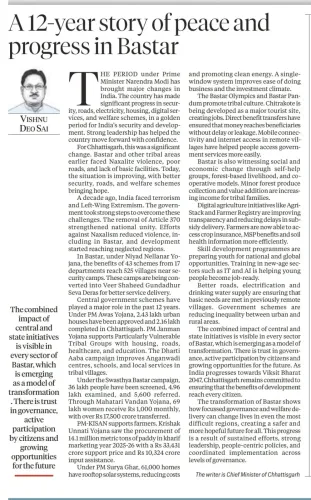
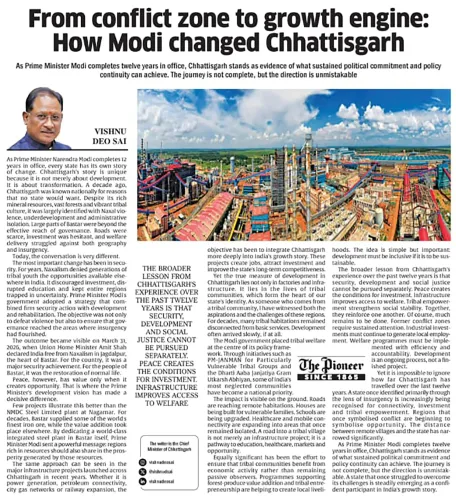
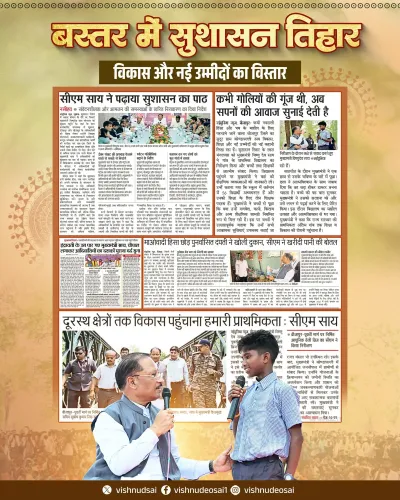
Chhattisgarh Chief Minister Vishnu Deo Sai on Saturday, 30 May 2026, declared that Bastar is emerging as a new symbol of development, trust, and public welfare, crediting his government's people-centric schemes for bringing tangible change to the region's remote forest villages.
Writing in Hindi, the Chief Minister stated: 'नया बस्तर अब विकास, विश्वास और जनकल्याण की नई पहचान बन रहा है' ('New Bastar is now becoming a new identity of development, trust, and public welfare'). He noted that villages once deprived of basic amenities are now receiving roads, education, healthcare, drinking water, housing, and livelihood opportunities.
Context
Bastar, a southern division of Chhattisgarh, comprises seven districts with a predominantly tribal population and has historically been among India's most conflict-affected regions due to decades of Left-Wing Extremism. Persistent insurgency had severely constrained the delivery of public services and infrastructure in its remote forest belts. The region's villages were long cited as among the most underserved in central India.
CM Sai, who took charge in December 2023 after the BJP's return to power in Chhattisgarh, has consistently positioned Bastar outreach as a cornerstone of his administration's agenda. His post reflects a deliberate effort to frame the state's approach as combining security operations with grassroots welfare delivery.
Policy Backdrop
The development push in Bastar sits within a broader national framework targeting Left-Wing Extremism districts. The central government's SAMADHAN doctrine, operational since the mid-2010s, explicitly pairs anti-insurgency measures with accelerated delivery of roads, schools, health facilities, and housing in affected districts. Chhattisgarh has been a primary focus of this integrated strategy.
State-level programmes under the current BJP government have sought to extend this model, channelling welfare schemes into villages that security forces have progressively brought under administrative reach. Roads and connectivity projects are considered a particular priority, as they underpin access to every other service.
Stakeholders and Impact
The primary beneficiaries are Bastar's tribal communities, spread across densely forested and geographically isolated villages. For these communities, the convergence of road connectivity, school access, primary healthcare, and housing schemes represents a qualitative shift from years of exclusion from mainstream government delivery systems.
CM Sai's post specifically frames the change not merely in statistical terms but as a felt experience — of 'विश्वास, सम्मान, सुरक्षा, आत्मविश्वास और समृद्धि' ('trust, dignity, security, self-confidence, and prosperity') — signalling an intent to anchor the government's narrative around lived outcomes rather than administrative metrics alone.
What's Next
Observers will watch for the release of district-wise scheme utilisation data from Bastar that can substantiate the claims of expanded service delivery. Any forthcoming Chhattisgarh state assembly session is also expected to see discussion on Bastar-specific development packages and security-linked welfare allocations.
The broader test for the administration will be whether the pace of infrastructure and welfare delivery in Bastar's most remote areas can be sustained and independently verified, as the region remains a benchmark for India's integrated approach to addressing Left-Wing Extremism through governance.
Point of View
Positioning Bastar's incremental security gains as a platform for welfare delivery — a narrative the BJP has cultivated nationally in Left-Wing Extremism districts since the mid-2010s. By emphasising felt experience over statistics, the Chief Minister is insulating the message from data-based scrutiny while appealing directly to tribal communities whose trust the party has historically struggled to consolidate in the region. The framing of 'new Bastar' also serves a forward-looking electoral purpose, embedding the government's identity with visible change in one of Chhattisgarh's most symbolically significant and contested territories. The real measure of this narrative will come when district-level delivery data and independent assessments are placed on the public record.
NationPress
15 Oct 2026
Frequently Asked Questions
What is CM Vishnu Deo Sai saying about Bastar's development?
CM Sai stated on 30 May 2026 that Bastar is becoming a new symbol of development, trust, and welfare, with remote tribal villages now receiving roads, education, healthcare, drinking water, housing, and livelihood opportunities.
What is the SAMADHAN doctrine and how does it relate to Bastar?
SAMADHAN is the central government's integrated strategy for Left-Wing Extremism districts that pairs security operations with accelerated delivery of roads, schools, health facilities, and housing. Bastar in Chhattisgarh is one of the primary focus areas of this approach.
Why has Bastar historically been underdeveloped?
Bastar's remote forest geography and decades of Left-Wing Extremism severely restricted the delivery of public services and infrastructure, leaving its predominantly tribal villages among the most underserved in central India.
When did the current Chhattisgarh government come to power?
The BJP government led by Chief Minister Vishnu Deo Sai came to power in Chhattisgarh in December 2023 following the state assembly elections.
What development facilities are now reaching Bastar villages?
According to CM Sai's post, villages in Bastar are now receiving roads, education, healthcare, drinking water, housing, and livelihood opportunities — services that were previously absent in many remote forest areas.