CM Sai, Modi, Shah credited as Bastar charts post-Naxal path
Synopsis
The Chhattisgarh Chief Minister's Office declared Bastar's transition from insurgency to development on 17 July 2026, attributing the shift to the combined leadership of PM Modi, Home Minister Amit Shah, and CM Vishnu Deo Sai, and calling for a new era of peace and tribal progress in the region.
Key Takeaways
The Chhattisgarh CMO posted on 17 July 2026 describing Bastar as moving from fear and conflict to trust and development.
PM Narendra Modi , Home Minister Amit Shah , and CM Vishnu Deo Sai were jointly credited for the region's claimed transformation.
The post used hashtags #NaxalFreeBastar and #BadaltaBastar , signalling a coordinated government narrative push.
The BJP government in Chhattisgarh, in power since December 2023 , has pursued a dual-track strategy of security operations and development in Left Wing Extremism-affected districts.
The Union government's Aspirational Districts Programme has been active in Bastar since 2018 , targeting health, education, and infrastructure improvements.
Delivery of road, school, and health projects in Bastar will be the practical measure of the government's development claims.
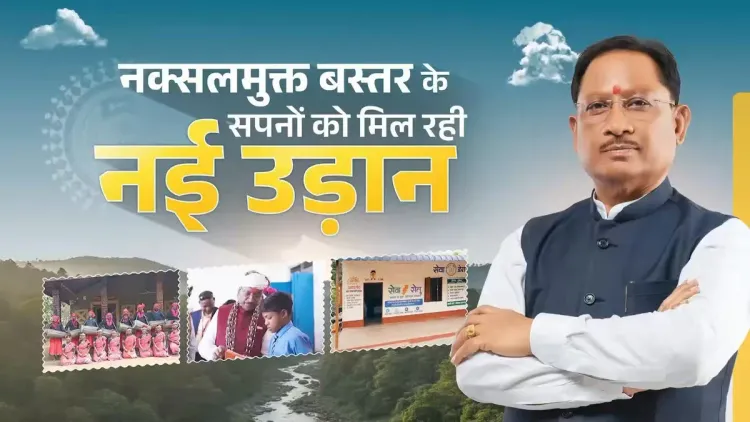
The Chief Minister's Office of Chhattisgarh on Friday, 17 July 2026 shared a message describing Bastar as having moved from fear to trust and from conflict to development, crediting the combined leadership of Prime Minister Narendra Modi, Union Home Minister Amit Shah, and Chief Minister Vishnu Deo Sai for the region's transformation.
Context
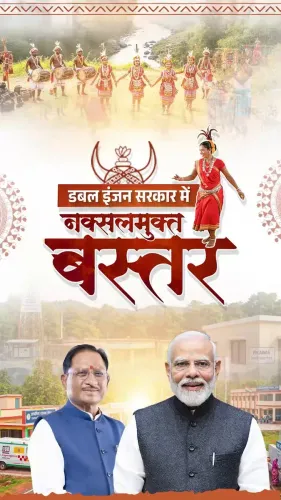
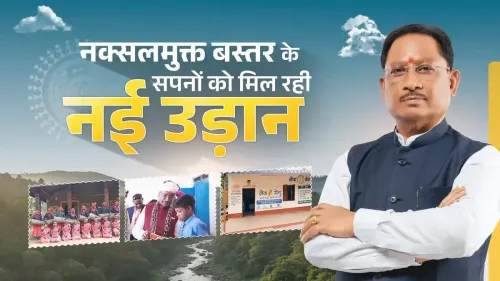
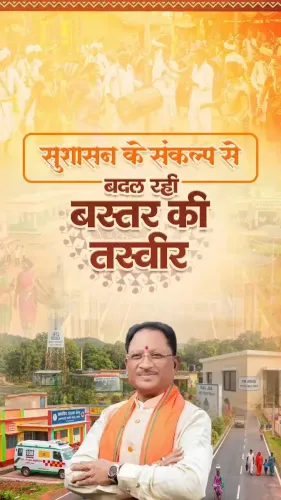
The post, written in Hindi, declares: 'डर से विश्वास तक... संघर्ष से विकास तक...' ('From fear to trust... from struggle to development...'), framing Bastar as forging a new identity. It states that under the guidance of Modi, the resolve of Shah, and the leadership of Sai, a Naxal-free Bastar is now moving toward a new era of peace, security, and development. The CMO used hashtags including #NaxalFreeBastar, #BadaltaBastar (Changing Bastar), and #TribalDevelopment, signalling a coordinated government messaging push around the region.
Policy Backdrop
The BJP government that came to power in Chhattisgarh after the December 2023 assembly elections made anti-Naxal operations and simultaneous development in Left Wing Extremism-affected districts a stated priority. The dual-track approach — pairing security operations with road connectivity, welfare delivery, and local governance — has been the central government's framework across Chhattisgarh, Jharkhand, and Odisha for several years.
The Union government's Aspirational Districts Programme, running since 2018, has covered Bastar with the aim of improving health, education, and infrastructure indicators in conflict-affected zones. Chief Minister Vishnu Deo Sai, who assumed office in December 2023, has emphasised tribal welfare alongside security consolidation as twin pillars of his administration's agenda in the region.
Stakeholders and Impact
Bastar's tribal communities stand at the centre of both the security narrative and the development promises. The region is home to significant Adivasi populations and considerable mineral wealth, making the question of who benefits from post-conflict development a closely watched one. Security forces deployed across the region have borne the operational burden of anti-insurgency campaigns over decades.
Local residents and tribal groups in Bastar have long sought greater access to schools, health facilities, and road connectivity — services that conflict disrupted for years. The government's messaging positions these communities as the primary beneficiaries of the claimed transformation, though independent assessment of on-ground delivery remains ongoing.
What's Next
The rollout of announced road, school, and health projects in Bastar will be the practical test of the government's claims. Any formal review of violence statistics by the Ministry of Home Affairs is expected to provide a more granular picture of the security situation. The CMO's post reflects a broader effort to consolidate the political narrative around Bastar as a governance success story ahead of continued scrutiny from civil society and opposition voices.
Point of View
Reinforcing a BJP-wide claim of success in a region that has been a benchmark for internal security policy for two decades. By framing Bastar's transformation as a trilateral achievement, the post distributes credit upward to the Centre while anchoring development delivery expectations with CM Sai's administration. The dual-track security-plus-development doctrine has been central to NDA governments' approach to Left Wing Extremism, and this kind of messaging typically precedes or accompanies official data releases or scheme launches designed to substantiate the narrative. Whether the ground reality in Bastar's tribal heartland matches the post's confident tone will ultimately be tested by independent assessments of violence indices and welfare delivery.
NationPress
16 Oct 2026
Frequently Asked Questions
Is Bastar now completely Naxal free?
The Chhattisgarh government has described Bastar as Naxal-free in its official communications as of July 2026, attributing this to security operations under PM Modi's guidance and Home Minister Amit Shah's direction. Independent verification of a complete end to Naxal activity in the region is subject to ongoing assessment by the Ministry of Home Affairs.
What is the Aspirational Districts Programme in Bastar?
The Aspirational Districts Programme, launched by the Union government in 2018, covers Bastar among other underdeveloped districts across India. It targets improvements in health, education, financial inclusion, and infrastructure, with particular focus on regions affected by Left Wing Extremism.
Who is Vishnu Deo Sai and what is his role in Bastar's development?
Vishnu Deo Sai is the Chief Minister of Chhattisgarh, in office since December 2023. He has made tribal welfare and anti-Naxal security consolidation central to his administration, and the CMO has credited his leadership for Bastar's claimed transition toward peace and development.
What development projects are planned for Bastar?
The Chhattisgarh government has announced road connectivity, school, and health facility projects for Bastar as part of its post-conflict development push. Specific timelines and allocations are expected to be detailed in official scheme rollout announcements.
What is the significance of Bastar for Chhattisgarh's politics?
Bastar is a strategically and symbolically important region in southern Chhattisgarh, home to large tribal populations and mineral resources. Its decades-long association with Maoist insurgency has made it a key benchmark for both security policy and governance credibility for successive state and central governments.