CM Sai: 421 Schools Reopened, Rail & Road Push in Bastar
Synopsis
Chief Minister Vishnu Deo Sai says 421 of 458 closed schools in Bastar's 240 Naxal-hit villages have been reopened and 36 new ones sanctioned. A Rs 3,513-crore rail project, expanded air services at Jagdalpur, and a near-complete Raipur-Visakhapatnam Expressway form the backbone of the state's post-Naxal development push.
Key Takeaways
421 of 458 schools previously shut in Naxal-affected Bastar villages have been reopened; 36 new schools have been sanctioned.
The schools span 240 Naxal-affected villages in Bastar division , southern Chhattisgarh.
The Jagdalpur-Raoghat Rail Project , costing Rs 3,513 crore , is underway to strengthen Bastar's rail connectivity.
Air services at Jagdalpur have been expanded, improving regional connectivity.
The Raipur-Visakhapatnam Expressway is in its final stage of construction, set to link Bastar to major economic corridors.
The statement was made during a state assembly resolution thanking the central government for the elimination of Naxalism.
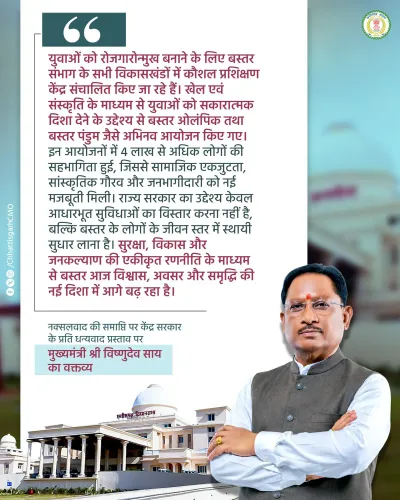
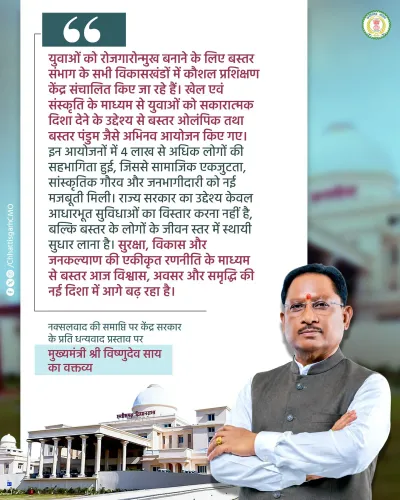
The Chief Minister's Office of Chhattisgarh shared a statement by Chief Minister Vishnu Deo Sai on 15 July 2026, detailing sweeping education and infrastructure gains across Bastar division as the state formally moved a resolution thanking the central government for the near-elimination of Naxalism in the region.
Context
Speaking during a resolution of gratitude on the ending of Naxalism, CM Sai said that of 458 schools that had been shut in 240 Naxal-affected villages across Bastar, 421 have been reopened, while 36 new schools have been sanctioned. The announcement signals a decisive shift in the region's ground reality — schools that were once forced to close under the shadow of Left Wing Extremism are now functional again, restoring access to education for thousands of children in remote tribal villages.
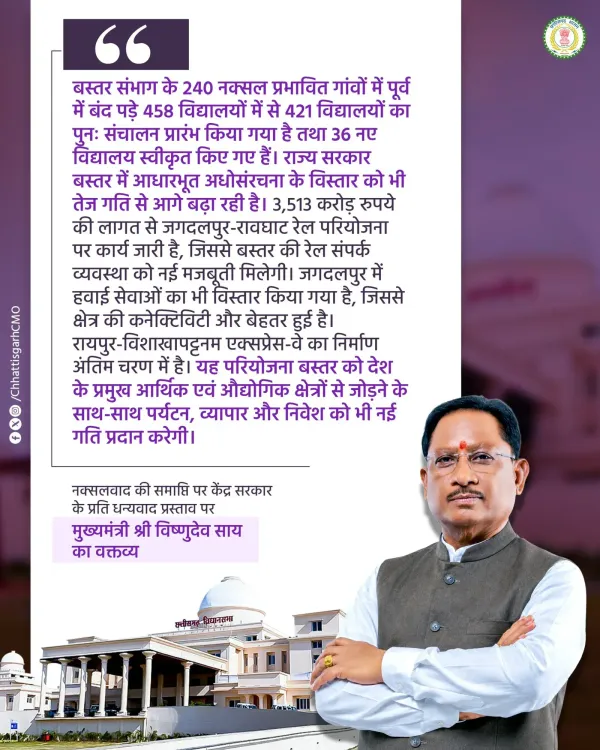
The statement, posted in Hindi on the CMO's official X account, quoted Sai as saying: 'बस्तर संभाग के 240 नक्सल प्रभावित गांवों में पूर्व में बंद पड़े 458 विद्यालयों में से 421 विद्यालयों का पुनः संचालन प्रारंभ किया गया है' ('Of the 458 schools previously shut in 240 Naxal-affected villages of Bastar division, 421 have been restarted').
Policy Backdrop
India's approach to Left Wing Extremism has long combined security operations with targeted development in affected districts — a strategy formalised through the Integrated Action Plan for LWE areas launched in 2006. Chhattisgarh's Bastar division, comprising several districts in the state's southern half, has been one of the most persistently affected zones, with schools, health posts, and road links frequently disrupted by insurgent activity over two decades.
The current state government's push accelerates that dual approach. Alongside the school revival, CM Sai highlighted that work is ongoing on the Jagdalpur-Raoghat Rail Project, estimated at Rs 3,513 crore, which is designed to open up the region's mineral-rich hinterland to rail connectivity. Air services at Jagdalpur have also been expanded, further improving the division's connectivity. Similar education and infrastructure revival programmes have been pursued in other LWE-affected states such as Jharkhand and Odisha.
Stakeholders and Impact
The most immediate beneficiaries are students and families in the 240 formerly Naxal-affected villages, where the return of functional schools ends years of educational disruption for tribal communities. Teachers, local government staff, and security personnel who had previously been unable to operate in these areas also stand to benefit from the improved security environment that has enabled these reopenings.
On the economic side, the Raipur-Visakhapatnam Expressway — described by CM Sai as being in its 'final stage of construction' — is expected to link Bastar directly to major economic and industrial corridors in eastern India. The state government has said the expressway will catalyse tourism, trade, and investment in the division, which holds significant mineral and forest resources that have historically been difficult to access due to both geography and security constraints.
What's Next
Attention will now turn to the completion timeline of the Raipur-Visakhapatnam Expressway and the commissioning of the Jagdalpur-Raoghat Rail Project, both of which are critical to translating security gains into lasting economic development. The sanctioning of 36 new schools also raises questions about staffing, infrastructure readiness, and state budget allocations for school construction in former conflict zones.
If the infrastructure projects are delivered on schedule, Bastar could emerge as a test case for India's broader post-insurgency development model — demonstrating whether connectivity and public services can be sustainably restored in areas that spent decades outside the mainstream economy.
Point of View
Framing the school reopenings and infrastructure push as dividends of the central government's counter-Naxal campaign, reinforced by a formal legislative resolution of gratitude. This dual messaging — security success plus visible development — is a deliberate consolidation of the ruling coalition's narrative ahead of any future electoral cycle in the state. The emphasis on connectivity projects like the Jagdalpur-Raoghat rail line and the Raipur-Visakhapatnam Expressway also signals an intent to shift Bastar's identity from a conflict zone to an investment destination, tapping its mineral and tourism potential. Whether ground-level implementation matches the scale of these announcements will determine whether Bastar becomes a replicable model for post-LWE recovery across India.
NationPress
13 Oct 2026
Frequently Asked Questions
How many schools have been reopened in Bastar's Naxal-affected villages?
421 schools out of 458 that were previously shut have been reopened in 240 Naxal-affected villages in Bastar division , according to a statement by CM Vishnu Deo Sai on 15 July 2026 . An additional 36 new schools have also been sanctioned.
What is the Jagdalpur-Raoghat Rail Project and what is its cost?
The Jagdalpur-Raoghat Rail Project is a major rail connectivity initiative in Bastar division , Chhattisgarh , aimed at linking the region's resource-rich hinterland to broader rail networks. Work is ongoing at an estimated cost of Rs 3,513 crore .
What is the Raipur-Visakhapatnam Expressway and how does it benefit Bastar?
The Raipur-Visakhapatnam Expressway is a highway project currently in its final stage of construction. It is designed to connect Bastar to major economic and industrial corridors in eastern India, and is expected to boost tourism, trade, and investment in the division.
What did CM Vishnu Deo Sai say about Naxalism in Chhattisgarh?
CM Vishnu Deo Sai made his statement during a state resolution thanking the central government for the elimination of Naxalism. He outlined education and infrastructure gains in Bastar as evidence of consolidation following the end of Left Wing Extremism in the region.
Has air connectivity improved in Bastar?
Yes. CM Sai stated that air services at Jagdalpur , the divisional headquarters of Bastar , have been expanded, improving the region's overall connectivity alongside the ongoing rail and road projects.