White House Claims Trump Strategy Is Dismantling Fentanyl Networks

Synopsis
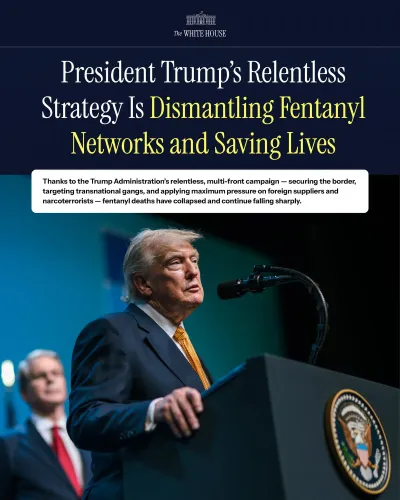
The White House on July 15, 2026, promoted a release claiming President Trump's strategy is dismantling fentanyl networks and saving lives, framing enforcement actions against Chinese precursor suppliers and Mexican cartels as delivering results in the long-running U.S. opioid crisis.
Key Takeaways
The White House shared a release on July 15, 2026 , asserting President Trump 's strategy is dismantling fentanyl trafficking networks.
Fentanyl is the leading driver of drug overdose deaths in the United States , approximately 100 times more potent than morphine.
Trump first declared the opioid crisis a public health emergency in October 2017 and expanded sanctions on Chinese and Mexican entities during his first term.
China supplies precursor chemicals while Mexico serves as the primary transit and production point for illicit fentanyl entering the U.S.
The DEA leads federal interdiction efforts coordinating multi-agency operations targeting fentanyl supply chains.
Further bilateral meetings with Mexico and potential new sanctions or chemical-control agreements with China are expected next steps.
The White House, the official communications account of the Executive Office of the President of the United States, on Wednesday, July 15, 2026, shared a release asserting that President Donald Trump's strategy is actively dismantling fentanyl trafficking networks and reducing overdose deaths across the country.
Context
The post links to a White House release titled 'President Trump's Relentless Strategy is Dismantling Fentanyl Networks and Saving Lives,' framing the administration's anti-fentanyl push as an ongoing, results-oriented campaign. Fentanyl, a synthetic opioid estimated to be roughly 100 times more potent than morphine, has been the leading driver of drug overdose deaths in the United States for over a decade.
The Trump administration has consistently positioned combating fentanyl as a signature national security and public health priority, combining domestic law enforcement pressure with diplomatic and economic tools aimed at supply chains abroad.
Policy Backdrop
Trump first declared the opioid crisis a nationwide public health emergency in October 2017 during his first term, and his administration subsequently expanded executive orders and sanctions targeting entities in China and Mexico implicated in fentanyl's production and transit. China has been identified as a major source of precursor chemicals, while Mexico — through cartel networks — serves as the primary transit and production point for finished fentanyl smuggled across the southern border.
The Drug Enforcement Administration (DEA), the lead federal agency on narcotics trafficking, has coordinated multi-agency operations targeting these supply chains. U.S. drug policy has historically combined supply-side interdiction with domestic treatment funding, though critics have long argued that enforcement-first approaches alone are insufficient to reduce overdose mortality.
Stakeholders and Impact
Communities across the United States that have been devastated by the opioid epidemic stand at the centre of this policy debate. Overdose deaths, the vast majority now attributed to synthetic opioids like fentanyl, have affected families in every state, cutting across socioeconomic lines.
Federal law enforcement agencies, bilateral diplomatic channels with Mexico City and Beijing, and domestic public health infrastructure are all stakeholders in any measurable outcome from the administration's declared strategy. The framing of the release — 'saving lives' — signals the White House intends to present this as a tangible policy win ahead of further legislative or diplomatic moves.
What's Next
Analysts and policymakers will watch for further bilateral engagement between Washington and Mexico City on cartel enforcement cooperation, as well as any new chemical-control agreements or sanctions targeting Chinese precursor suppliers. The administration's ability to demonstrate measurable declines in overdose fatalities will be central to sustaining political momentum behind this strategy.
As the White House continues to amplify this narrative, scrutiny will increase on whether enforcement metrics translate into sustained reductions in overdose deaths — the most direct measure of success that affected communities and public health advocates will demand.
Point of View
Particularly relevant as the administration seeks to demonstrate that its hardline posture on border security and foreign supplier accountability is yielding public health dividends. The framing of 'relentless strategy' signals an attempt to differentiate Trump's second-term approach from what the administration characterises as insufficient action by predecessors. However, the durability of this narrative depends heavily on overdose mortality data — a metric that has historically resisted quick turnarounds regardless of enforcement intensity. For India, which monitors U.S. drug diplomacy closely given its own pharmaceutical and chemical export ecosystem, the direction of U.S. pressure on precursor-chemical supply chains remains a live regulatory and trade consideration.
NationPress
15 Jul 2026
Frequently Asked Questions
What is the White House's fentanyl strategy under Trump in 2026?
The White House has described President Trump's approach as a 'relentless strategy' targeting fentanyl trafficking networks through domestic law enforcement, diplomatic pressure on Mexico to curb cartel activity, and sanctions or controls aimed at Chinese suppliers of precursor chemicals.
Why is fentanyl considered so dangerous?
Fentanyl is a synthetic opioid approximately 100 times more potent than morphine. Even a small amount can cause a fatal overdose, making it the leading driver of drug overdose deaths in the United States for over a decade.
What role does China play in the U.S. fentanyl crisis?
China has been identified as a major source of the precursor chemicals used to manufacture illicit fentanyl, primarily in Mexican cartel laboratories before the finished drug is smuggled into the United States.
What is the DEA's role in combating fentanyl?
The Drug Enforcement Administration (DEA) is the lead U.S. federal agency targeting fentanyl trafficking organisations, coordinating multi-agency domestic operations and working with international partners to disrupt supply chains.
How does the U.S. fentanyl crisis affect India?
India's pharmaceutical and chemical manufacturing sectors are subject to scrutiny under U.S. drug diplomacy efforts focused on precursor chemicals. Any expansion of U.S. sanctions or chemical-control agreements targeting global supply chains could have regulatory and trade implications for Indian exporters.