Did Trump Just Unveil the Great American Recovery Plan?
Synopsis
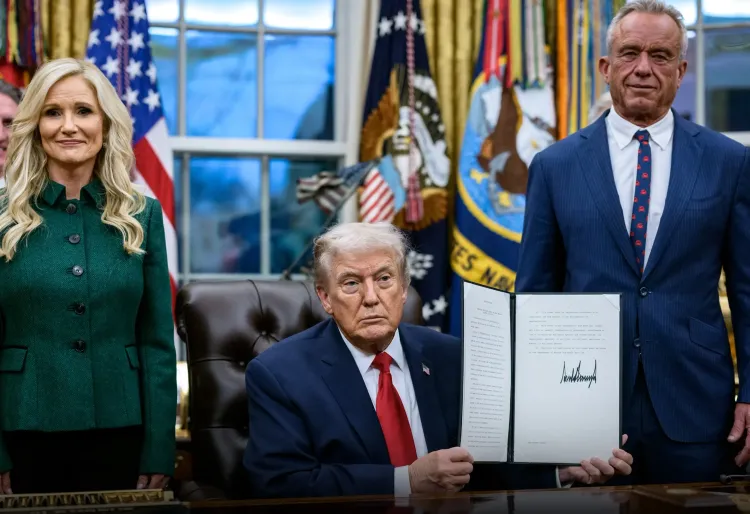
On January 30, President Trump signed an executive order for the Great American Recovery Initiative to combat addiction and substance abuse. This sweeping plan aims to unify federal, state, and local resources to help Americans overcome dependency and improve recovery outcomes.
Key Takeaways
The Great American Recovery Initiative aims to address addiction and substance abuse effectively.
Coordination among federal, state, and local resources is crucial for success.
Approximately 300,000 Americans die annually from substance abuse.
Kennedy Jr. emphasizes treating addiction as a disease.
The initiative promotes early intervention and long-term recovery support.
Washington, Jan 30 (NationPress) - US President Donald Trump has enacted a comprehensive executive order to initiate what he terms the Great American Recovery Initiative. This national campaign aims to tackle addiction and substance abuse by synchronizing resources from federal, state, local, and private sectors.
Referring to addiction as “a significant issue” both domestically and internationally, Trump emphasized that the initiative is geared towards providing the necessary help and support for Americans to liberate themselves from the devastating grip of dependency.
The President noted that approximately 300,000 individuals succumb to drug and alcohol abuse annually in the United States, suggesting that the actual figure may be even higher. He mentioned that drug overdose fatalities had decreased by 21 percent in the last year.
Trump attributed this decline to enhanced border enforcement and drug confiscations, citing that authorities had intercepted over 47 million fentanyl pills and 10,000 pounds of fentanyl powder. He also stated that maritime drug trafficking was down 97 percent as a result of enforcement actions in the area he dubbed the “Gulf of America.”
“We’re taking decisive actions to assist Americans battling various forms of addiction,” Trump declared. “The Great American Recovery Initiative will pool resources from federal, state, local, and private sectors to bolster addiction treatment, recovery, and prevention.”
Health and Human Services Secretary Robert F. Kennedy Jr., who will co-chair the initiative, indicated that the executive order signifies a pivotal transformation in the federal government's approach to addiction.
“Addiction is not a moral failing; it is a disease. It’s chronic and treatable,” Kennedy remarked, pointing out that the nation has relied for too long on fragmentation, stigmatization, and silence rather than on science, compassion, and coordination.
He highlighted that nearly 50 million Americans grapple with substance use disorders, with many never receiving the care they require. The initiative aims to align federal programs, broaden access to evidence-based treatments, emphasize early intervention, and support sustained recovery.
“Recovery transcends being a mere side issue,” Kennedy asserted. “It’s a matter of economic stability, workforce viability, family dynamics, and national security.”
Kathryn Burgum, a senior advisor at the White House for the initiative, described addiction as a chronic medical condition akin to diabetes, cancer, or heart disease. She noted that this new framework signifies a transition from reactionary measures to preventive strategies, from fragmentation to coordination, and from stigma to science.
“This initiative exemplifies a fundamental change,” Burgum stated, adding that early and correct treatment of addiction leads to recovery and family healing.
Various administration officials and guests shared personal stories of addiction and loss, including Special Envoy Steve Witkoff, who spoke about his son's death due to addiction, along with senior health officials who emphasized research, treatment expansion, and prevention initiatives.
Trump mentioned that this initiative builds upon measures taken during his presidency, like securing the border, enhancing access to treatment and naloxone, and investing in prevention and recovery programs.
The United States has been contending with an opioid and addiction crisis for over a decade, with overdose deaths peaking during the COVID-19 pandemic. Federal and state governments have increasingly leaned towards public health-based strategies in conjunction with law enforcement.
Trump stressed that the new initiative will establish a coordinated national response to addiction, concluding, “When Americans recover, communities strengthen, families mend, and children flourish.”
Point of View
It's essential to recognize the significance of President Trump's Great American Recovery Initiative. By addressing addiction as a health crisis rather than a moral failing, this initiative represents a pivotal shift towards a more compassionate and coordinated approach to tackling substance abuse in America.
NationPress
14 Sept 2026
Frequently Asked Questions
What is the Great American Recovery Initiative?
The Great American Recovery Initiative is a national effort launched by President Trump to combat addiction and substance abuse by coordinating resources from federal, state, local, and private sectors.
How many people die from addiction in the U.S.?
Approximately 300,000 people die each year in the United States due to drug and alcohol abuse, with the actual number likely being higher.
What role does Robert F. Kennedy Jr. play in the initiative?
Robert F. Kennedy Jr. serves as the co-chair of the initiative and emphasizes a shift towards treating addiction as a disease rather than a moral failing.
What are the goals of the initiative?
The initiative aims to align federal programs, expand access to evidence-based care, focus on early intervention, and support long-term recovery.
Why is addiction considered a public health issue?
Addiction is viewed as a public health issue because it affects economic stability, workforce viability, family dynamics, and national security.