White House Says Trump Is Cutting Fentanyl on US Streets
Synopsis
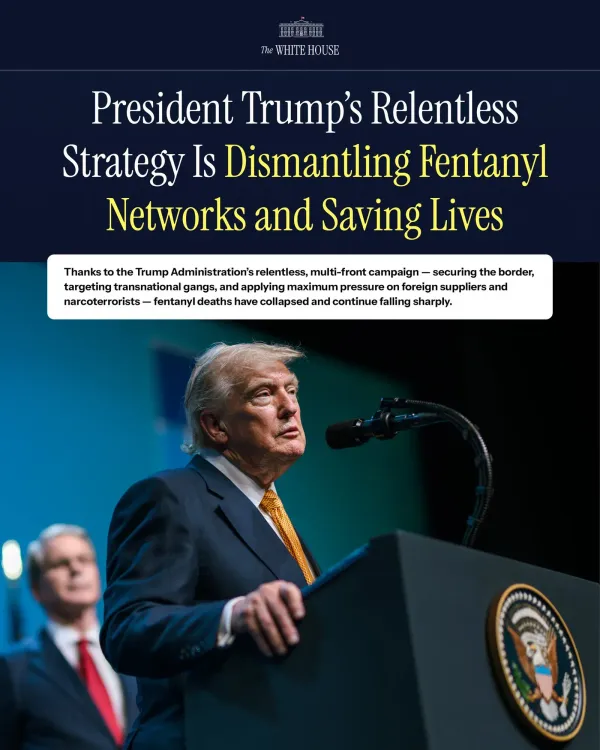
The White House announced on 15 July 2026 that President Trump has directed a comprehensive effort to reduce deadly fentanyl on American streets. The move continues a supply-side enforcement approach that has defined US opioid policy since Trump's 2017 public health emergency declaration, targeting precursor chemical flows from China and cartel smuggling via Mexico.
Key Takeaways
The White House posted on 15 July 2026 that President Trump has directed a 'comprehensive effort' to reduce fentanyl on American streets since taking office.
Fentanyl is a synthetic opioid roughly 100 times more potent than morphine and is the leading driver of US drug overdose deaths.
Trump first declared the opioid crisis a national public health emergency in October 2017 , directing resources toward enforcement and treatment.
US policy targets the fentanyl supply chain at two key nodes: precursor chemicals from China and finished product smuggled via Mexican cartels .
The Drug Enforcement Administration (DEA) is the primary federal agency coordinating cross-border enforcement efforts.
Congressional action on border security appropriations and potential new trilateral initiatives with Mexico and China are the next policy milestones to watch.
The White House announced on Wednesday, 15 July 2026 that President Donald Trump has directed a wide-ranging federal effort aimed at reducing the presence of deadly fentanyl across the United States, framing the push as a central priority of his administration since taking office.
The official post from the Executive Office of the President stated that Trump 'has directed a comprehensive effort which is fighting to ensure LESS DEADLY FENTANYL ON AMERICAN STREETS,' underscoring the administration's supply-side approach to the ongoing synthetic opioid crisis.
Context
Fentanyl, a synthetic opioid estimated to be roughly 100 times more potent than morphine, has been at the centre of the United States' drug overdose crisis for over a decade. The substance is responsible for a significant share of overdose fatalities recorded annually across American communities, making it a persistent political and public health flashpoint.
Trump's engagement with the opioid issue dates to his first term, when in October 2017 he declared the opioid crisis a national public health emergency, directing additional federal resources toward both treatment programmes and law enforcement. The current push represents a continuation of that supply-reduction emphasis.
Policy Backdrop
US fentanyl policy has historically centred on disrupting the flow of precursor chemicals — largely sourced from China — and interdicting finished product smuggled into the country through Mexico via transnational criminal organisations. Tools deployed across administrations have included sanctions, federal indictments, and bilateral security cooperation agreements.
The Drug Enforcement Administration (DEA), the principal federal agency for enforcing controlled substances laws, plays a coordinating role in these cross-border enforcement efforts. Domestic scheduling actions — classifying new synthetic variants as controlled substances — have run in parallel to these international measures since the mid-2010s surge in synthetic opioid deaths.
Stakeholders and Impact
American communities, particularly those in rural and post-industrial regions that have borne a disproportionate burden of opioid addiction, stand to be most directly affected by any measurable reduction in street-level fentanyl supply. Law enforcement agencies at the federal, state, and local levels are key operational stakeholders in executing the administration's directives.
The framing of the announcement — emphasising reduction of fentanyl 'on American streets' — signals a focus on visible supply-side outcomes, a metric that resonates with both law enforcement partners and the broader public, though public health advocates have consistently argued that demand-side treatment and harm-reduction measures must accompany enforcement action.
What's Next
Attention now turns to the US Congress, where appropriations for border security and drug interdiction programmes remain under active consideration. Any new trilateral enforcement initiatives involving Mexico and China — the two primary nodes in the fentanyl supply chain — would mark a significant escalation of the current effort. The administration's ability to demonstrate measurable reductions in fentanyl availability will likely shape the political and legislative momentum around this issue in the months ahead.
Point of View
The administration is positioning fentanyl reduction as a tangible, measurable deliverable rather than a systemic public health undertaking. This framing serves a dual political purpose: reinforcing border-security credentials while signalling to law enforcement constituencies that federal resources remain committed. The critical test will be whether downstream data on overdose fatalities and seizure volumes validates the 'comprehensive effort' claim in the months ahead.
NationPress
15 Jul 2026
Frequently Asked Questions
What is the White House's fentanyl policy under Trump?
The White House says President Trump has directed a comprehensive federal effort to reduce deadly fentanyl on American streets, continuing a supply-side enforcement approach that includes disrupting precursor chemical flows from China and interdicting smuggled product via Mexico.
When did Trump first address the opioid crisis?
President Trump first declared the opioid crisis a national public health emergency in October 2017 during his first term, directing additional federal resources toward treatment programmes and law enforcement.
What is fentanyl and why is it dangerous?
Fentanyl is a synthetic opioid approximately 100 times more potent than morphine . It has been the leading driver of drug overdose deaths in the United States for several years due to its extreme potency and widespread presence in the illicit drug supply.
Which agencies are involved in the US fentanyl crackdown?
The Drug Enforcement Administration (DEA) is the principal federal agency coordinating enforcement. Efforts also involve bilateral and multilateral cooperation with Mexico and China , the two primary nodes in the fentanyl supply chain.
What comes next in US fentanyl policy?
Key developments to watch include Congressional consideration of border security appropriations and any new trilateral enforcement initiatives involving Mexico and China. Measurable reductions in street-level fentanyl availability will be the benchmark by which the administration's effort is judged.