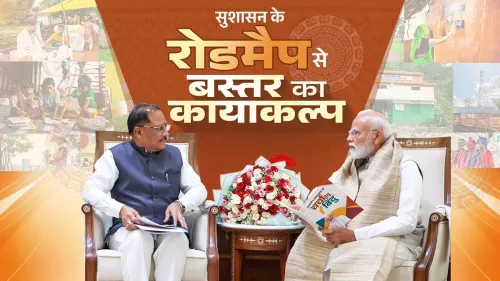
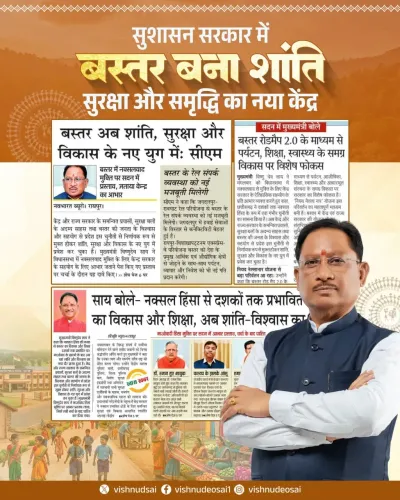
CM Sai Unveils Bastar Roadmap 2.0 for Post-Naxal Development
Synopsis
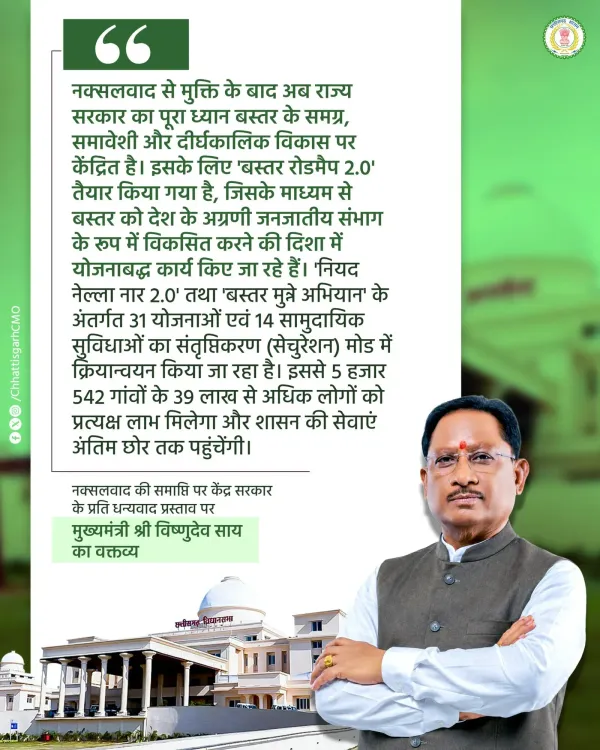
Chief Minister Vishnu Deo Sai has announced 'Bastar Roadmap 2.0', a post-Naxal development framework targeting over 39 lakh people across 5,542 villages through 31 schemes and 14 community facilities delivered in saturation mode under Niyad Nella Nar 2.0 and Bastar Munne Abhiyan.
Key Takeaways
Bastar Roadmap 2.0 has been formally announced by CM Vishnu Deo Sai as the state's post-Naxal development blueprint for the Bastar division.
The plan aims to develop Bastar as India's leading tribal division through planned, phase-wise implementation.
31 welfare schemes and 14 community facilities are being implemented in saturation mode under Niyad Nella Nar 2.0 and Bastar Munne Abhiyan .
More than 39 lakh people across 5,542 villages are the intended direct beneficiaries.
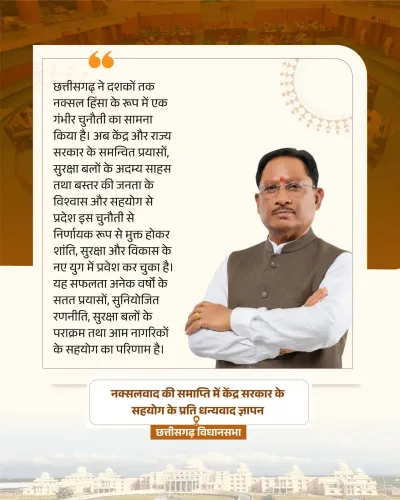
The statement was made during a formal thanksgiving resolution to the Central government for its role in ending Naxalism in the region.
The initiative reflects India's broader policy of converting security gains in LWE-affected areas into lasting socio-economic development.
The Chief Minister's Office of Chhattisgarh shared a statement by Chief Minister Vishnu Deo Sai on Wednesday, 15 July 2026, outlining a comprehensive development agenda for Bastar following the state government's declaration of freedom from Naxalism. The statement was delivered as part of a formal resolution thanking the Central government for its role in ending Naxal insurgency in the region.
Context
Speaking on the occasion of a thanksgiving resolution to the Union government on the end of Naxalism, CM Sai said the state's focus has now fully shifted to 'samgra, samaveshi aur dirghkalik vikas' — holistic, inclusive, and long-term development of Bastar. He announced that 'Bastar Roadmap 2.0' has been prepared to develop Bastar as the country's leading tribal division. The statement marks a formal transition in the state's posture from counter-insurgency to post-conflict development.
Policy Backdrop
Under the twin programmes 'Niyad Nella Nar 2.0' and 'Bastar Munne Abhiyan', the government is implementing 31 schemes and 14 community facilities in saturation mode — meaning universal coverage rather than selective delivery. The aim is to ensure that governance services reach the last mile across the region's remote villages. This approach mirrors the broader Indian policy model of pairing security gains in Left Wing Extremism-affected areas with intensive welfare delivery, a pattern seen across the central Indian tribal belt since the early 2000s.
Chhattisgarh and the Central government have run coordinated anti-Naxal operations and special development plans for LWE-affected districts for over two decades. The current phase represents an effort to consolidate those security gains into durable socio-economic integration for Bastar's predominantly tribal population.
Stakeholders and Impact
The government's statement claims the initiative will directly benefit more than 39 lakh people across 5,542 villages in Bastar. The primary beneficiaries are tribal communities who have historically been caught between state security operations and Naxal influence, with limited access to government schemes and infrastructure. Saturation-mode implementation is intended to close that gap by ensuring no eligible household is left out.
Bastar division, comprising several districts in southern Chhattisgarh, has long been identified as one of the most Naxal-affected zones in India. Its largely forest-dwelling tribal population has faced decades of disrupted education, healthcare, and livelihood access. The shift to a development-first framework signals a significant change in administrative priority for the region.
What's Next
The rollout of Bastar Roadmap 2.0 and the saturation delivery of 31 schemes across thousands of villages will be the key metric to watch in the months ahead. Observers will track whether the administrative machinery can sustain last-mile delivery at the scale announced, and whether the security environment remains stable enough to enable uninterrupted programme implementation. Any official updates on scheme coverage and beneficiary enrollment across Bastar's districts will be closely followed by both policy analysts and tribal welfare advocates.
Point of View
CM Sai simultaneously credits the BJP-led Union government and claims ownership of the development dividend, reinforcing the party's electoral messaging in a tribal-dominated region. The saturation-mode delivery model, if executed at the scale cited, would mark one of the more ambitious last-mile governance pushes in post-conflict India. The real test lies in implementation fidelity across thousands of remote forest villages where state capacity has historically been thin.
NationPress
13 Oct 2026
Frequently Asked Questions
What is Bastar Roadmap 2.0?
Bastar Roadmap 2.0 is a development framework announced by Chhattisgarh Chief Minister Vishnu Deo Sai to guide the holistic, inclusive, and long-term development of the Bastar division following the state's declaration of freedom from Naxalism. It aims to establish Bastar as India's leading tribal division.
What is Niyad Nella Nar 2.0?
Niyad Nella Nar 2.0 is a Chhattisgarh government programme being implemented in Bastar under which 31 welfare schemes and 14 community facilities are being delivered in saturation mode to ensure universal coverage across remote tribal villages.
How many villages and people will benefit from Bastar Roadmap 2.0?
According to the Chief Minister's statement, more than 39 lakh people across 5,542 villages in Bastar are expected to directly benefit from the schemes being implemented under the roadmap.
What is Bastar Munne Abhiyan?
Bastar Munne Abhiyan is one of the two flagship programmes — alongside Niyad Nella Nar 2.0 — through which the Chhattisgarh government is rolling out 31 schemes and 14 community facilities in saturation mode across Bastar's tribal villages.
Why did CM Vishnu Deo Sai thank the Central government regarding Naxalism?
CM Sai's statement was delivered as part of a formal thanksgiving resolution passed by the Chhattisgarh government to the Central government, acknowledging its role in the security operations that led to what the state has declared as freedom from Naxalism in the Bastar region.