CM Sai: 22 Lakh Ayushman Cards, 6.79L Ration Cards Issued in Bastar
Synopsis
Chief Minister Vishnu Deo Sai's office has detailed a massive welfare saturation drive in Bastar division, reporting 22 lakh Ayushman cards, 17 lakh Jan Dhan accounts, 6.79 lakh ration cards and 1.76 lakh PMAY homes sanctioned, alongside 15,000 houses for Naxal-affected families and surrendered cadres.
Key Takeaways
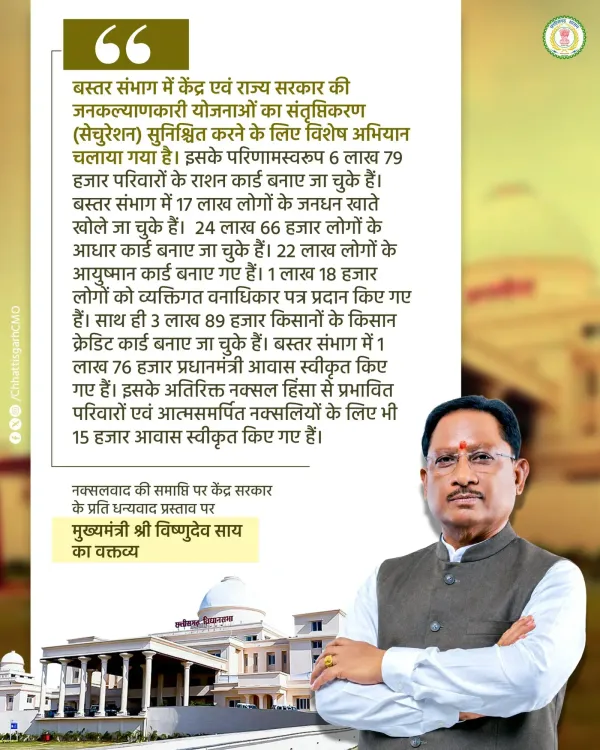
6 lakh 79 thousand ration cards issued to families in Bastar division under the welfare saturation campaign.
17 lakh Jan Dhan bank accounts opened, bringing financial inclusion to previously unbanked tribal households.
22 lakh Ayushman Bharat health cards issued, enabling cashless hospitalisation cover of up to Rs 5 lakh per family.
1 lakh 18 thousand individual forest rights pattas distributed under the Forest Rights Act, 2006 .
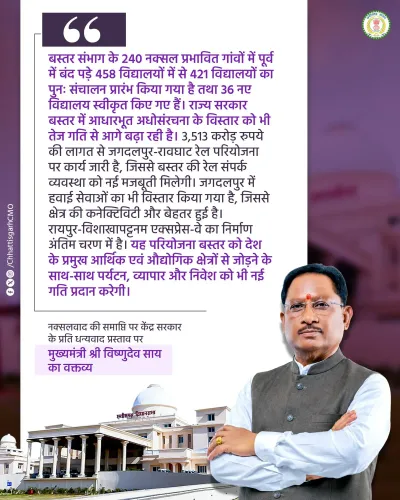
1 lakh 76 thousand houses sanctioned under Pradhan Mantri Awas Yojana ; a separate 15 thousand homes earmarked for Naxal-affected families and surrendered cadres.
3 lakh 89 thousand Kisan Credit Cards issued to farmers, expanding access to institutional agricultural credit.
The Chief Minister's Office of Chhattisgarh shared a statement by Chief Minister Vishnu Deo Sai on Wednesday, 15 July 2026, detailing the scale of welfare scheme saturation across Bastar division as the state government moved a resolution thanking the Centre for the decline of Naxal violence in the region.
Context
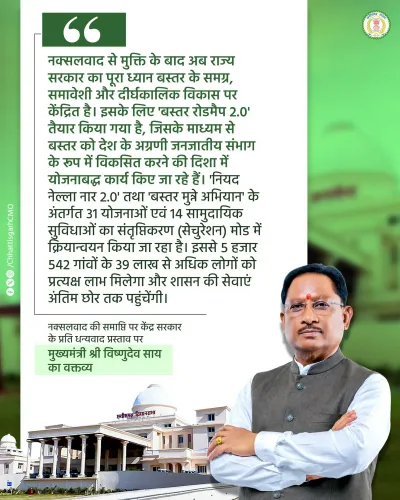
Speaking on the occasion of a thanksgiving resolution on the naksalvad ki samapti (end of Naxalism), CM Sai outlined a sweeping list of welfare deliverables achieved through a special saturation campaign in Bastar. The campaign was designed to ensure that both Central and state government welfare schemes reached every eligible household in the division, which spans seven districts in southern Chhattisgarh and has been affected by Left-Wing Extremism for decades.
The statement cited that 6 lakh 79 thousand ration cards have been issued to families, 17 lakh Jan Dhan bank accounts opened, and 24 lakh 66 thousand Aadhaar cards created in the division. Additionally, 22 lakh Ayushman health cards have been issued, giving beneficiaries access to cashless hospitalisation cover of up to Rs 5 lakh per year under the Ayushman Bharat–Pradhan Mantri Jan Arogya Yojana.
Policy Backdrop
The figures span several flagship Central schemes. Pradhan Mantri Jan Dhan Yojana, launched in August 2014, was designed to bring zero-balance banking to the unbanked, with Bastar's tribal and forest-dwelling communities historically among the most excluded. The National Food Security Act, 2013 mandated subsidised grain coverage for up to 75 per cent of the rural population, making ration card issuance a legal entitlement.
On land rights, 1 lakh 18 thousand individual forest rights pattas have been distributed under the Forest Rights Act, 2006, which recognises the claims of Scheduled Tribes and traditional forest dwellers over land they have historically cultivated. 3 lakh 89 thousand farmers have received Kisan Credit Cards, enabling institutional credit access for agricultural and allied activities.
On housing, 1 lakh 76 thousand homes have been sanctioned under Pradhan Mantri Awas Yojana, the Central rural housing scheme launched in 2015. Notably, a separate tranche of 15 thousand houses has been sanctioned specifically for families affected by Naxal violence and for aatmasamarpit naksaliyon (surrendered Naxals) — an acknowledgement of the human cost of the insurgency and an incentive structure for former cadres reintegrating into civilian life.
Stakeholders and Impact
The primary beneficiaries are Bastar's tribal communities, smallholder farmers, and families displaced or affected by decades of Left-Wing Extremism. The saturation approach — pushing every eligible household into scheme coverage simultaneously — is intended to close gaps that insurgents have historically exploited by positioning the state as absent or hostile.
Surrendered Naxal cadres represent a distinct stakeholder group. The dedicated 15,000 housing allocation signals that reintegration is being backed by material support, not just amnesty. Farmers receiving Kisan Credit Cards gain access to formal credit at subsidised rates, reducing dependence on informal moneylenders who have long operated in the region's economic vacuum.
What's Next
The BJP government in Raipur has framed the saturation drive as an ongoing process rather than a one-time exercise. The Union Ministry of Home Affairs publishes quarterly data on Left-Wing Extremism violence, and any sustained decline will be closely watched as a metric of whether the development-security linkage is holding.
With Chhattisgarh assembly elections due in 2028, the state government is expected to extend the saturation model to remaining LWE-affected pockets beyond Bastar division. The thanksgiving resolution itself marks a political milestone — it is rare for a state assembly to formally acknowledge the Centre's security role — and underscores the alignment between Raipur and New Delhi on the Naxal-free roadmap.
Point of View
The BJP government in Raipur is attempting to shrink the governance vacuum that Left-Wing Extremism has historically fed on. The thanksgiving resolution to the Centre is politically significant — it publicly credits New Delhi's security apparatus for a shift that the state government simultaneously claims credit for on the welfare side. The 15,000 houses for surrendered Naxals are a particularly telling detail, signalling that the reintegration pipeline is now being institutionalised with material incentives. If the saturation numbers hold and violence indices continue to fall, this model could become a template for LWE-affected districts in Odisha, Jharkhand and Maharashtra ahead of their own electoral cycles.
NationPress
13 Oct 2026
Frequently Asked Questions
How many Ayushman cards have been issued in Bastar division?
22 lakh Ayushman Bharat health cards have been issued in Bastar division as part of the state government's welfare saturation campaign, giving beneficiaries access to cashless hospitalisation of up to Rs 5 lakh per year.
What is the welfare saturation campaign in Bastar?
The welfare saturation campaign is a special drive by the Chhattisgarh government to ensure every eligible household in Bastar division is enrolled in Central and state government schemes, including ration cards, Jan Dhan accounts, Ayushman cards, forest rights pattas, Kisan Credit Cards and PMAY housing.
How many houses have been sanctioned under PMAY in Bastar?
1 lakh 76 thousand homes have been sanctioned under Pradhan Mantri Awas Yojana in Bastar division . An additional 15 thousand houses have been sanctioned specifically for families affected by Naxal violence and for surrendered Naxal cadres.
What did CM Vishnu Deo Sai say about Naxalism in Chhattisgarh?
CM Vishnu Deo Sai made the statement while moving a thanksgiving resolution in the Chhattisgarh assembly acknowledging the Central government's role in bringing about a decline in Naxal violence, and outlined the welfare deliverables achieved in Bastar as part of the post-Naxal development push.
How many forest rights pattas have been given in Bastar?
1 lakh 18 thousand individual forest rights pattas ( vyaktigat vanadhikar patra ) have been distributed in Bastar division under the Forest Rights Act, 2006 , recognising tribal and traditional forest dwellers' rights over land they have historically cultivated.