Excise duty on E22-E30 ethanol-blended petrol cut to nil by Centre

Synopsis
India has zeroed out excise duty on E22-to-E30 petrol blends — a fiscal nudge that goes well beyond the already-achieved 20% blending milestone. With E85 also launched for flex-fuel vehicles, the Centre is quietly laying the groundwork for a post-E20 fuel economy, even as retail infrastructure and vehicle compatibility remain the real bottlenecks.
Key Takeaways
The Ministry of Finance on 11 June set excise duty to nil on petrol blended with 22%-30% ethanol (E22, E25, E27, E30).
The exemption is granted under Section 5A of the Central Excise Act, 1944 , covering BIS-conforming blends.
India's ethanol blending share rose from 1.5% in 2014 to 10% in 2022 ; the 20% target originally set for 2030 was achieved in 2024 .
The government has separately launched E85 fuel for compatible flex-fuel vehicles.
The move supports India's National Policy on Biofuels and its goal of cutting crude oil import dependency.
The Centre has exempted petrol blended with higher concentrations of ethanol from excise duty, covering fuel variants with 22 per cent, 25 per cent, 27 per cent, and 30 per cent ethanol content, according to a notification issued by the Ministry of Finance on Thursday, 11 June. The move is the latest step in India's accelerating push to reduce dependence on imported crude oil through domestic biofuel expansion.
What the Notification Says
Under the revised excise structure, the duty on ethanol-blended motor spirit conforming to Bureau of Indian Standards (BIS) specifications has been set at nil for blends where ethanol content ranges from 22 per cent to 30 per cent by volume. The exemption has been granted under Section 5A of the Central Excise Act, 1944.
The notification formally defines E22, E25, E27, and E30 petrol as mixtures of motor spirit and ethanol in specified proportions, with applicable central, state, Union Territory, or integrated taxes continuing to apply on the underlying ethanol and duty-paid petrol components.
Context: India's Biofuel Policy Drive
The excise relief aligns with India's National Policy on Biofuels and the government's decision to advance blending targets to 2025-26. In a separate but related development, the government recently launched E85 fuel for compatible flex-fuel vehicles, signalling a broader transition across fuel grades.
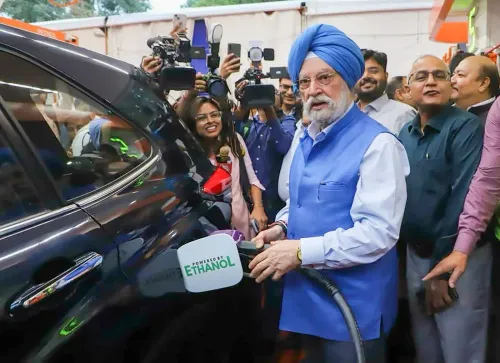
Union Petroleum and Natural Gas Minister Hardeep Singh Puri has cited India's ethanol blending trajectory as a benchmark achievement. Ethanol's share in petrol stood at just 1.5 per cent in 2014, rising to 10 per cent by June 2022. The government's original target of 20 per cent blending by 2030 was met six years ahead of schedule, in 2024.
'From 2014 until now, we have increased ethanol blending from 1.5 per cent to 10 per cent, which was achieved in November 2022. Our target was to achieve 20 per cent blending by 2030, but we completed it in 2024 itself,' Puri said.
Why This Matters for Consumers and Industry
Removing excise duty on higher-blend petrol lowers the cost of producing and retailing E22-to-E30 variants, potentially making them more price-competitive at the pump. This is critical for encouraging oil marketing companies and fuel retailers to stock and promote higher-blend fuels beyond the current mainstream E20 standard.
For the domestic sugar and grain industries — the primary ethanol feedstock suppliers — the policy signals sustained demand, providing a degree of revenue certainty. Critics, however, note that widespread availability of E22-E30 fuel will depend on upgrades to vehicle compatibility and retail infrastructure, neither of which is yet universal.
What Comes Next
With the E20 target already achieved and the excise framework now extended to E30, the trajectory points toward a progressive phase-out of lower-blend petrol at the retail level. Industry observers expect oil marketing companies to outline a rollout timeline for higher-blend variants in the coming months, in step with the government's broader energy transition agenda.
Point of View
Vehicle warranties for blends above E20 remain a grey area for many models, and feedstock supply chains need to scale further. The duty waiver removes a cost barrier, but without parallel investment in dispensing infrastructure and OEM compatibility mandates, it risks being a policy signal that outruns ground reality.
NationPress
29 Jul 2026
Frequently Asked Questions
What is the excise duty change on ethanol-blended petrol announced by the Centre?
The Centre has set excise duty to nil on petrol blended with 22% to 30% ethanol — covering E22, E25, E27, and E30 variants — via a Finance Ministry notification dated 11 June. The exemption applies to BIS-conforming blends under Section 5A of the Central Excise Act, 1944.
Which ethanol-petrol blend grades are covered by the new exemption?
The nil-duty exemption covers E22, E25, E27, and E30 petrol, defined as mixtures of motor spirit and ethanol in specified proportions ranging from 22% to 30% ethanol by volume.
How far has India progressed on ethanol blending in petrol?
India's ethanol blending share stood at just 1.5% in 2014 and reached 10% by June 2022. The government's 20% blending target, originally set for 2030, was achieved in 2024 — six years ahead of schedule, according to Petroleum Minister Hardeep Singh Puri.
Why is the government removing excise duty on higher-blend petrol?
The exemption is designed to make E22-to-E30 petrol more cost-competitive at the retail level, supporting India's National Policy on Biofuels and its broader goal of reducing crude oil imports by expanding domestic renewable fuel usage.
What is E85 fuel and how does it relate to this policy?
E85 is a high-ethanol fuel blend containing approximately 85% ethanol, recently launched by the government for compatible flex-fuel vehicles. It represents a higher step in the same biofuel transition that the new E22-E30 excise exemption is designed to accelerate.