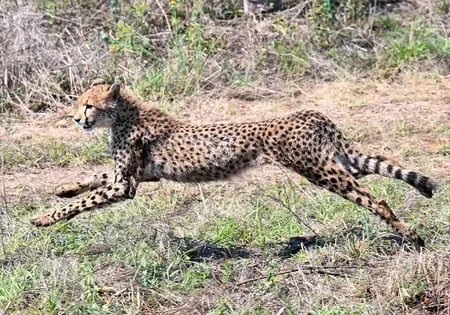
Panic Ensues in Rajasthan Village as Cheetah KP-2 Strays from Kuno National Park
Synopsis
A cheetah from Kuno National Park has wandered into a Rajasthan village, prompting local residents to stay indoors. The animal's presence has alarmed the community, but officials assure there is no immediate danger.
Key Takeaways
Cheetah KP-2 has strayed into Rajasthan from Kuno National Park.
Local officials are monitoring the cheetah's movements.
Residents have been advised to remain calm.
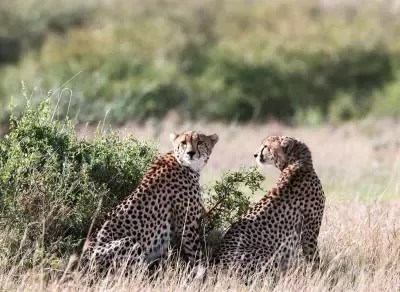
KP-2 and another cheetah, KP-3, are exploring new territories.
Authorities emphasize that cheetahs generally do not pose a danger to humans.
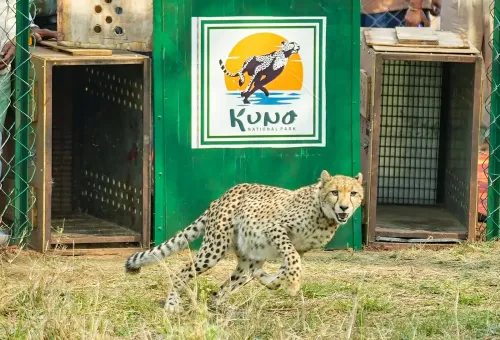
Jaipur, March 27 (NationPress) A cheetah that wandered away from the Kuno National Park in Madhya Pradesh has made its way into Rajasthan, causing alarm among residents of Pipalda Sammel village in the Madanpura panchayat located in the Sultanpur region of Kota district.
The cheetah, known as KP-2, was seen traversing fields and residential neighborhoods on Friday, leading villagers to take shelter indoors.
Farmers first spotting the big cat in their fields quickly informed the local Forest Department and police. Footage of the cheetah has been captured and shared with the authorities.
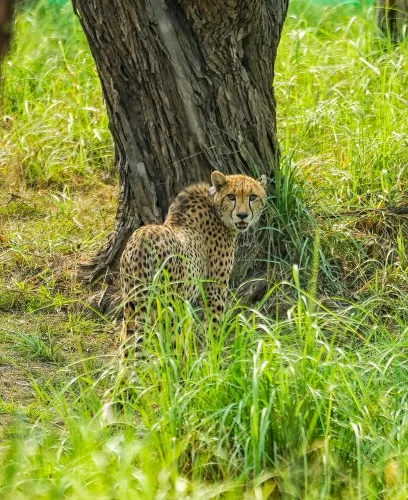
Forest officials from both Rajasthan and Kuno National Park are closely observing the cheetah's movements around the clock. Reports indicate that the animal has been resting under trees and cautiously navigating through farmland and populated areas.
Authorities have advised locals to remain vigilant but not to panic, emphasizing that cheetahs typically do not pose a threat to humans.
Officials highlighted that KP-2, along with another cheetah, KP-3, has been frequently entering Rajasthan due to the proximity of Kuno National Park to the state boundary.
Continuous monitoring is being conducted by Kuno teams in collaboration with Rajasthan's forest officials. KP-3 has been frequently spotted in the Mangrol range of Baran district and has been roaming the area for over three weeks.
Both KP-2 and KP-3 are approximately 2.5 years old, offspring of Aasha, an African cheetah that was relocated to Kuno.
Experts suggest that their movements indicate a natural dispersal behavior as young cheetahs search for new territories and establish independent ranges.
In addition to Kota and Baran, cheetah sightings have also been reported in the Vijaypur region and neighboring areas of Morena district in Madhya Pradesh, reflecting a broader roaming pattern near the Rajasthan border.
Earlier in mid-March, KP-2, which strayed from Kuno National Park and had been present in Rajasthan's Baran for 45 days, entered Kota and was seen wandering through wheat fields.
Upon notification, a team from the forest department began tracking the big cat, while another team from Kuno provided continuous surveillance. A significant number of villagers gathered when the big cat entered the villages of Lakshmipura and Luhavad under the jurisdiction of Ayana police station in Kota.
Subsequently, Tehsildar Vishwanath Pratap Naruka and the Station House Officer (SHO) arrived to disperse the crowd.
After finding a clear path, the cheetah exited the vicinity. Meanwhile, the National Tiger Conservation Authority (NTCA) has acknowledged the recent movements of the two cheetahs that have dispersed from Kuno National Park to areas in Rajasthan, characterizing it as natural behavior.
Point of View
It is crucial to balance public safety with awareness of wildlife behavior. The presence of KP-2 may cause anxiety, but authorities emphasize that there is no imminent threat to residents. This event highlights the natural movements of wildlife and the importance of monitoring their interactions with human habitats.
NationPress
15 Oct 2026
Frequently Asked Questions
What should residents do if they see a cheetah?
Residents are advised to stay calm, avoid approaching the animal, and report sightings to local authorities.
Are cheetahs dangerous to humans?
Cheetahs are generally not a threat to humans and prefer to avoid contact.
Why are cheetahs moving into new areas?
Young cheetahs, like KP-2 and KP-3, often explore new territories as part of their natural dispersal behavior.
How are authorities monitoring the cheetah?
Forest teams from Rajasthan and Kuno National Park are conducting round-the-clock surveillance of the cheetah's movements.
What is being done to ensure public safety?
Local authorities have urged residents to remain vigilant while assuring them that cheetahs typically do not attack humans.