Chennai's Bold Step: 20,000 Mangroves Planted Along Buckingham Canal for Climate Resilience
Synopsis
In a landmark initiative, the Tamil Nadu Forest Department has planted 20,000 mangroves along the Buckingham Canal, aiming to restore coastal ecosystems and enhance Chennai's defenses against climate change. Discover how this project is reshaping the region's ecological landscape.
Key Takeaways
20,000 mangrove seedlings planted to enhance coastal resilience.
Innovative 'fishbone' canal system developed for tidal flow.
Part of a phased initiative for ecological restoration.
Financially supported by ICICI Bank under CSR.
Aims to create a continuous mangrove green belt.
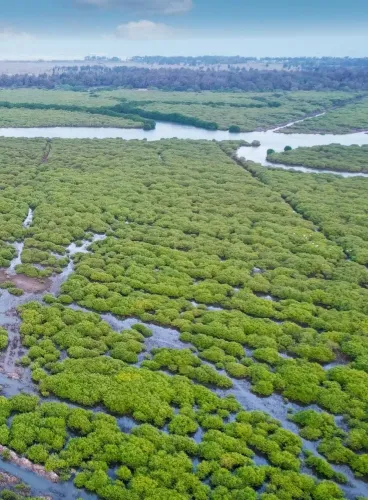
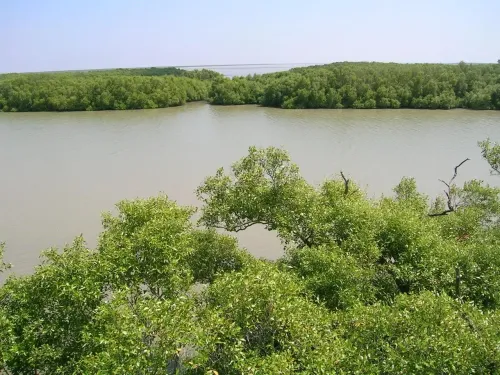
Chennai, March 10 (NationPress) The Tamil Nadu Forest Department has successfully established 20,000 mangrove seedlings over an area of 20 hectares alongside the Buckingham Canal during the period of 2025–26 as part of a significant project aimed at revitalizing coastal ecosystems and bolstering Chennai's defenses against climate change.
In a post shared on the social media platform X, Supriya Sahu, the Additional Chief Secretary for Environment, Climate Change and Forests, elaborated on this initiative, which seeks to develop a natural coastal bioshield and improve the area's ecological equilibrium.
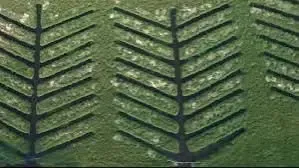
To facilitate the growth of these mangroves, an inventive 'fishbone' canal system has been constructed to maintain the necessary tidal flow of saline water, which is crucial for the survival of mangrove trees.
This innovative system includes eight primary fishbone canals, eight feeder canals, and 186 distribution channels, allowing seawater to circulate efficiently throughout the plantation area.
Sahu stated that this mangrove initiative was executed by the Chennai Forest Division, with financial backing from ICICI Bank as part of its Corporate Social Responsibility (CSR) efforts.
The restoration project is being rolled out in stages, aiming to establish a continuous green belt of mangroves along the vulnerable coastal areas of the district.
In the initial phase, the Forest Department pinpointed an island near the Hiranandani Apartments along the Old Mahabalipuram Road in Kazhipattur village for planting, after acquiring the necessary approvals from the Water Resources Department.
During the 2024–25 phase, roughly 12,500 mangrove seedlings from six different species—Rhizophora mucronata, Bruguiera cylindrica, Avicennia marina, Aegiceras corniculatum, Excoecaria agallocha, and Acanthus ilicifolius—were planted across the same area.
Additionally, around 2,500 associated coastal species were also introduced along the canal banks to enhance the ecological habitat.
The second phase of the project involved the planting of approximately 5,000 mangrove saplings at the Battle of Adyar Island, located at the estuary of the Adyar River, which included species like Rhizophora mucronata, Rhizophora apiculata, Avicennia marina, and Excoecaria agallocha.
The latest phase has introduced 20,000 additional mangrove seedlings from five species, including Avicennia marina, Avicennia officinalis, Rhizophora mucronata, Rhizophora apiculata, and Excoecaria agallocha.
Chennai District Forest Officer V.A. Saravanan remarked that this phased restoration plan is aimed at gradually reinstating the city’s mangrove cover.
He emphasized that this initiative will not only safeguard the coastline from cyclones and rising sea levels but will also promote biodiversity and enhance Chennai's long-term ecological resilience.
Point of View
The initiative undertaken by the Tamil Nadu Forest Department highlights a proactive approach to environmental conservation. The phased mangrove plantation along the Buckingham Canal is a commendable effort that addresses both ecological balance and climate change resilience, setting a precedent for similar projects nationwide.
NationPress
7 Oct 2026
Frequently Asked Questions
What is the purpose of planting mangroves along the Buckingham Canal?
The main goal is to restore coastal ecosystems and enhance Chennai's resilience to climate change by creating a natural coastal bioshield.
How many mangrove seedlings have been planted?
A total of 20,000 mangrove seedlings have been planted across 20 hectares.
What species of mangroves were planted?
The plantation includes species like Rhizophora mucronata, Bruguiera cylindrica, and Avicennia marina, among others.
Who funded the mangrove plantation initiative?
The initiative received financial support from ICICI Bank as part of its Corporate Social Responsibility (CSR) programme.
What is the significance of the 'fishbone' canal system?
The 'fishbone' canal system is designed to ensure proper tidal flow of saline water, which is essential for the survival and growth of mangroves.