CM Sai Launches Zero-Tolerance Drive Against Illegal Sand Mining
Synopsis
Chief Minister Vishnu Deo Sai's office has announced a zero-tolerance drive against illegal sand mining in Chhattisgarh, deploying drone surveillance to monitor riverbed extraction. The move extends a national trend of technology-led enforcement and follows longstanding NGT directives to states on curbing unauthorised mineral extraction.
Key Takeaways
The Chief Minister's Office of Chhattisgarh announced a zero-tolerance crackdown on illegal sand mining on 24 June 2026 .
Drone surveillance has been introduced as part of the enforcement mechanism to monitor riverbeds and remote extraction sites.
CM Vishnu Deo Sai , in office since December 2023 , has framed the action under a 'Sudarshan' metaphor, signalling swift and decisive governance.
The move aligns with National Green Tribunal directives issued since 2013 requiring states to curb illegal sand extraction.
Riverbed communities and legal sand lease-holders are among the key stakeholders expected to be affected by stricter enforcement.
Operational details — including districts covered and enforcement statistics — are yet to be officially disclosed by the state mining department.
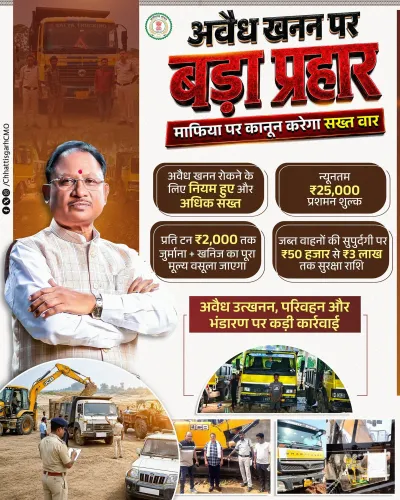
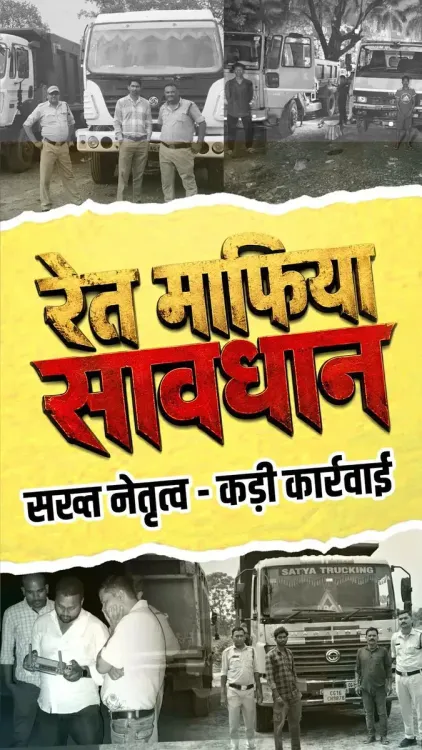
The Chief Minister's Office of Chhattisgarh announced on Wednesday, 24 June 2026 that the state government has launched a zero-tolerance crackdown on illegal sand mining, deploying drone surveillance as part of the enforcement drive under Chief Minister Vishnu Deo Sai.
The post, shared under the hashtags #SushasanSarkar (Good Governance Government) and #StrongDecisions, declared: 'Avaidh ret khanan par chala Vishnu ka Sudarshan — zero tolerance approach ke saath drone se bhi nigrani shuru' — loosely translated as 'Vishnu's Sudarshan [discus] has struck illegal sand mining — zero tolerance approach with drone surveillance now underway.'
Context
Illegal sand mining has long been a persistent governance challenge across Chhattisgarh, a mineral-rich state in central India where river sand is a high-demand construction material. Unauthorised extraction depletes riverbeds, disrupts aquatic ecosystems, and deprives the state exchequer of legitimate royalty revenue. The reference to Vishnu's Sudarshan — the mythological spinning discus of Lord Vishnu — is a rhetorical device invoking swift, decisive action, a framing consistent with CM Sai's broader anti-corruption messaging since taking office in December 2023.
Policy Backdrop
The National Green Tribunal has, since 2013, repeatedly directed states to tighten sand mining oversight, and Chhattisgarh incorporated provisions of the Mines and Minerals (Development and Regulation) Amendment Act in 2015 to penalise illegal extraction. Despite these measures, enforcement on the ground has historically been uneven, with river ghats and remote sand deposits remaining difficult to monitor through conventional patrolling alone.
The integration of drone surveillance into mining enforcement is part of a broader national pattern that several Indian states have adopted since the mid-2010s. Technology-led monitoring is seen as a cost-effective way to cover large riverine stretches and generate time-stamped visual evidence for legal proceedings against violators.
Stakeholders and Impact
The crackdown directly targets illegal sand miners and their supply chains, which often operate at night or in remote stretches beyond the reach of revenue officials. Riverbed communities — including fisherfolk and farmers dependent on seasonal river flows — stand to benefit from reduced ecological disruption caused by unregulated extraction.
Legitimate lease-holders operating within the law are also stakeholders, as unchecked illegal mining undercuts legal operators on price and availability. Stricter enforcement could stabilise the regulated sand market, though it may also create short-term supply tightness in the construction sector if illegal supply is curtailed rapidly.
What's Next
The key questions going forward are the operational scale of the drone monitoring programme — including the number of districts covered, the frequency of sorties, and the agency responsible for data analysis. The Chhattisgarh state mining department's enforcement statistics and any revision to sand lease policies will be closely watched as indicators of whether this announcement translates into sustained action on the ground. Any significant seizure data or FIR counts released in the coming weeks will serve as early benchmarks for the initiative's effectiveness.
Point of View
Particularly in the months following an electoral mandate. The 'Sudarshan' framing is notable — it positions CM Sai as a reformist executive willing to confront entrenched extraction networks that have historically had political protection. Whether this translates into durable enforcement or remains a headline measure will depend on the institutional follow-through: lease policy reform, judicial referrals, and sustained monitoring budgets. At the national level, this also reinforces the Centre's push for transparent mineral governance under the revised MMDR framework.
NationPress
23 Sept 2026
Frequently Asked Questions
What is Chhattisgarh doing about illegal sand mining?
The Chhattisgarh government has launched a zero-tolerance enforcement drive against illegal sand mining, including the use of drone surveillance to monitor riverbed extraction sites across the state.
Who is leading the crackdown on sand mining in Chhattisgarh?
Chief Minister Vishnu Deo Sai , who has headed the BJP government in Chhattisgarh since December 2023, is leading the zero-tolerance initiative against unauthorised sand extraction.
How are drones being used to stop illegal sand mining in India?
Drones provide aerial, time-stamped footage of riverbeds and mining sites, allowing authorities to detect illegal extraction in remote or night-time conditions where ground patrols are ineffective. Several Indian states have adopted this approach since the mid-2010s.
What laws govern sand mining in Chhattisgarh?
Sand mining in Chhattisgarh is regulated under provisions of the Mines and Minerals (Development and Regulation) Amendment Act, which the state adopted in 2015, along with National Green Tribunal directives that have mandated stricter oversight since 2013.
What is the impact of illegal sand mining on rivers in Chhattisgarh?
Illegal sand mining depletes riverbeds, disrupts aquatic ecosystems, affects water tables, and harms communities — including fisherfolk and farmers — who depend on seasonal river flows. It also deprives the state of royalty revenue from legitimate mining leases.