Chhattisgarh Cabinet Clears Water Act 2024 Adoption
Synopsis
The Chhattisgarh Council of Ministers has approved a resolution to adopt the central Water (Prevention and Control of Pollution) Amendment Act, 2024, which decriminalises minor violations and replaces them with monetary penalties, aiming to balance environmental compliance with ease of doing business.
Key Takeaways
The Chhattisgarh Council of Ministers approved presenting a resolution in the state assembly to adopt the Water (Prevention and Control of Pollution) Amendment Act, 2024 .
The central amendment replaces criminal penalties for minor violations with financial penalties , decriminalising routine regulatory infractions.
The adjudication and appeals process under the water-pollution framework will be streamlined under the new regime.
The reform is part of a national exercise that began with the Jan Vishwas (Amendment of Provisions) Act, 2023 , which decriminalised minor offences across multiple statutes.
The resolution must be passed by the Chhattisgarh Legislative Assembly before the amended law takes legal effect in the state.
The decision is intended to improve ease of doing business while maintaining effective environmental protection.
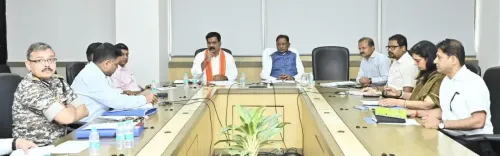
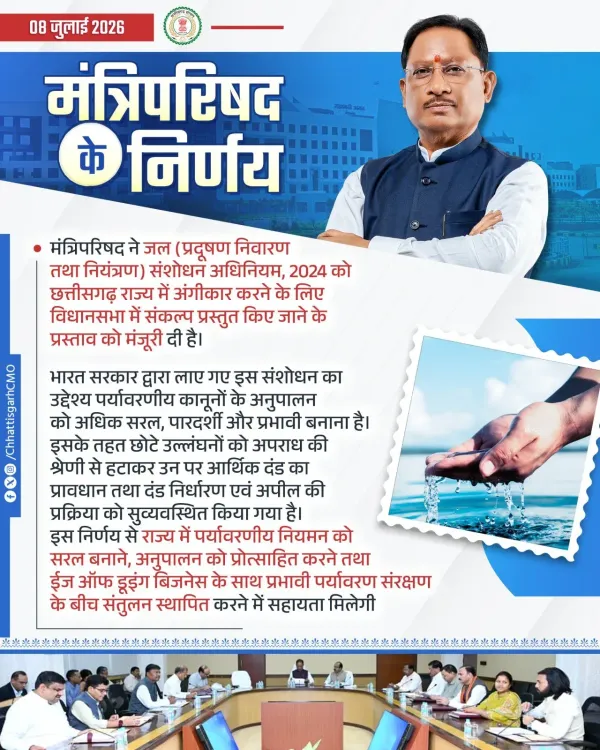
The Chief Minister's Office of Chhattisgarh announced on Wednesday, 8 July 2026 that the state's Council of Ministers has approved presenting a resolution in the Chhattisgarh Legislative Assembly to adopt the central Water (Prevention and Control of Pollution) Amendment Act, 2024. The decision moves the state toward aligning its pollution-control enforcement with a revised national framework that replaces criminal penalties for minor violations with monetary fines.
The cabinet's communiqué, posted in Hindi, stated: 'मंत्रिपरिषद ने जल (प्रदूषण निवारण तथा नियंत्रण) संशोधन अधिनियम, 2024 को छत्तीसगढ़ राज्य में अंगीकार करने के लिए विधानसभा में संकल्प प्रस्तुत किए जाने के प्रस्ताव को मंजूरी दी है।' — ('The Council of Ministers has approved the proposal to present a resolution in the Assembly for adopting the Water (Prevention and Control of Pollution) Amendment Act, 2024 in the state of Chhattisgarh.')
Context
The central amendment's stated aim, as relayed by the Chief Minister's Office, is to make compliance with environmental laws 'simpler, more transparent and more effective.' Under the revised framework, minor violations are decriminalised and instead attract financial penalties. The adjudication and appeals process is also being streamlined. The cabinet's approval is the first formal step; the resolution must still be passed by the state legislature before the amended law takes effect in Chhattisgarh.Policy Backdrop
The foundational statute, the Water (Prevention and Control of Pollution) Act, 1974, established state pollution control boards and the consent mechanism that industries still operate under. The current amendment flows from a broader national reform exercise: the Jan Vishwas (Amendment of Provisions) Act, 2023 decriminalised minor offences across several regulatory statutes — including environmental ones — converting selected criminal penalties into civil penalties to ease the compliance burden on businesses. The Water (Prevention and Control of Pollution) Amendment Act, 2024 extended that logic specifically to the water-pollution framework. Several states moved to adopt the central amendment during 2024–25, and Chhattisgarh's cabinet decision follows that pattern.Stakeholders and Impact
The primary beneficiaries of decriminalisation are small enterprises and industries operating in Chhattisgarh that were previously exposed to criminal prosecution for procedural or minor technical breaches of water-pollution norms. For the Chhattisgarh Environment Conservation Board, the change means recalibrating its consent-granting and penalty-assessment procedures to reflect the new civil-penalty regime. Environmental advocates have broadly accepted that proportionate financial deterrents — if set at meaningful levels — can be as effective as criminal sanctions for minor infractions, while freeing courts and enforcement agencies to focus on serious violations. The cabinet communiqué framed the decision as striking 'a balance between simplifying environmental regulation, encouraging compliance, and effective environmental protection alongside ease of doing business.'What's Next
The resolution will now be placed before the Chhattisgarh Legislative Assembly in its forthcoming session. If passed, the state's pollution-control enforcement machinery will need to issue revised guidelines on penalty schedules and the appeals mechanism under the amended act. How swiftly the Chhattisgarh Environment Conservation Board operationalises the new procedures — and whether the penalty amounts are calibrated to serve as genuine deterrents — will determine whether the reform achieves its twin goals of regulatory simplicity and meaningful environmental protection.Point of View
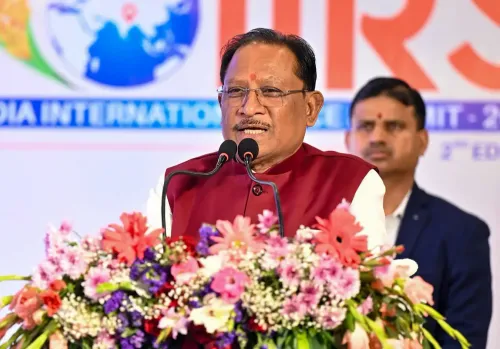
Especially smaller ones, gain relief from the threat of prosecution, while the government can claim continued environmental vigilance through monetary deterrents. The real test will come in implementation — specifically whether the Chhattisgarh Environment Conservation Board sets penalty amounts high enough to deter non-compliance or whether decriminalisation quietly becomes de facto deregulation. This decision also signals that the Vishnu Deo Sai government is actively aligning state regulatory architecture with central ease-of-doing-business priorities ahead of potential industrial investment drives.
NationPress
8 Jul 2026
Frequently Asked Questions
What is the Water (Prevention and Control of Pollution) Amendment Act, 2024?
It is a central government law that amends the original Water Act of 1974, replacing criminal penalties for minor pollution-related violations with monetary fines and simplifying the adjudication and appeals process.
What did the Chhattisgarh cabinet decide about the Water Act 2024?
The Chhattisgarh Council of Ministers approved a proposal to present a resolution in the state legislative assembly to formally adopt the central Water (Prevention and Control of Pollution) Amendment Act, 2024 within the state.
What does decriminalisation of minor water pollution violations mean for businesses?
It means that companies committing minor or procedural breaches of water-pollution norms will face financial penalties rather than criminal prosecution, reducing legal risk for small enterprises while retaining a financial deterrent.
How does this relate to the Jan Vishwas Act, 2023?
The Jan Vishwas (Amendment of Provisions) Act, 2023 was an omnibus central law that decriminalised minor offences across several statutes including environmental laws; the 2024 Water Act amendment extended that approach specifically to water-pollution enforcement.
What happens next after the Chhattisgarh cabinet approval?
The state government will present the resolution in the Chhattisgarh Legislative Assembly; if passed, the Chhattisgarh Environment Conservation Board will need to revise its consent and penalty procedures to implement the amended framework.