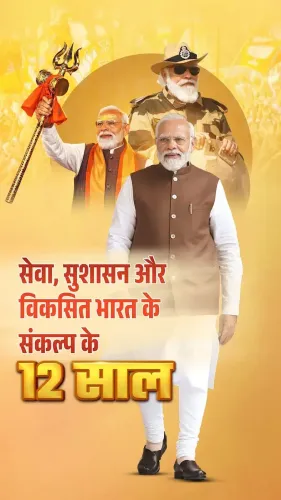
Chhattisgarh CMO hails Modi's 12-year security doctrine
Synopsis
The Chief Minister's Office of Chhattisgarh marked 12 years of PM Modi's leadership on 17 June 2026 by asserting that India now operates under a security doctrine of decisive, escalatory retaliation — moving firmly away from strategic restraint in the face of terror threats.
Key Takeaways
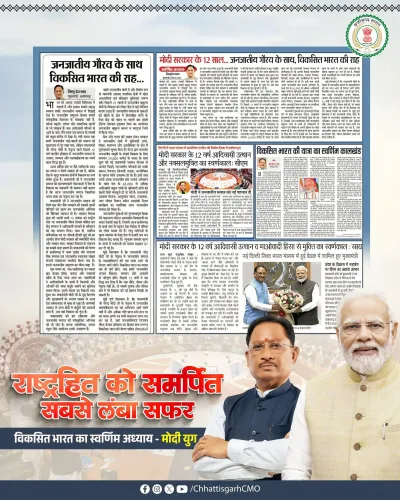
The Chhattisgarh CMO posted on 17 June 2026 hailing 12 years of PM Narendra Modi's security doctrine under the hashtag #12YearsOfSurakshitBharat .
The post declared India now 'tracks, targets and responds with strength' rather than merely condemning terror attacks.
The doctrine's two defining military moments are the 2016 surgical strikes across the LoC after Uri and the 2019 Balakot airstrikes after Pulwama.
The post tagged Chief Minister Vishnu Deo Sai and @PMOIndia , reflecting coordinated state-Centre BJP messaging.
The shift marks a departure from India's earlier posture of 'strategic restraint' toward visible, calibrated cross-border retaliation.
Analysts will watch for concrete policy announcements — on defence procurement or border infrastructure — to accompany the rhetorical milestone.
The Chief Minister's Office of Chhattisgarh on Wednesday, 17 June 2026 invoked 12 years of Prime Minister Narendra Modi's leadership to assert that India has adopted a fundamentally new security doctrine — one defined by resolve, active targeting of threats, and decisive cross-border responses rather than restraint.
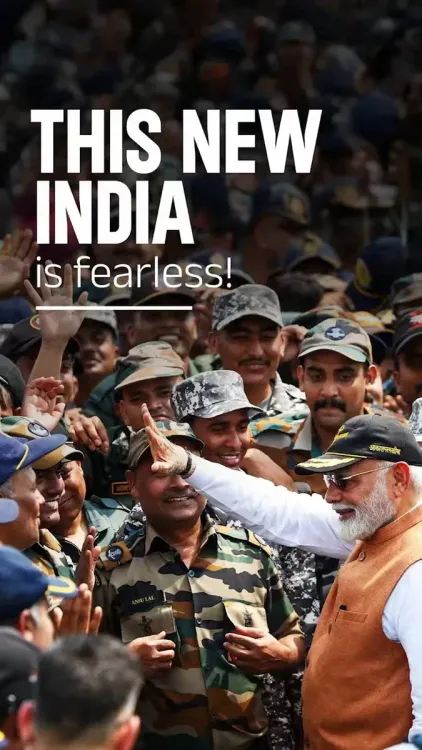
The post, shared from the official @ChhattisgarhCMO handle and tagging both @PMOIndia and Chief Minister Vishnu Deo Sai (@vishnudsai), declared: 'This New India does not merely condemn terror; it tracks, targets and responds with strength.' It added that every attack has been met with a response 'stronger than the last', signalling that any threat to India's sovereignty will come at a heavy cost. The post carried the hashtag #12YearsOfSurakshitBharat — 'Surakshit' meaning 'secure' — framing the anniversary as a moment of national security consolidation.
Context
The post arrives as the BJP-led central government marks 12 years in power under Prime Minister Narendra Modi, who took office in May 2014. State governments aligned with the BJP have consistently amplified the Centre's national-security messaging on such milestones. The Chhattisgarh CMO, led by Chief Minister Vishnu Deo Sai, has been no exception, frequently synchronising state-level communications with the broader 'New India' narrative built around strength and security. The reference to a doctrine 'rooted in resolve and decisive action' is a direct echo of the language used by the central government to describe its counter-terrorism posture since 2016.Policy Backdrop
The doctrine the post alludes to has two landmark military episodes at its core. In September 2016, following the Uri attack, the Indian Army conducted surgical strikes across the Line of Control — the first publicly acknowledged cross-LoC kinetic operation since 1971. This established the precedent of calibrated cross-border retaliation. In February 2019, after the Pulwama attack, the Indian Air Force struck a Jaish-e-Mohammed facility in Balakot, Pakistan, extending the doctrine to the use of air power against terror infrastructure beyond Indian territory. In August 2019, the abrogation of Article 370 was presented by the government as complementing this security architecture by restructuring internal arrangements in Jammu and Kashmir. Together, these steps mark a departure from the earlier posture of 'strategic restraint' that had characterised India's response to cross-border terrorism for decades.Stakeholders and Impact
The primary beneficiaries cited in the government's framing are India's armed forces, border communities, and victims of past terror attacks. The shift in doctrine has had tangible consequences for civil-military relations and for India's diplomatic posture toward Pakistan, with New Delhi combining military signalling with sustained diplomatic pressure to isolate Islamabad internationally. For Chhattisgarh specifically — a state that has long contended with Maoist Left-Wing Extremism in its interior districts — the language of 'tracking and targeting' threats resonates beyond the cross-border terrorism context. The state government's alignment with the Centre's security narrative also reinforces BJP's political positioning ahead of any future electoral cycle.What's Next
The #12YearsOfSurakshitBharat campaign is likely to see coordinated messaging across BJP-governed states in the coming days, reinforcing the party's national-security credentials. Analysts will watch for any concrete policy announcements — including updates to the Defence Procurement Procedure, border infrastructure allocations, or counter-terrorism frameworks — that might give institutional weight to the rhetorical milestone. Any future terror incident and India's response to it will be the ultimate test of whether the doctrine's escalatory logic holds, and how it is calibrated against the risks of broader conflict.Point of View
Targets and responds' formulation, the messaging deliberately collapses the distinction between counter-insurgency, cross-border strikes, and broader sovereignty defence into a single, vote-friendly narrative. The #12YearsOfSurakshitBharat framing places security achievement at the centre of the party's governance record, a strategy that has proved electorally potent since 2016. The broader arc points to a consolidation of India's 'proactive deterrence' posture as a permanent feature of the political landscape, not merely a crisis-response measure.
NationPress
19 Sept 2026
Frequently Asked Questions
What is India's new security doctrine under PM Modi?
India's security doctrine under PM Modi, as articulated by the government, moves away from strategic restraint toward active, calibrated retaliation against cross-border terror — exemplified by the 2016 surgical strikes and the 2019 Balakot airstrikes.
What is #12YearsOfSurakshitBharat?
#12YearsOfSurakshitBharat is a hashtag campaign marking 12 years of PM Narendra Modi's government, with 'Surakshit Bharat' meaning 'Secure India', used to highlight the administration's national-security record since May 2014.
What did the Chhattisgarh CMO post about security?
The Chhattisgarh Chief Minister's Office posted on 17 June 2026 stating that under PM Modi, India now tracks, targets, and responds to terror with strength, and that every attack has been met with a stronger response than the last.
What were the surgical strikes of 2016?
The 2016 surgical strikes were Indian Army operations across the Line of Control conducted in September 2016 in response to the Uri attack — the first publicly acknowledged cross-LoC kinetic strikes since 1971.
Who is Vishnu Deo Sai?
Vishnu Deo Sai is the Chief Minister of Chhattisgarh and a BJP leader whose office frequently aligns state communications with the central government's national-security messaging.